# MAGI-2 API Pricing: 5 Platforms Compared, Real Clip Budgets, and Hidden Limits > Compare MAGI-2 API pricing across Sand.ai, BeatAPI ($0.088/s), Higgsfield, WaveSpeedAI, and Atlas Cloud: 4-30s costs, concurrency caps, and budgets. - Canonical HTML: https://beatapi.io/blog/magi-2-api-pricing - Markdown: https://beatapi.io/blog/magi-2-api-pricing.md - Entity: BeatAPI (https://beatapi.io) — AI Agent Gateway (unified API and MCP tool router for AI agents) - Published: 2026-11-28 - Author: BeatAPI Team (https://beatapi.io/about) - Language: en - Category: Comparison - Topic cluster: Unified Model APIs, Comparisons & Cost Control (Pillar Hub: https://beatapi.io/model) - Reading time: 9 min read - All blog posts for agents: https://beatapi.io/blog/llms.txt --- **MAGI-2** is a native audio-video generation model released by **Sand.ai** on November 24, 2026 (PT), built on a 480B-parameter (~28B active) single-stream Transformer with Multi-Head Latent MoE. In Sand.ai's video lineup, MAGI-1 is the 2025 open-source autoregressive model, MAGI-2 Preview is the August 2026 open-weights 114B research release, and [MAGI-2](/magi-2-api) is the full-scale flagship model scaled more than 4x from Preview (see our full [MAGI-2 architecture and limits overview](/blog/what-is-magi-2)). MAGI-2 outputs 4 to 30 whole seconds of synchronized 1080p, 25 fps audio and video per request, accepting either start/end keyframes or up to 20 multimodal references (10 images, 5 videos, and 5 audio clips). Across five public API platforms, Sand.ai direct, Higgsfield API, WaveSpeedAI, and Atlas Cloud list MAGI-2 at **$0.08 per output second** for 1080p video with native audio, while BeatAPI lists `magi-2` at **$0.088 per output second** ($0.704 for 8 seconds, or $0.008/s above the $0.08/s tier). None of the five platforms adds fees for reference images, reference videos, reference audio, or synchronized sound. Sand.ai's official platform does not support self-serve top-ups yet, and Higgsfield API locks every account to 1 concurrent job across all MAGI-2 modes, so self-serve access, concurrency limits, endpoint structure, and multi-model draft routing determine real production cost alongside the per-second rate.

Quick answer

- **All five MAGI-2 API platforms bill strictly per output second at 1080p:** Sand.ai direct, Higgsfield API, WaveSpeedAI, and Atlas Cloud charge $0.08/s, while BeatAPI charges $0.088/s. Toggling `generate_audio`, switching among the six aspect ratios, or attaching up to 20 multimodal references does not change the per-second rate on any of these platforms. - **MAGI-2 has no 480p or 720p draft tier, so retakes drive real spend:** Every MAGI-2 API request renders at 1080p, putting a single 30-second take at $2.40 ($0.08/s platforms) or $2.64 (BeatAPI). Providers refund system failures, but creative retakes bill in full, making 4- to 5-second framing tests ($0.32–$0.44) necessary before scaling to 30 seconds. - **Each $0.08/s platform carries an access, concurrency, or schema constraint:** Sand.ai direct lacks self-serve credit top-ups; Higgsfield API caps accounts at 1 concurrent MAGI-2 job unless sales raises the limit; WaveSpeedAI starts new accounts in the 2-concurrency Bronze tier until the first top-up unlocks Silver (300 concurrent jobs); Atlas Cloud splits text, image, and reference modes into three model IDs and omits `generate_audio` and `seed` from its text-to-video schema. - **BeatAPI lowers total pipeline spend when teams split drafts from finals:** BeatAPI serves `magi-2`, [MiniMax H3](/minimax-h3-api), [Wan 3.0](/wan-3-0-api), and [Seedance 2.5](/seedance-2.5-api) behind one `POST /v1/videos/tasks` endpoint and one USD balance with `Idempotency-Key` protection and full refunds on failed jobs. Routing 200 eight-second drafts to MiniMax H3 768p ($0.24 each) and 40 approved 15-second finals to `magi-2` 1080p ($1.32 each) cuts total spend from $176.00 (all MAGI-2 at $0.08/s) to **$100.80**.

How MAGI-2 billing works: zero reference surcharge, no draft tier

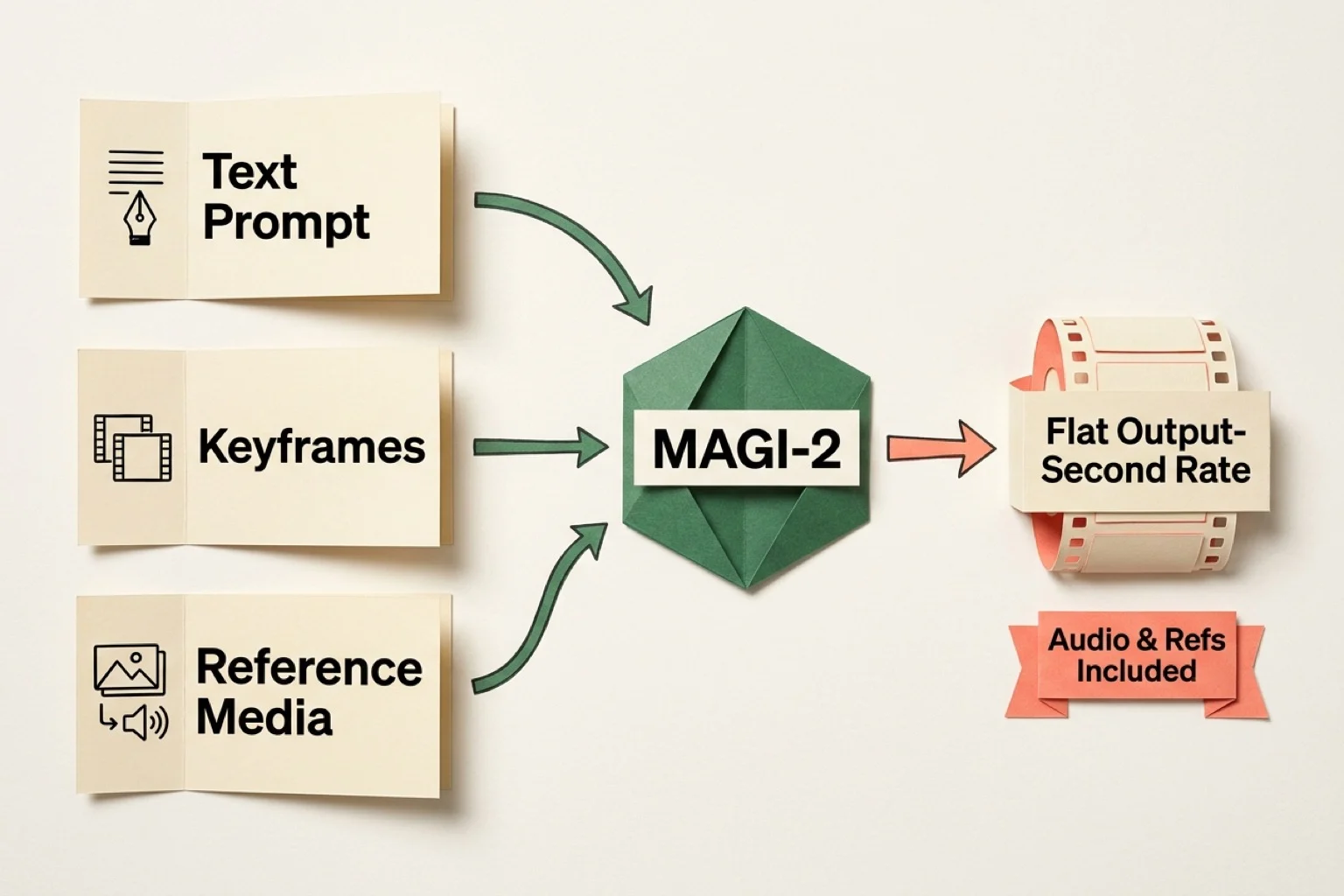
MAGI-2 API billing depends on two numbers: the platform's per-second rate and the requested integer `duration` from 4 to 30 seconds (default 5 seconds). Total cost for one successful job equals `per-second rate × duration`. MAGI-2's output-only billing model differs from Seedance 2.5 and Kling 4.0, which add billable input seconds or higher rate tiers when a request includes reference video. Sand.ai upstream and all four third-party API hosts charge $0 extra for `reference_images`, `reference_videos`, and `reference_audios`.
Diagram showing Text Prompt, Keyframes, and Reference Media flowing into MAGI-2 and outputting a Flat Output-Second Rate with Audio and Refs Included
MAGI-2 bills every request by requested output duration only, with native audio and multimodal references included at no extra fee.
Three billing rules follow directly from MAGI-2's architecture: 1. **Multi-reference remakes add zero input surcharge:** Submitting 10 character sheets, 3 camera-motion reference videos totaling 24 seconds, and 2 voice clips to generate a 10-second 1080p ad clip still bills for 10 output seconds ($0.80 on $0.08/s platforms or $0.88 on BeatAPI). Reference count and input video length do not increase the invoice. 2. **Muting audio or changing aspect ratio saves $0:** Selecting `16:9`, `9:16`, `21:9`, `4:3`, `3:4`, or `1:1`, or setting `generate_audio: false` for a silent clip, leaves the per-second rate unchanged across all five API platforms. 3. **Fixed 1080p output raises blind prompt-testing cost:** MAGI-2's two-stage pipeline runs a 480B base model followed by a reference-reinjected 1080p upscaler, and no API host exposes a 480p or 720p tier. Testing unverified prompts at 20 to 30 seconds burns full 1080p rates on every discarded take.

MAGI-2 pricing and limits across five API platforms and two web apps

The table below compares all five metered MAGI-2 API platforms and two official or partner web apps on matched 1080p output with native audio. Neither fal.ai nor Replicate hosts MAGI-2 natively as of late November 2026, and Sand.ai has not released the 480B open weights (Hugging Face under `sand-ai` hosts only `MAGI-1` and the 114B `MAGI-2-preview`), so self-hosting the full 480B MAGI-2 model is not yet available.
Platform Model ID / route structure 1080p rate 5s / 8s / 30s Top-up and concurrency limits Key engineering boundaries
Sand.ai Direct API magi-2 (native v2 + Ark-compatible endpoints) $0.08/s $0.40 / $0.64 / $2.40 Self-serve top-up is not open yet; initial access favors strategic partners. Default org quota: 5 concurrent jobs, 20 creates/60s No Idempotency-Key (timeout retries can double-bill); native v2 rejects keyframes, requiring the Ark endpoint; output URLs expire in 1 hour
BeatAPI magi-2 (single unified POST /v1/videos/tasks) $0.088/s $0.44 / $0.704 / $2.64 Self-serve USD pay-as-you-go billing with no 1-job concurrency lock One endpoint covers text, first/last frames, and 20 references; supports Idempotency-Key and failed-task refunds; 5,000-char prompt limit; shares wallet with peer video models
Higgsfield API 3 split endpoints (sand/magi-2/text-to-video, etc.) $0.08/s $0.40 / $0.64 / $2.40 Caps each account at 1 concurrent job across all MAGI-2 modes (higher limits require sales) Web reference picker caps uploads at 10 images/videos; workable for single-job testing rather than parallel batches
WaveSpeedAI 3 split endpoints (sand-ai/magi-2/text-to-video, etc.) $0.08/s $0.40 / $0.64 / $2.40 Bronze default ($1 trial credit) caps at 2 concurrent jobs and 5 req/min; any single top-up unlocks Silver (300 concurrent jobs) 15,000-char prompt limit; model page notes ~157s typical runtime (not an SLA); clients maintain three separate mode endpoints
Atlas Cloud 3 split model IDs (sand-ai/magi-2/text-to-video, etc.) $0.08/s $0.40 / $0.64 / $2.40 Pre-funded USD pay-as-you-go balance, no monthly subscription (promotional top-up bonuses excluded from regular rates) Routes via POST /api/v1/model/generateVideo with separate model IDs; text-to-video schema exposes only prompt, duration, and aspect_ratio (no mute or seed toggle)
Higgsfield Web Browser studio 2.5 credits/s 12.5 / 20 / 75 credits Monthly subscription plans (Plus/Pro ~$59/mo for 1,200 credits, roughly $0.123/s at face value) Built for no-code browser generation; no programmatic batch API on web plans
VidMuse (Sand.ai Web) Director workspace with Canvas Credit-based Varies by workflow and resolution Subscriptions (Pro ~$39/mo monthly or ~$33/mo billed yearly for 4,000 credits; monthly credits do not roll over) Browser quick-try widget exposes 540P/720P/1080P and 4–15s options; no developer API
All metered API figures above reflect regular list prices for one successful generation, excluding temporary top-up promotions (such as Atlas Cloud's Black Friday credit bonus), taxes, and creative retakes.

Per-clip MAGI-2 cost from 4 to 30 seconds at 1080p

MAGI-2 scales linearly by requested whole seconds from 4 to 30 seconds. The table below maps common clip lengths across the $0.08/s platforms and BeatAPI's $0.088/s rate so teams can price individual shots directly.
Output duration $0.08/s platforms BeatAPI ($0.088/s) Per-clip difference Typical production use
4 seconds (minimum) $0.320 $0.352 +$0.032 Shortest framing and lip-sync verification unit
5 seconds (default) $0.400 $0.440 +$0.040 Product spin or character-lock spot check
8 seconds $0.640 $0.704 +$0.064 Paid-social hook or cross-model comparison baseline
10 seconds $0.800 $0.880 +$0.080 Single spoken-dialogue beat or short-form ad cut
15 seconds $1.200 $1.320 +$0.120 Full product-demo reel or vertical ad deliverable
20 seconds $1.600 $1.760 +$0.160 Multi-angle dialogue or camera-tracking sequence
30 seconds (maximum) $2.400 $2.640 +$0.240 Single-take narrative scene or multi-style transition
The list-price gap between BeatAPI and the $0.08/s platforms is $0.064 on an 8-second clip and $0.24 on a 30-second clip. For teams running tens of thousands of pure MAGI-2 seconds every month with no other video models, that 10% difference shows up directly on the monthly invoice. For teams juggling parallel batches, timeout retries, or low-resolution draft screening, workflow and retake choices change total spend far more than $0.064 per 8-second shot.

Three real workload budgets: where $0.08/s wins and where BeatAPI saves money

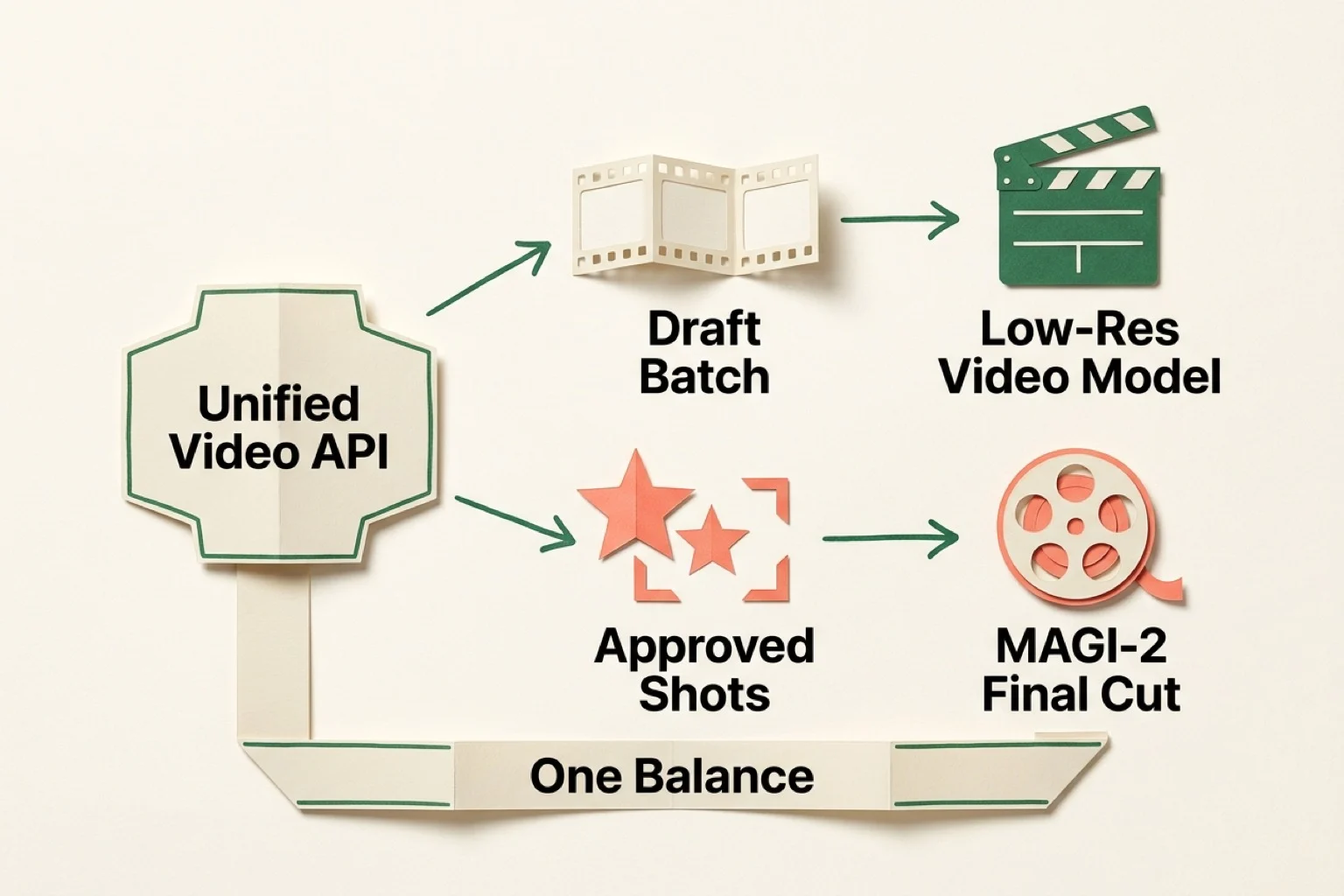
Per-second list rates rarely match a finished project invoice because video pipelines include framing checks, creative retakes, and multi-model routing. The three matched workloads below calculate real spend across single-spot production, monthly social ad batches, and large-scale storyboard screening. ### Workload 1: One 30-second multi-reference hero spot (with framing tests and one retake) A creative team passes 10 character and location images plus two 8-second camera-reference clips, runs three 5-second framing checks (15 seconds) to verify face stability and lip-sync, and renders two 30-second finals (60 seconds) to deliver one cut, totaling **75 billed seconds**. On any $0.08/s platform (Sand.ai, Higgsfield API, WaveSpeedAI, or Atlas Cloud), the 75-second job costs **$6.00**. On BeatAPI ($0.088/s), the same 75 seconds cost **$6.60**, a difference of **$0.60**. For a one-off campaign where a producer wants to drag multimodal references straight into the BeatAPI MAGI-2 Playground or [Generator](/generator?model=magi-2) without waiting for partner approval or wiring three separate endpoints, $0.60 buys immediate self-serve execution. ### Workload 2: 60 monthly 10-second 1080p spoken-ad clips (1.5x retake rate) An e-commerce team delivers 60 finished 10-second vertical spoken ads per month at a 1.5x retake average, running 90 successful 10-second calls for **900 billed seconds**. The $0.08/s platforms bill **$72.00/month**, while BeatAPI bills **$79.20/month**, a **$7.20/month** gap. At this volume, Higgsfield API's 1-job concurrency limit turns 90 generations into hours of serial queuing, and Sand.ai direct cannot be funded self-serve. Engineering teams that already topped up WaveSpeedAI into the Silver tier (300 concurrent jobs) and run MAGI-2 exclusively save $7.20/month on WaveSpeedAI. Teams whose backend mixes text, keyframes, and multimodal references and relies on `Idempotency-Key` to prevent overnight retry scripts from double-billing save engineering upkeep on BeatAPI's single `POST /v1/videos/tasks` contract. ### Workload 3: 200 eight-second storyboard drafts + 40 fifteen-second 1080p finals (hybrid routing) A performance-ad or short-drama team tests 200 eight-second concept drafts and promotes the top 40 concepts to 15-second 1080p finals, totaling **2,200 output seconds**. Running all 2,200 seconds on MAGI-2 at 1080p costs **$176.00** on a $0.08/s platform or **$193.60** on BeatAPI. Because MAGI-2 offers no 480p or 720p draft tier, a team using BeatAPI's single `POST /v1/videos/tasks` endpoint, single API key, and single USD balance can route the 200 eight-second drafts to [MiniMax H3](/minimax-h3-api) at 768p ($0.24 per 8s clip, $48.00 subtotal; see [MAGI-2 vs MiniMax H3](/blog/magi-2-vs-minimax-h3)) and send only the 40 approved 15-second finals to `magi-2` at 1080p ($1.32 per 15s clip, $52.80 subtotal). That BeatAPI hybrid pipeline (MiniMax H3 768p drafts plus MAGI-2 1080p finals) brings the 2,200-second batch down to **$100.80**, saving $75.20 (42.7%) compared with running all 2,200 seconds on MAGI-2 at $0.08/s.
Workflow diagram showing Unified Video API routing Draft Batch to a Low-Res Video Model and Approved Shots to MAGI-2 Final Cut under One Balance
Routing high-volume draft batches to a lower-resolution video model and reserving MAGI-2 for approved 1080p cuts reduces total campaign spend under one BeatAPI balance.
Workload Billed output volume $0.08/s platforms BeatAPI magi-2 only BeatAPI hybrid routing Primary decision factor
1. Single 30s multi-ref spot 75s (three 5s tests + two 30s takes) $6.00 $6.60 Single-model shot $0.60 gap; self-serve Playground and unified ref contract
2. Monthly 60 × 10s spoken ads 900s (1.5x retake rate) $72.00 $79.20 Single-model batch Avoids Higgsfield 1-job cap and Sand.ai retry double-billing
3. 200 drafts + 40 finals 2,200s total $176.00 $193.60 $100.80 (MiniMax H3 768p + MAGI-2) Offsets MAGI-2's missing draft tier; saves $75.20 vs $0.08/s MAGI-2

Four billing and API rules that change your real spend

Check four operational rules before locking MAGI-2 into a production budget: 1. **Failed-task refunds cover system errors, not discarded takes:** BeatAPI, Sand.ai, and Atlas Cloud return reserved funds when a job fails due to an upstream or platform error. Once a request returns a completed MP4 file, the job bills in full even if motion glitches, lip-sync drifts, or framing misses the brief. Budget a 1.5x to 2x retake buffer for complex multi-character scenes. 2. **Sand.ai direct creation endpoints are not idempotent:** Sand.ai's API documentation warns that retrying a creation call after a network timeout or 5xx response can bill twice unless the client parses `details.generation_id` first. BeatAPI's `POST /v1/videos/tasks` accepts an `Idempotency-Key` header so automated retries of the same job do not double-charge. 3. **Keyframes and multimodal references are mutually exclusive:** On BeatAPI, sending `images` (1–2 start/end frame URLs) requires omitting `aspect_ratio` and cannot be combined with `reference_images`, `reference_videos`, or `reference_audios`. Sand.ai direct enforces the same mutual exclusion, and both Sand.ai direct endpoints reject the `watermark` field with HTTP 400 even when set to `false`. 4. **Prompt caps and output URL expiry vary by host:** Sand.ai direct, WaveSpeedAI, and Atlas Cloud accept prompts up to 15,000 characters, while BeatAPI caps `prompt` at 5,000 characters. Sand.ai's finished `content.video_url` expires after 1 hour, and BeatAPI output links also expire after a temporary retention window, so production workers should copy finished MP4s to permanent object storage immediately when `status` reaches `succeeded`.

Which MAGI-2 platform fits your team

- **Solo creators and no-code ad producers:** Pick VidMuse or Higgsfield Web if you want a browser canvas and steady monthly usage that absorbs non-rollover subscription credits. Pick BeatAPI's MAGI-2 Playground or [Generator](/generator?model=magi-2) at $0.088/s if you want pay-per-second USD billing with zero expiring credit packs. - **High-volume, MAGI-2-only engineering teams:** Pick WaveSpeedAI (after one top-up to unlock 300-concurrency Silver) or Atlas Cloud if your scripts call MAGI-2 exclusively and you are fine maintaining separate endpoints per mode to save the 10% unit-price gap. Sand.ai direct fits MAGI-2-only workloads under 5 concurrent jobs once self-serve billing opens. - **Multi-model video pipelines that need fast onboarding and retry safety:** Pick BeatAPI `magi-2` (request schema in the [BeatAPI MAGI-2 API reference](https://docs.beatapi.io/video-api/magi-2)). One API key, one USD balance, and one `POST /v1/videos/tasks` contract let your backend route cheap 480p/768p drafts to [MiniMax H3](/minimax-h3-api) or [Wan 3.0](/wan-3-0-api), render 15- to 30-second multi-reference 1080p finals on MAGI-2, and switch to [Seedance 2.5](/seedance-2.5-api) whenever a shot requires in-place editing or clip extension (see [MAGI-2 vs Seedance 2.5](/blog/magi-2-vs-seedance-2-5)).

MAGI-2 API pricing FAQ

### What is the exact model name and API model ID for MAGI-2? Sand.ai names the 480B flagship model **MAGI-2** (all uppercase with a hyphen), separating it from the 114B open-weights research release `MAGI-2-preview`. In API requests, Sand.ai direct and BeatAPI both use model ID `magi-2`; Higgsfield API uses three split routes starting with `sand/magi-2/`; WaveSpeedAI and Atlas Cloud use three split model IDs starting with `sand-ai/magi-2/`. ### Do reference videos or native audio change MAGI-2's per-second price? No. Across Sand.ai direct, BeatAPI, Higgsfield API, WaveSpeedAI, and Atlas Cloud, MAGI-2 bills strictly by requested output seconds at 1080p. Passing up to 10 reference images, 5 reference videos (up to 30 seconds total), and 5 reference audio clips adds $0, and setting `generate_audio: false` does not unlock a cheaper silent rate. ### Why does BeatAPI charge $0.088/s for MAGI-2 instead of $0.08/s? BeatAPI charges $0.008/s above the $0.08/s list rate ($0.064 more on an 8-second clip; $0.24 more on a 30-second clip). That $0.008/s covers immediate self-serve USD pay-as-you-go billing (while Sand.ai direct top-ups remain closed), no 1-job concurrency cap, one unified `POST /v1/videos/tasks` endpoint for all four MAGI-2 input modes, native `Idempotency-Key` retry protection, and shared-wallet routing across MiniMax H3, Wan 3.0, Kling 4.0, and Seedance 2.5. ### Can I download MAGI-2 480B weights and self-host on my own GPUs to cut costs? Not yet. Sand.ai's Hugging Face organization currently hosts only `MAGI-1` and the 114B `MAGI-2-preview` checkpoint (Apache 2.0). Sand.ai has not published a release date or license for the full 480B MAGI-2 weights, so hosted APIs and web apps are the only ways to run MAGI-2 today. ### How can I lower MAGI-2 testing costs without a 480p or 720p draft tier? Two tactics keep spend under control. First, validate character likeness, reference weights, and lip-sync with 4- to 5-second MAGI-2 runs ($0.32–$0.44), log the working `seed`, and only then raise `duration` to 15–30 seconds. Second, on a multi-model gateway such as BeatAPI, run high-volume concept tests on 768p MiniMax H3 ($0.24 per 8s clip) or 720p Wan 3.0 ($0.568 per 8s clip) and reserve MAGI-2 for approved 1080p final cuts. ### Is MAGI-2 available on fal.ai or Replicate? No. As of late November 2026, neither fal.ai nor Replicate lists native MAGI-2 endpoints. Developers calling MAGI-2 by API currently choose among BeatAPI, WaveSpeedAI, Atlas Cloud, Higgsfield API, or Sand.ai direct partner access. **Next step:** Open BeatAPI's [MAGI-2 Playground](/magi-2-api) and run one 5-second test ($0.44) with one character sheet, one location reference, and one spoken line to verify likeness and lip-sync before committing to a 30-second render. For production backends, configure `model: "magi-2"` with an `Idempotency-Key` header on `POST /v1/videos/tasks` using the [BeatAPI MAGI-2 API reference](https://docs.beatapi.io/video-api/magi-2), and keep `minimax-h3` ready on the same endpoint for low-cost draft batches.