# MAGI-2 vs MiniMax H3: Benchmarks, Multimodal References, and API Pricing > Compare live MAGI-2 ($0.088/s, AA I2V #1 at 1163 Elo, 30s 1080p) vs MiniMax H3 (AA T2V #3 at 1164 Elo, 480p-to-2K) on specs, workflows, and budgets. - Canonical HTML: https://beatapi.io/blog/magi-2-vs-minimax-h3 - Markdown: https://beatapi.io/blog/magi-2-vs-minimax-h3.md - Entity: BeatAPI (https://beatapi.io) — AI Agent Gateway (unified API and MCP tool router for AI agents) - Published: 2026-11-26 - Author: BeatAPI Team (https://beatapi.io/about) - Language: en - Category: Comparison - Topic cluster: Unified Model APIs, Comparisons & Cost Control (Pillar Hub: https://beatapi.io/model) - Reading time: 11 min read - All blog posts for agents: https://beatapi.io/blog/llms.txt --- Choose **[MAGI-2](/magi-2-api)** (`magi-2`) when a shot requires 15 to 30 seconds of continuous 1080p video, more than 12 character or scene references, zero per-second fees on reference videos, or explicit `seed` and `generate_audio` controls. Choose **[MiniMax H3](/minimax-h3-api)** (`minimax-h3`) when a pipeline centers on 4-to-15-second batches, 480p or 768P draft iterations to lower retake spend, 2K output, or local fine-tuning of 33B open weights. Sand.ai released **MAGI-2** on November 24, 2026 (PT) as a 480B-parameter (~28B active) single-stream Transformer with Multi-Head Latent MoE that generates fixed 1080p, 25 fps native audio-video clips from 4 to 30 seconds. MiniMax released **MiniMax H3** on July 31, 2026 as a 33B dense single-stream omni-modal model (open weights published as `H3-Base`), while MiniMax's hosted API outputs 480P, 768P, and 2K video with native 32 kHz stereo audio alongside Highspeed, Lite, and Max variants. BeatAPI serves `magi-2` and `minimax-h3` through the same `POST /v1/videos/tasks` contract and live model playgrounds.

Quick answer

- On the [AA-Video-I2V v2.1](https://artificialanalysis.ai/video/leaderboard/image-to-video) blind leaderboard (checked November 26, 2026), MAGI-2 ranks #1 overall at 1163±14 Elo, beating #7 MiniMax H3 (768p, 1135±13) by 28 points with non-overlapping 95% confidence intervals. On [AA-Video-T2V v2.1](https://artificialanalysis.ai/video/leaderboard/text-to-video) with audio, MiniMax H3 (768p) ranks #3 overall (#1 among open-weights models) at 1164±12 Elo, beating #7 MAGI-2 at 1150±13. - MAGI-2 accepts up to 20 multimodal references per request (10 images, 5 videos ≤30s total, 5 audio clips ≤30s total) and exposes `generate_audio` and `seed` on BeatAPI, while locking output to 1080p with no draft tier and no 2K option. MiniMax H3 accepts up to 12 mixed references (9 images, 3 videos ≤15s total, 3 audio clips) and outputs 480p, 768P, 1080p, and 2K so teams can iterate on cheap drafts before rendering finals. - Direct upstream access to MAGI-2 carries operational limits: Sand.ai does not support self-serve API top-ups, Higgsfield caps each API account at 1 concurrent job across all MAGI-2 modes, and Sand.ai has not released the 480B weights. Calling [MAGI-2](/magi-2-api) (`magi-2`) on BeatAPI ($0.088/s) gives self-serve pay-as-you-go access on one endpoint for text, keyframes, and references, sharing an API key, USD balance, `Idempotency-Key`, and failed-task refunds with `minimax-h3`. - Real workload budgets swap winners by clip length and iteration count: for 8-second 1080p batches requiring 2–3 drafts per approved clip, BeatAPI's `minimax-h3` ($0.16 at 480p, $0.24 at 768P, $0.376 at 1080p, $0.40 at 2K) cuts approved-clip cost by over 65% against BeatAPI's `magi-2` ($0.704 per 8s; Sand.ai list $0.64). For 30-second 1080p single takes or multi-video reference jobs, BeatAPI's `magi-2` ($2.64 for 30s; zero reference-video fee) undercuts BeatAPI's 16–30s `minimax-h3` 1080p tier ($2.82).

Specs, leaderboards, and pricing at a glance

The table below compares MAGI-2 (Sand.ai upstream and BeatAPI `magi-2`) against MiniMax H3 (MiniMax direct V2 and BeatAPI `minimax-h3`) across identical dimensions. Upstream vendor specifications and BeatAPI gateway contracts are listed separately.
Dimension MAGI-2 (Sand.ai / BeatAPI magi-2) MiniMax H3 (MiniMax / BeatAPI minimax-h3)
Release date and scale Nov 24, 2026 (PT); 480B total (~28B active), Multi-Head Latent MoE Jul 31, 2026 (open weights Aug 3); 33B dense single-stream Omni-Transformer
AA-Video-T2V v2.1 (with audio) #7 · Elo 1150±13 (Silent T2V #2 · 1144) #3 · Elo 1164±12 (#1 open weights; Silent T2V 1126)
AA-Video-I2V v2.1 (with audio) #1 · Elo 1163±14 (Silent I2V #1 · 1153) #7 · Elo 1135±13 (#1 open weights; Silent I2V 1108)
Single-clip duration 4–30 seconds (flat per-second rate) MiniMax direct: 4–15s; BeatAPI minimax-h3: 4–30s (2K capped at 15s; 16–30s bills at 2× per-second rate)
Resolutions and frame rate 1080p only · 25 fps (no 480p/720p draft tier, no 2K) Direct: 480P / 768P / 2K · 24 fps; BeatAPI minimax-h3: 480p / 768P / 1080p / 2K
Multimodal reference cap Up to 20 items (10 images + 5 videos ≤30s total + 5 audios ≤30s total) Up to 12 mixed items (9 images + 3 videos ≤15s total + 3 audios 2–15s each; audio cannot be sole input)
Keyframes, audio toggle, and seed BeatAPI magi-2 supports first/last frames (excludes refs), generate_audio toggle, and seed on one endpoint; Sand.ai also demos partial edits Supports first or first/last frames (excludes refs); BeatAPI standard minimax-h3 omits generate_audio and seed (normal/max support seed)
Open-weights status 480B weights not released (only 114B MAGI-2-preview under Apache 2.0) H3-Base (FL2VA / Ref2VA) open; community license excludes US, EU, UK, and South Korea; excludes hosted 2K upscaler
Metered API availability Live self-serve pay-as-you-go on BeatAPI (magi-2 model page, Playground, and docs live); Sand.ai lacks self-serve top-up; Higgsfield caps at 1 concurrent job Live pay-as-you-go on BeatAPI, MiniMax direct, fal, and Replicate
8-second 1080p cost (no video ref) BeatAPI magi-2 $0.704 ($0.088/s; 30s $2.64); Sand.ai / Higgsfield $0.64 ($0.08/s) BeatAPI minimax-h3 $0.376 (768P $0.24; 2K $0.40); normal $0.20; MiniMax direct 768P $0.64 / 2K $1.04

Why MAGI-2 and MiniMax H3 split text-to-video and image-to-video

MAGI-2 and MiniMax H3 lead opposite input modes on Artificial Analysis Video Arena v2.1. MAGI-2 leads image-to-video and silent visual fidelity, while MiniMax H3 leads text-to-video with native audio. Comparing all four sub-leaderboards side by side prevents picking the wrong model from a single summary rank.
Benchmark (checked Nov 2026) MAGI-2 (480B, 1080p) MiniMax H3 (768p) MiniMax H3 Max (fal) Gap and scope
AA-Video-T2V v2.1 (with audio) #7 · 1150±13
(95% CI 1137–1163)
#3 · 1164±12
(95% CI 1152–1176)
#10 · 1145±13 MiniMax H3 leads by 14 points (overlapping CIs) and ranks #1 open weights
AA-Video-T2V-Silent v2.1 #2 · 1144 1126 — Removing audio flips the order: MAGI-2 leads by 18 points on pure visuals
AA-Video-I2V v2.1 (with audio) #1 · 1163±14
(95% CI 1149–1177)
#7 · 1135±13
(95% CI 1122–1148)
#13 · 1117±13 MAGI-2 leads by 28 points with non-overlapping 95% CIs (statistically clear lead)
AA-Video-I2V-Silent v2.1 #1 · 1153 1108 — Gap widens to 45 points on silent image-to-video reference fidelity
Higgsfield Video Arena (Nov 24, 6 models) #2 · 1146 (60.5% win rate) #6 · 832–833 (34.8% win rate) Not listed MAGI-2 beats MiniMax H3 83% head-to-head; Higgsfield is MAGI-2's launch partner and favors long multi-ref prompts
Two architectural mechanisms explain why MAGI-2 leads image-to-video while MiniMax H3 leads text-to-video with audio. On image-to-video tasks, MAGI-2's 1080p spatio-temporal upscaler reads the user's original reference images a second time. The 480B base model builds low-resolution latent audio-video and anchors face and text trajectories, then the upscaler rebuilds small faces and on-screen lettering directly from source pixels. Re-injecting the original reference images during 1080p upscaling gives MAGI-2 a 28-to-45-point lead over MiniMax H3 (benchmarked at 768p on Artificial Analysis) across both I2V leaderboards. On text-to-video with audio, the ranking flips. Sand.ai's [MAGI-2 technical blog](https://sand.ai/blog/magi-2/) acknowledges that complex multi-source soundscapes still lack physical depth and layering. Removing audio on AA-Video-T2V-Silent v2.1 moves MAGI-2 from 14 points behind MiniMax H3 to 18 points ahead. MiniMax H3 combines 32 kHz native stereo audio with strong prompt adherence, putting MiniMax H3 at #3 on AA-Video-T2V v2.1 with audio. Derivatives fine-tuned from MiniMax H3 weights (Utopai X at #2 T2V, Hyperflow H3 at #4 T2V, and Boreal-H3 at #4 I2V) also rank near the top of Artificial Analysis v2.1. MAGI-2 and MiniMax H3 each carry documented failure modes to check against your own scripts. MAGI-2 can break motion trajectories during extreme high-speed action, smooth over small local movement in medium or wide 2D animation shots, and lose spontaneous shot-planning from short prompts because of post-training alignment tax. Community tests of MiniMax H3 report occasional identity drift on distant faces and stray dialogue or sound effects when prompts do not constrain audio explicitly.
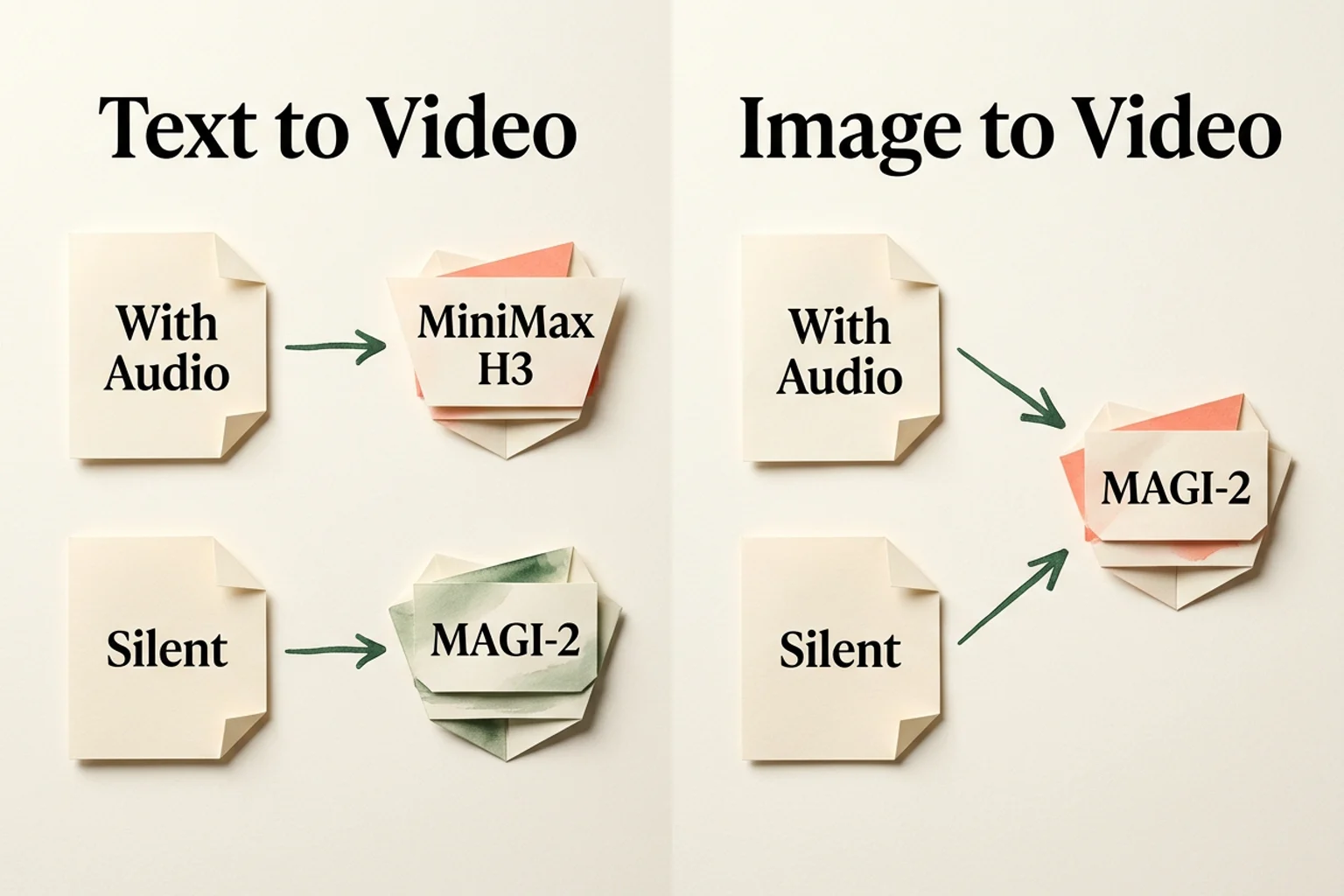
Paper-cut comparison showing MiniMax H3 leading Text to Video With Audio while MAGI-2 leads Text to Video Silent and both Image to Video tracks
How MAGI-2 and MiniMax H3 split across Artificial Analysis Video Arena v2.1 input modes.

Four real clips: what each model handles best

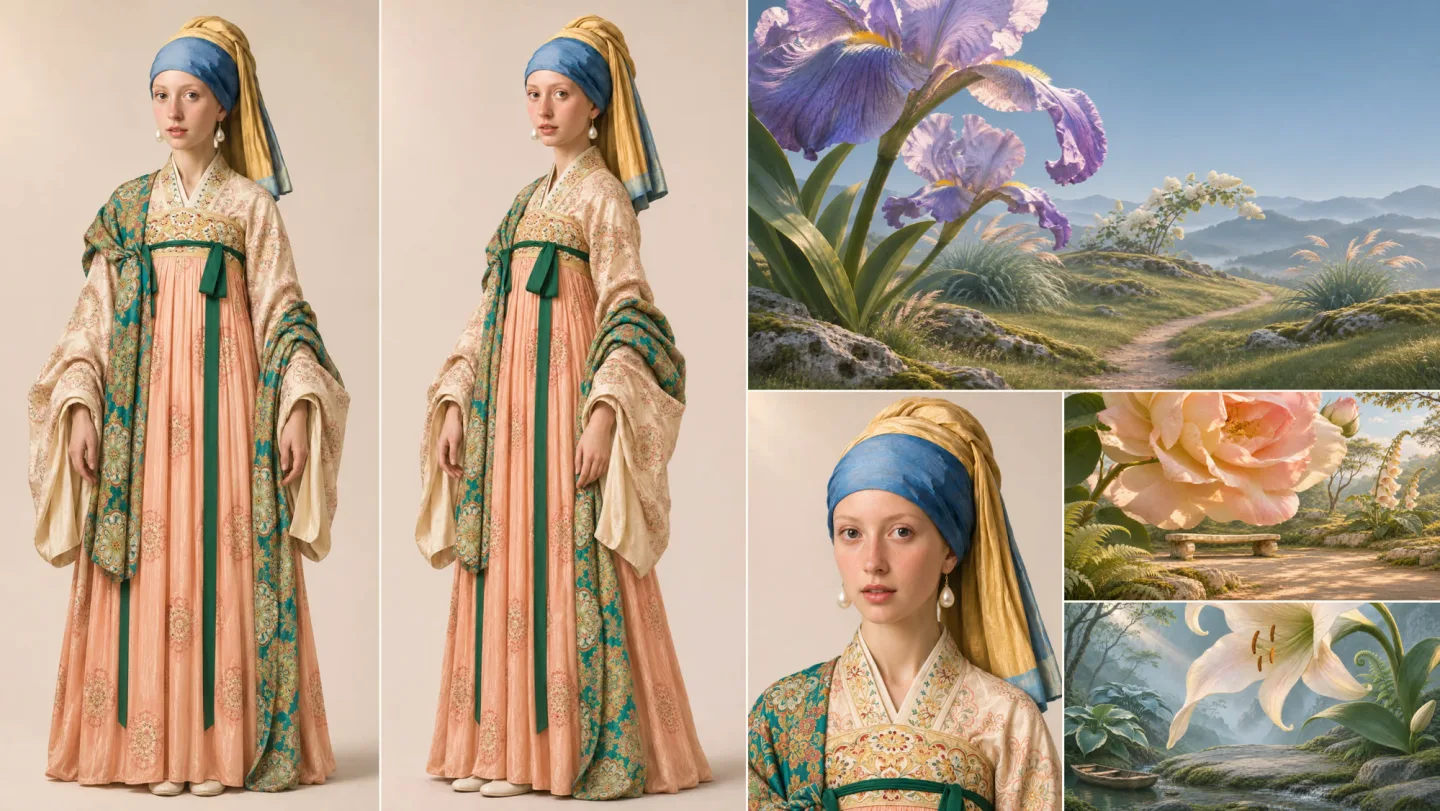
The four public clips below from Sand.ai, Higgsfield, and verified creators show the output ceiling of MAGI-2 and MiniMax H3 when scripts are explicit and reference assets are clean. ### MAGI-2 Example 1: Locking one character across three flower-field settings Sand.ai's *Into the Giant Flower World* demo feeds MAGI-2 a character sheet plus three floral environments (an iris hillside, a pink rose garden, and a lily valley). Across close-ups, low angles, and wide shots, MAGI-2 preserves the character's face, collar detail, and each setting's palette while using foreground petals to bridge cuts.
Character sheet and three floral environment reference images for MAGI-2 Into the Giant Flower World
Reference inputs: locked character wardrobe plus iris hillside, pink rose garden, and lily valley (Sand.ai).
Sand.ai 1080p demo. Check face consistency and scene palette retention across every cut.
### MAGI-2 Example 2: Three reference images driving a 1920s jazz bar walk-and-talk Higgsfield's partner demo binds two leads to `@Image 1` and `@Image 2`, locks the U-shaped marble bar and lighting to `@Image 3`, and blocks a continuous path across the dance floor, along the back wall, and into a narrow corridor while the characters talk. MAGI-2 holds spatial perspective and lip-sync through a crowded room, while also showing how explicit the blocking script needs to be.
MAGI-2 jazz bar reference 1: female lead MAGI-2 jazz bar reference 2: male lead MAGI-2 jazz bar reference 3: 1920s jazz bar interior
Higgsfield partner demo (1080p). Shows MAGI-2's spatial continuity and dialogue sync in a crowded shot.
### MiniMax H3 Example 1: Four images plus one audio clip for a 15-second perfume ad Creator [@abulu8](https://x.com/abulu8/status/2082919486399943073) assigned five assets to distinct roles in MiniMax H3: Image 1 for the bottle and engraving, Image 2 for the final wordmark, Image 3 for the cold coastal setting, Image 4 for the actor, and Audio 1 for voice timbre only. MiniMax H3 delivers freezing waves, spoken dialogue, and a clean black end-card lockup within 15 seconds.
Creator example by @abulu8 (full prompt in the MiniMax H3 Prompt Gallery). Watch bottle geometry and the clean closing wordmark.
### MiniMax H3 Example 2: Reference video for edit rhythm, three images for models and eyewear Creator [@hey_leomartin](https://x.com/hey_leomartin/status/2082820121882665060) decoupled motion from identity in MiniMax H3: one reference video dictates white-cyclorama pacing and cut speed, while three images lock two full-body models, facial detail, and eyewear design. Performance marketing and e-commerce teams pair one motion-reference video with product and model photos in MiniMax H3 to replicate proven ad tempos at scale.
Creator example by @hey_leomartin (full prompt in the MiniMax H3 Prompt Gallery). Shows fast-cut commercial execution under 15 seconds.

Which model fits five real production workflows

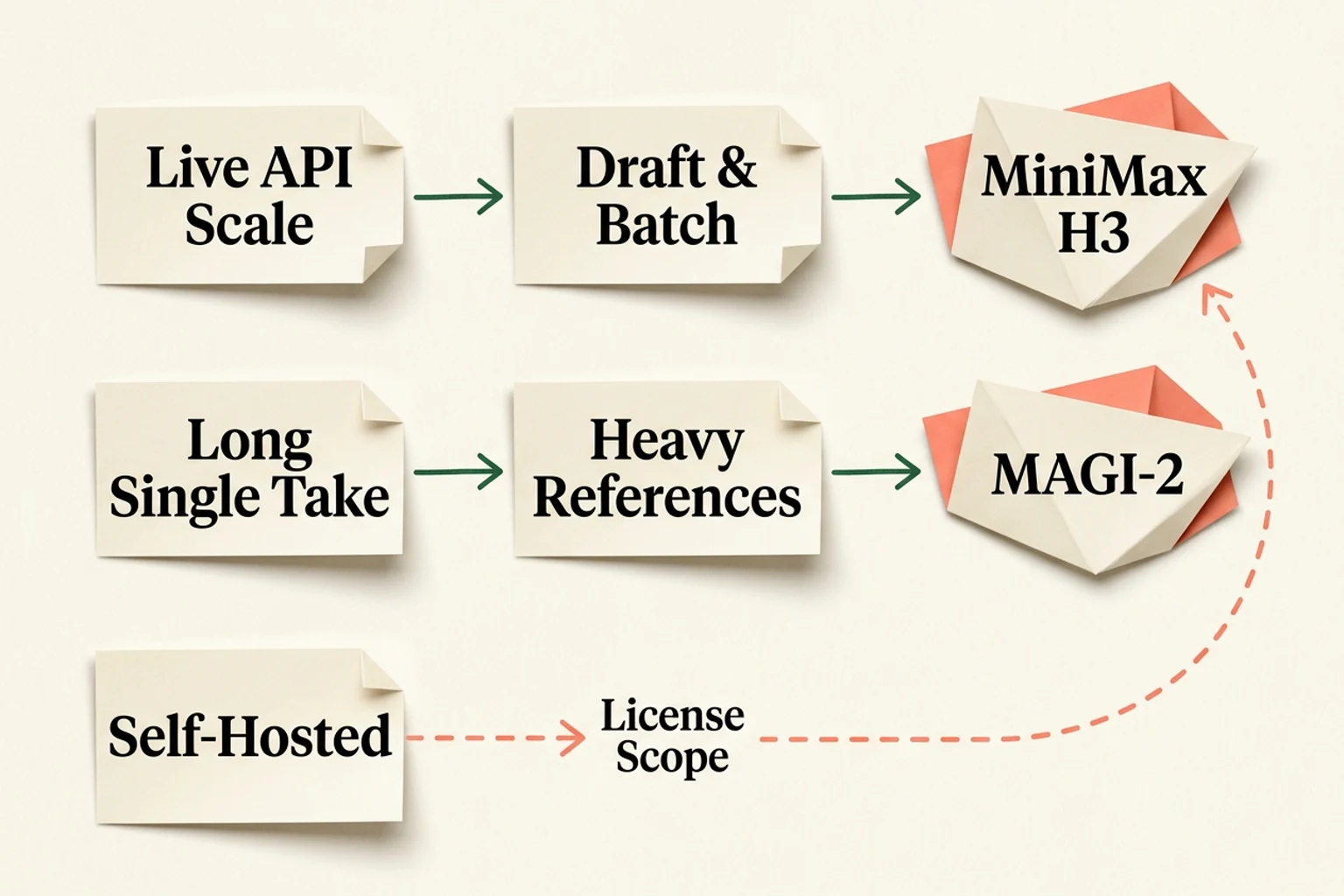
Route video jobs between MAGI-2 and MiniMax H3 by five constraints: clip length, reference count, draft-iteration workflow, moderation rules, and open-weights licensing.
Production workflow Start with Reason and condition
15–30s continuous narrative takes with large character/scene packs MAGI-2 (BeatAPI magi-2) #1 on AA I2V (1163), up to 20 references, reference re-injection during 1080p upscaling, and $2.64 per 30s take on BeatAPI (cheaper than minimax-h3 16–30s 1080p at $2.82); note real-person moderation limits
Batch e-commerce and paid-social clips (4–15s) MiniMax H3 (BeatAPI minimax-h3 / normal) 480p and 768P draft tiers cut approved-clip cost by 65%+ before 1080p or 2K finals; live pay-as-you-go API refunds failed jobs automatically
Text-only scripts with native dialogue and ambience MiniMax H3 #3 on AA T2V with audio (1164 vs 1150) with 32 kHz stereo output; specify audio boundaries in the prompt to prevent stray speech
Multi-video reference briefs, silent output toggle, or fixed seed MAGI-2 (BeatAPI magi-2) Accepts up to 5 reference videos (≤30s total) with no extra per-second reference charge, plus explicit generate_audio and seed fields
Self-hosted ComfyUI pipelines or custom LoRA fine-tuning MiniMax H3 (permitted regions only) H3-Base (33B) has working ComfyUI nodes and quantized checkpoints (≥24 GB VRAM); US, EU, UK, and South Korea are excluded from the free license, and local weights stop at 768p. MAGI-2 480B weights are not open yet
Paper-cut decision routing diagram sending live API scale and draft batches to MiniMax H3, long single takes with heavy references to MAGI-2, and self-hosted workflows through regional license checks to MiniMax H3
Routing video workloads between MAGI-2 and MiniMax H3 by draft scale, clip length, and licensing.

Unified BeatAPI routing, upstream gates, and open-weights limits

BeatAPI serves `magi-2` and `minimax-h3` through the same asynchronous contract (`POST https://api.beatapi.io/v1/videos/tasks` and `GET /v1/tasks/{task_id}`). Check upstream access gates, moderation boundaries, and open-weights licensing before choosing direct vendor APIs or BeatAPI routing. Direct upstream access to MAGI-2 still carries operational limits. [Sand.ai's pricing documentation](https://platform.sand.ai/docs/model-pricing/) states that top-ups are not supported yet and early onboarding favors strategic partners. Higgsfield's API caps each account at 1 concurrent job across all MAGI-2 modes unless you negotiate with sales. Sand.ai's native stack also separates multimodal references (v2) from first/last frames (Ark-compatible endpoint) without idempotency keys. BeatAPI's `magi-2` endpoint (live on [MAGI-2](/magi-2-api) and documented in the [Magi 2 API reference](https://docs.beatapi.io/video-api/magi-2)) accepts text, first/last frames, and up to 10 images, 5 videos, and 5 audio clips on one endpoint (referencing inputs as `@image1`, `@video1`, `@audio1` within a 5,000-character prompt), adds `Idempotency-Key` protection, and refunds failed tasks in full. BeatAPI's `magi-2` moderation policy can reject real people, public figures, and copyrighted characters with `content_policy_violation` (refunded in full), with no face-approval whitelist. MiniMax H3's hosted APIs are mature, while MiniMax H3's open weights carry two hard limits. First, `MiniMaxAI/MiniMax-H3` on Hugging Face uses the custom `MiniMax H3 Community License`, and the license's free territory excludes the United States, the European Union, the United Kingdom, and South Korea, while requiring written authorization above $20 million in trailing 12-month revenue inside permitted territories. Teams in the US, EU, UK, and South Korea must use hosted APIs for compliant commercial work. Second, the open `H3-Base` release covers only the 768p backbone (`FL2VA` and `Ref2VA`), whereas MiniMax's cloud `H3-Context-IR` preprocessor and `H3-Regenerate-2K` upscaler remain hosted-only. Full BF16 inference peaks past 66 GB VRAM per GPU, and quantized 24 GB local runs remain slow for batch production. Because `magi-2` and `minimax-h3` share one BeatAPI key and USD balance, backend workers can route jobs by task rule without maintaining two client SDKs: send 4-to-15-second batches and 480p/768P drafts to [MiniMax H3](/minimax-h3-api) (`minimax-h3` or `minimax-h3-normal`), and route 16-to-30-second 1080p takes or multi-video reference packs to [MAGI-2](/magi-2-api) (`magi-2`). Keep two validation checks in your request builder: `magi-2` rejects `aspect_ratio` whenever `images` is sent and requires lowercase `1080p` (or omitted `resolution`), while `minimax-h3` requires at least one reference image or video whenever `reference_audios` is sent.

Per-second rates and three real workload budgets

Real video API spend is set by four factors: resolution tiers, duration surcharges past 15 seconds, reference-video billing, and retakes per approved clip. The table below lists verified public pay-as-you-go rates as of November 26, 2026 (excluding taxes, top-up fees, and custom enterprise contracts).
Platform and model ID 480p (8s) 768P (8s) 1080p (8s) 2K (8s) Reference and duration billing rules
BeatAPI · magi-2 Not offered Not offered $0.704 ($0.088/s) Not offered Flat $0.088/s across 4–30s (30s = $2.64); ref images/videos/audio and audio toggle add $0; live self-serve pay-as-you-go
Sand.ai / Higgsfield · MAGI-2 Not offered Not offered $0.64 ($0.08/s) Not offered Flat $0.08/s across 4–30s (30s = $2.40); Sand.ai lacks self-serve top-up; Higgsfield caps accounts at 1 concurrent job
MiniMax direct (MiniMax-H3) $0.32 ($0.04/s) $0.64 ($0.08/s) Not listed $1.04 ($0.13/s) 4–15s; first 5 ref images free ($0.04/extra); ref video billed at output-tier per-second rate
BeatAPI · minimax-h3 (standard) $0.16 ($0.02/s) $0.24 ($0.03/s) $0.376 ($0.047/s) $0.40 ($0.05/s) 4–30s (2K max 15s); 16–30s bills at 2× per-second rate; ref video billed at output rate; ref images/audio free
BeatAPI · minimax-h3-normal $0.14 ($0.0175/s) $0.16 ($0.02/s) $0.20 ($0.025/s) Not offered 5–15s; up to 4 images + 1 video (no audio ref); no extra charge for ref video; supports seed
BeatAPI · minimax-h3-fast (priority) $0.32 ($0.04/s) $0.48 ($0.06/s) $0.752 ($0.094/s) $0.80 ($0.10/s) Same inputs as minimax-h3 at 2× standard per-second rate
Three assumed production budgets show how the lower-cost model changes by job shape. MiniMax H3 costs less on short multi-draft batches, while MAGI-2 costs less on 30-second 1080p single takes and multi-video reference packs. All totals below are arithmetic calculations from published rates, not measured billing logs.
Assumed workload MAGI-2 (BeatAPI / Upstream) MiniMax H3 (MiniMax direct) MiniMax H3 (BeatAPI) Budget takeaway
Workload A: 100 eight-second 1080p ad clips
2 draft takes + 1 final render each (300 clips)
BeatAPI $211.20 ($2.11/approved)
Upstream $192.00 (no draft tier; 3 × 1080p)
$128.00 (2 × 480P + 1 × 768P)
or $168.00 (2K final)
$69.60 (minimax-h3 2 × 480p + 1 × 1080p; $72.00 for 2K final)
normal 3 × 1080p = $60.00
When creative iteration takes 2–3 passes, MAGI-2's missing draft tier makes BeatAPI MiniMax H3 65%+ cheaper
Workload B: 10 thirty-second 1080p single takes
1 render each, no reference video
BeatAPI $26.40 ($2.64 each)
Upstream $24.00 ($2.40 each; concurrency-gated)
No single 30s call
(requires stitching two 15s clips)
$28.20
(minimax-h3 16–30s 1080p tier $0.094/s × 30s × 10; $2.82 each)
Past 15 seconds, even BeatAPI magi-2 ($2.64) undercuts BeatAPI minimax-h3 1080p ($2.82) while leading I2V quality
Workload C: 50 eight-second 1080p motion transfers
Each passes one 8-second reference video
BeatAPI $35.20 ($0.704 each; ref video free)
Upstream $32.00 ($0.64 each)
$64.00 (768P, 8s output + 8s ref video) minimax-h3 $37.60 (16s × $0.047/s)
minimax-h3-normal $10.00 ($0.20 each)
For multi-video or audio-paired refs, BeatAPI magi-2 waives ref-video fees and beats minimax-h3; for 1 ref video without audio, minimax-h3-normal is lowest
In batch production, a technically succeeded video that misses creative direction still bills on every platform, because refunds apply only to failed executions. On BeatAPI, cap retries per deliverable (for example, 3 attempts max): validate framing at `480p` or `768P` before rendering `1080p` or `2K` finals on `minimax-h3` (a 2K run is a fresh generation), and verify reference likeness with 4-to-6-second runs ($0.352–$0.528) on `magi-2` before scaling `duration` up to 15–30 seconds.

FAQ

Which model produces better visual quality: MAGI-2 or MiniMax H3?

Visual quality leadership splits by input mode. On image-to-video and silent visual quality, MAGI-2 holds a clear lead: on November 26, 2026, AA-Video-I2V v2.1 ranks MAGI-2 #1 overall at 1163 Elo, 28 points above MiniMax H3 (768p, 1135), and 45 points ahead on silent I2V. On text-to-video with native audio, MiniMax H3 (#3 at 1164 Elo) leads MAGI-2 (#7 at 1150 Elo) by 14 points.

Why call MAGI-2 through BeatAPI at $0.088/s instead of upstream at $0.08/s?

Sand.ai lists $0.08/s but has not opened self-serve API top-ups, and Higgsfield's $0.08/s API caps accounts at 1 concurrent job across all MAGI-2 modes. [MAGI-2](/magi-2-api) on BeatAPI ($0.088/s; documented in the [Magi 2 API reference](https://docs.beatapi.io/video-api/magi-2)) provides immediate self-serve pay-as-you-go billing, unifies keyframes, multimodal references, `seed`, and `generate_audio` on `POST /v1/videos/tasks`, adds `Idempotency-Key` protection and full refunds on failed jobs, and lets you route between `magi-2` and `minimax-h3` under one key.

Should I use MiniMax H3 Max instead of standard MiniMax H3?

Not for multimodal reference or high-resolution work. [MiniMax H3 Max](/minimax-h3-max-api) is fal's post-trained variant of MiniMax H3's open weights, and MiniMax H3 Max scores below standard MiniMax H3 on both AA T2V (1145 vs 1164) and I2V (1117 vs 1135). On BeatAPI, `minimax-h3-max` ($0.64 for 8s at 768P) accepts text and first/last frames only, omitting reference arrays and 2K output. Test MiniMax H3 Max on a small matched prompt batch only when comparing style on text or keyframe jobs.

Why is MAGI-2 pricier for short ad batches yet cheaper for 30-second takes and heavy video references?

MAGI-2 locks output to 1080p with no 480p or 768P draft tier, so 3 eight-second attempts cost $2.112 on BeatAPI versus $0.696 on BeatAPI `minimax-h3` (two 480p drafts plus one 1080p final). Once clips pass 15 seconds, BeatAPI `minimax-h3` doubles its 1080p rate to $0.094/s ($2.82 for 30s) and bills reference video seconds separately, whereas BeatAPI `magi-2` stays flat at $0.088/s ($2.64 for 30s) with zero reference-video fees.

Can I self-host MiniMax H3 open weights to cut API costs?

Verify regional licensing and GPU utilization first. The `MiniMax H3 Community License` excludes the US, EU, UK, and South Korea from free use, requiring written authorization from MiniMax in the US, EU, UK, and South Korea. The open `H3-Base` checkpoint also stops at 768p without MiniMax's cloud `H3-Regenerate-2K` upscaler or `H3-Context-IR` preprocessor, and full-precision BF16 inference exceeds 66 GB VRAM. Unless you already run compliant multi-GPU clusters or need custom LoRA fine-tuning, pay-as-you-go hosted APIs ($0.24 for 8s 768P or $0.40 for 8s 2K on BeatAPI) cost less than operating idle GPUs. **Next step:** MAGI-2 and MiniMax H3 are both live on BeatAPI today. Pull 5 real scripts covering 8-second batch ads and 20-to-30-second multi-reference shots, then run those scripts under one BeatAPI key on [MAGI-2](/magi-2-api) (starting with 5-second checks to verify likeness and moderation) and [MiniMax H3](/minimax-h3-api) (drafting at 480p or 768P first). Set your production routing rule from measured cost per approved clip.