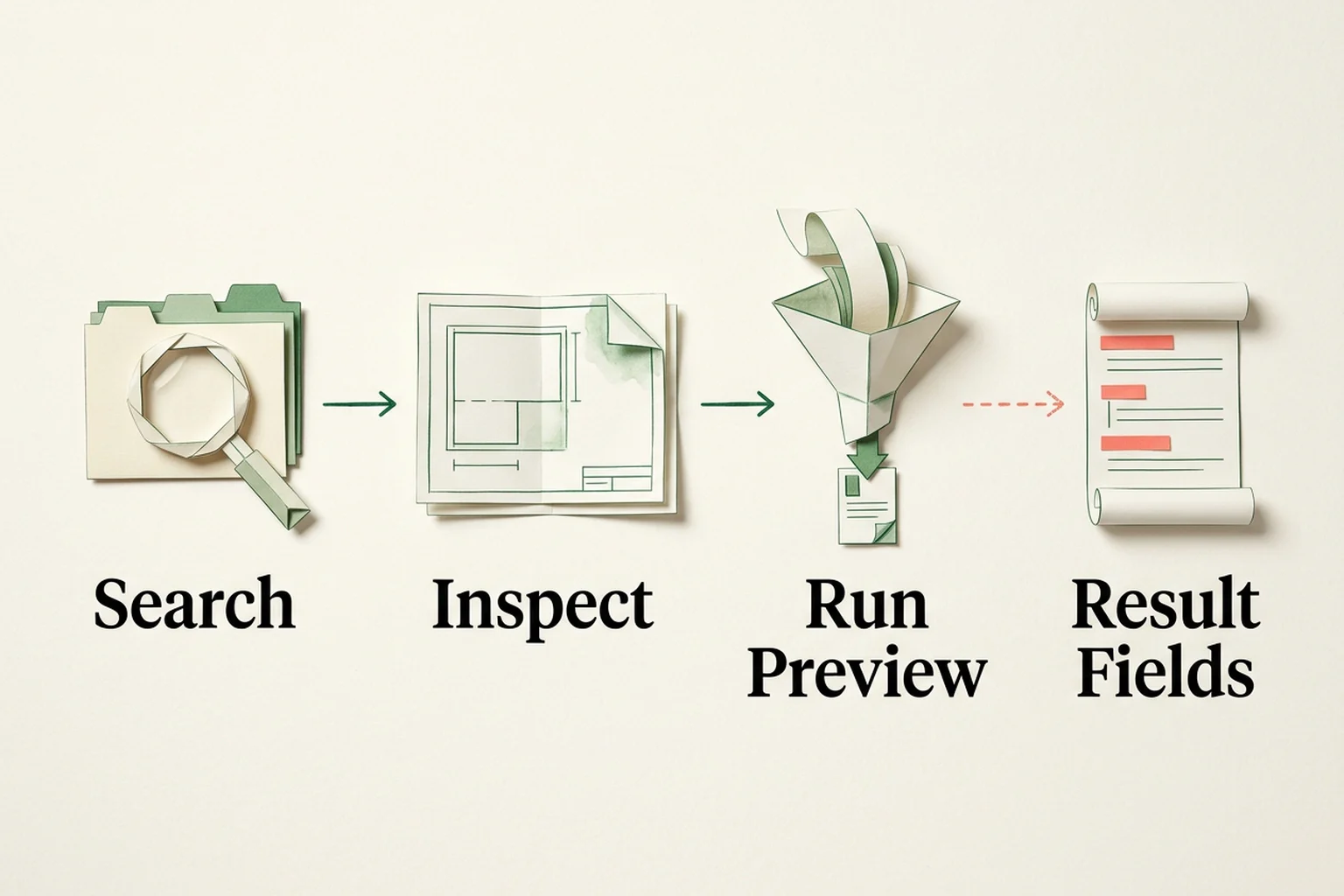
# MCP Servers for Social Media Data in 2026: Static Tool Lists vs Dynamic Search-Inspect-Run > Compare static tool lists, scoped lists, and dynamic Search-Inspect-Run for social data MCP servers: context cost, Prompt Cache stability, and accuracy. - Canonical HTML: https://beatapi.io/blog/mcp-server-social-media-data - Markdown: https://beatapi.io/blog/mcp-server-social-media-data.md - Entity: BeatAPI (https://beatapi.io) — unified capability layer for AI agents - Published: 2026-11-21 - Author: BeatAPI Team (https://beatapi.io/about) - Language: en - Category: Comparison - Topic cluster: Social Data & Creator Discovery (Pillar Hub: https://beatapi.io/data) - Reading time: 10 min read - All blog posts for agents: https://beatapi.io/blog/llms.txt --- **When connecting an AI agent to public social media data in 2026, static tool lists fit narrow workflows locked to one to three platforms with explicit tool trimming, while dynamic Search-Inspect-Run fits multi-platform research, cross-capability agent workflows, Prompt Cache stability, and pre-run contract and price checks.** Both architectures retrieve public posts, profiles, and comments; they diverge in how the MCP server structures `tools/list` across hundreds or thousands of endpoints and how it keeps raw social JSON from flooding the model's context window. A **static tool list MCP server** maps each social media REST endpoint one-to-one into an MCP tool definition and injects those schemas into the model prompt during initialization. A **dynamic Search-Inspect-Run MCP server** keeps the full action catalog on the server side, exposes a small fixed set of meta-tools, and lets the agent search for matching actions, inspect one contract and live price before spending credits, and execute with bounded payload previews.
| Architectural dimension | Static flat tool list | Scoped static tool list | Dynamic Search-Inspect-Run |
|---|---|---|---|
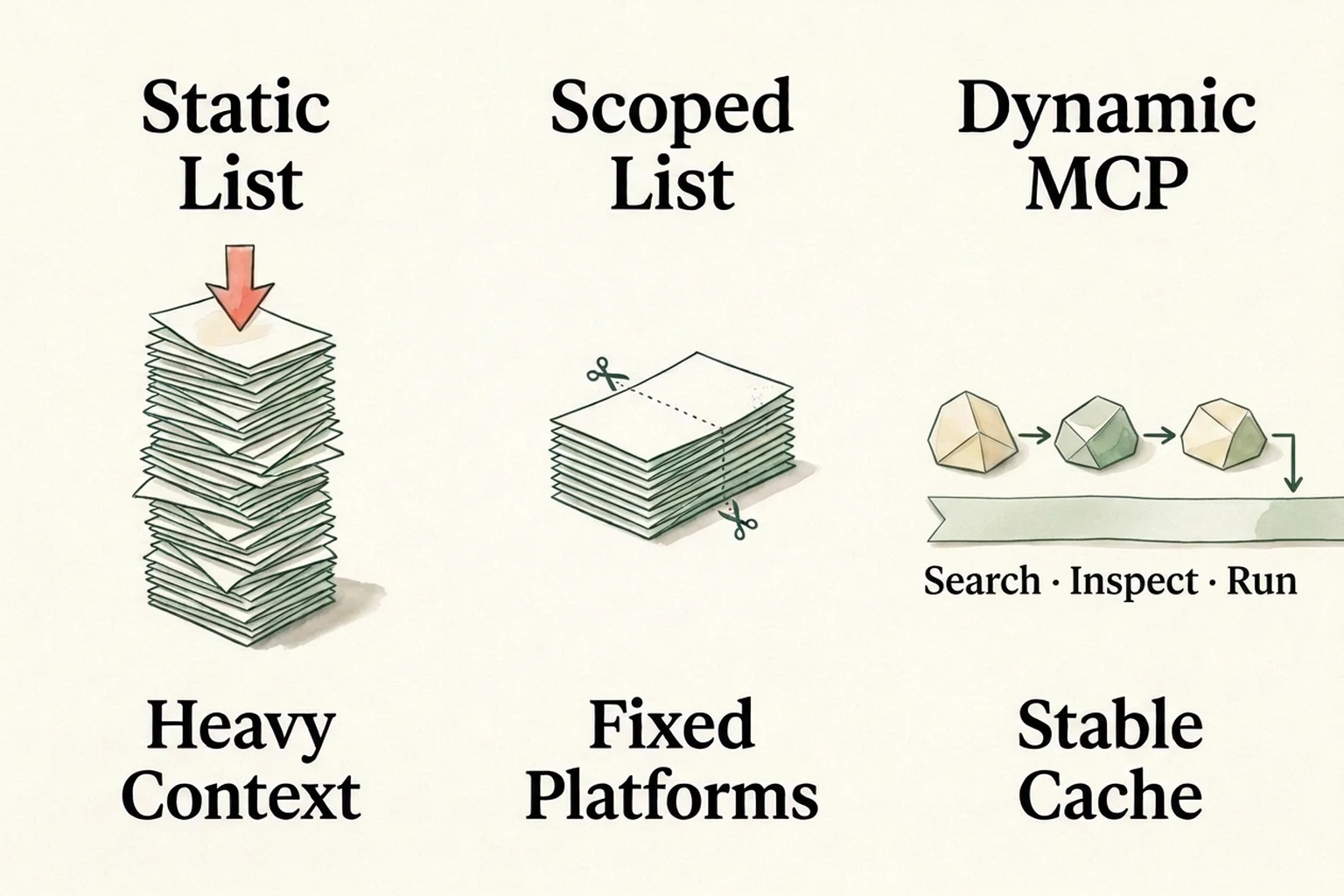
tools/list shape |
Hundreds to 1,000+ endpoint-specific tools loaded upfront | Developer-selected platform or group subset (typically 10–60 tools) | Fixed set of 3 core meta-tools (Search, Inspect, Run), optionally paired with a few high-frequency tools |
| Startup context cost | Very high; tens of thousands of tokens consumed before the first prompt | Low to moderate; scales linearly with selected platforms | Constant and minimal; adding 500 backend actions does not grow tools/list |
| Unplanned cross-platform exploration | All platforms present, but crowded schemas raise misselection risk | Blocked until a human edits the scoped URL or reconnects | Native; the agent discovers any covered platform within the same session |
| Prompt Cache behavior | Static array, but carries a heavy unpruned prefix baseline | Stable within one session; changing scopes forces a new prefix | Optimal; tools array remains byte-identical across turns and platforms |
| Pre-run parameter and price gate | Weak; pricing and nuances rely on static descriptions or external docs | Weak; fallback natural-language routers often bill immediately upon routing | Built-in; free Inspect returns required inputs, live price, billing unit, and readiness |
| First-call latency on an unfamiliar action | 1 tool round trip if the model selects the right tool and parameters | 1 tool round trip for tools inside the preconfigured scope | 2–3 tool round trips (Search → Inspect → Run); 1 round trip once cached by schema hash |
| Large JSON payload protection | Usually returns full REST payloads directly into conversation history | Usually returns full REST payloads directly into conversation history | Centralized in Run via default preview truncation, fields projection, or staged retrieval |
| Workload scenario | Primary engineering bottleneck | Recommended architecture | Implementation guardrail |
|---|---|---|---|
| Narrow assistant on 1–2 fixed platforms (<15 tools total) | Single-turn latency with completely fixed endpoint scope | Scoped static tool list | Cap tools/list at the exact 10–15 needed tools; avoid connecting unfiltered full catalogs. |
| Cross-platform creator, post, and comment research (global + APAC networks) | Target platforms and operations vary dynamically per prompt | Dynamic Search-Inspect-Run | Require free Inspect before Run; forbid constructing action references from platform names. |
| End-to-end research and content agents (social data + SEO + web search + AI models) | Stacking separate MCP servers floods context, breaks caches, and fragments keys | Dynamic Search-Inspect-Run unified capability layer | Keep one fixed meta-tool manifest across data and model pillars so Prompt Cache stays warm. |
| Scheduled daily monitoring or bulk ingestion for fixed account lists | Throughput, deterministic retries, and eliminating LLM inference cost | Direct REST API / SDK (no MCP in the cron loop) | Use MCP to prototype and inspect contracts, then move recurring jobs to direct HTTP calls. |