# How to Connect an SEO Data MCP Server to Claude Code (and Control Per-Run Cost)
> Connect live keyword, ranking, Domain Rating, and backlink data to Claude Code over remote HTTP MCP without a $129–$199/month SEO seat or bloated context windows.
- Canonical HTML: https://beatapi.io/blog/seo-mcp-server-claude-code
- Markdown: https://beatapi.io/blog/seo-mcp-server-claude-code.md
- Entity: BeatAPI (https://beatapi.io) — unified capability layer for AI agents
- Published: 2026-11-23
- Author: BeatAPI Team (https://beatapi.io/about)
- Language: en
- Category: Tutorial
- Topic cluster: SEO Data & Web Search (Pillar Hub: https://beatapi.io/seo)
- Reading time: 9 min read
- All blog posts for agents: https://beatapi.io/blog/llms.txt
---
**You can give Claude Code live keyword volume, competitor top pages, backlinks, and Domain Rating by adding a remote HTTP MCP entry to `.mcp.json` in your project root.** Before you copy a config snippet, three practical constraints decide whether the setup actually saves time or burns money: official Ahrefs and Semrush MCP servers require $129–$199/month paid plans, connecting heavy MCP servers eats tens of thousands of context tokens before your first prompt, and unbounded list queries can multiply your per-call bill in a single follow-up turn.
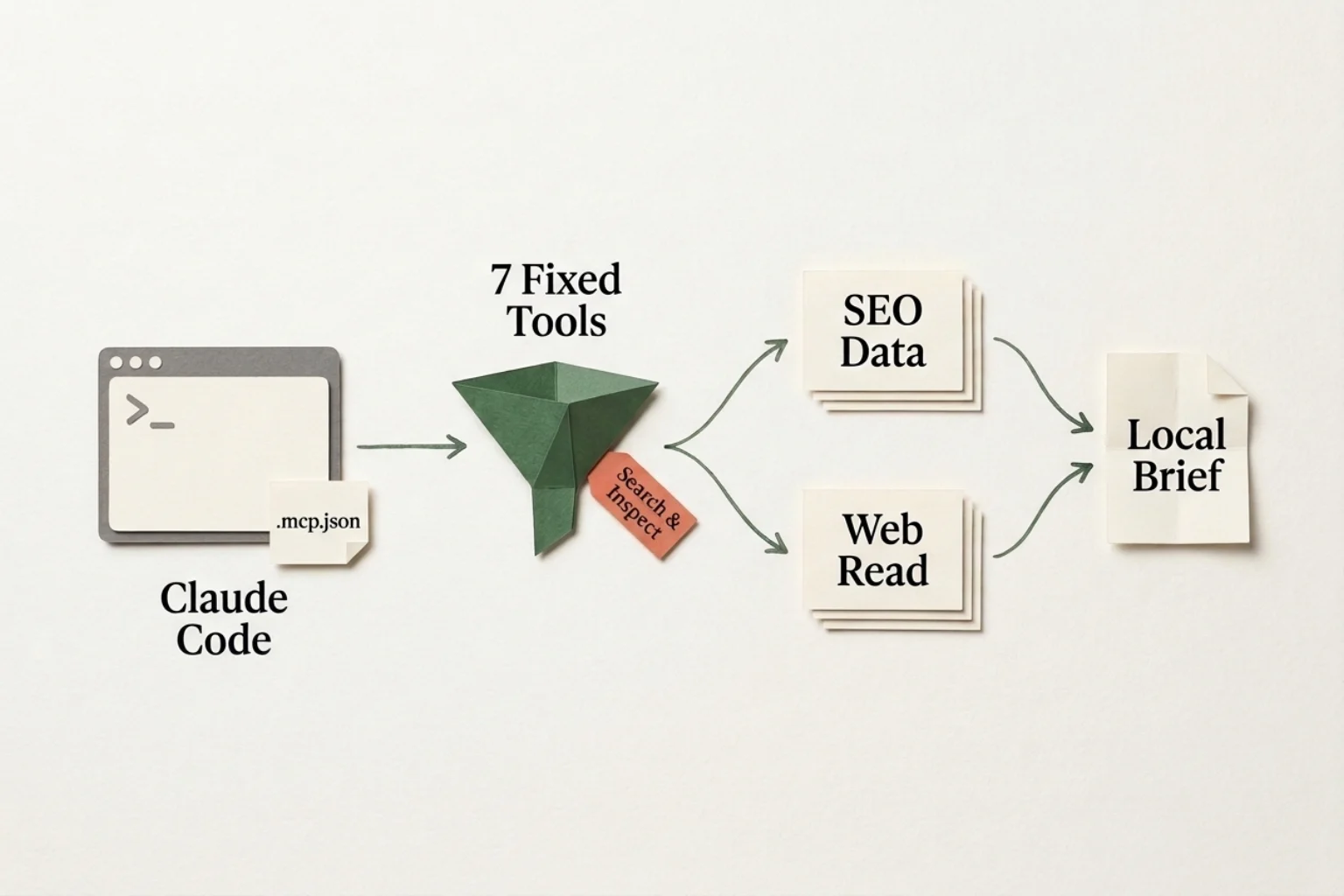
If your team already pays for Ahrefs or Semrush every month, connect their official MCP and keep an eye on row limits. If you only pull SEO data during content sprints or competitor research and do not want another monthly seat, [BeatAPI SEO Data API](/seo) over remote MCP (`https://beatapi.io/mcp`) is a cleaner fit: you pay per call and per returned row from a prepaid USD balance (`domain-rating` costs **$0.005**, a capped competitor top-page and keyword audit runs **$0.05–$0.07**), the server exposes only **7 fixed tools** so it does not bloat Claude Code's context window, and the same API key lets Claude Code call `web_read` ($0.002/URL) to inspect a competitor's top-ranking article in the same conversation.
Quick answer
- **Choose by existing spend, not hype:** Use Ahrefs MCP (Lite from ~$129/month) or Semrush MCP (Starter from ~$199/month) if you already hold those subscriptions; use BeatAPI remote MCP when you want pay-as-you-go SEO data with zero monthly seat fee and no local Node or Python server to run.
- **Scope the config to your project:** Put `.mcp.json` in your content or growth repository (or pass `--scope project`) instead of installing globally (`--scope user`), so coding repos never carry SEO tool overhead.
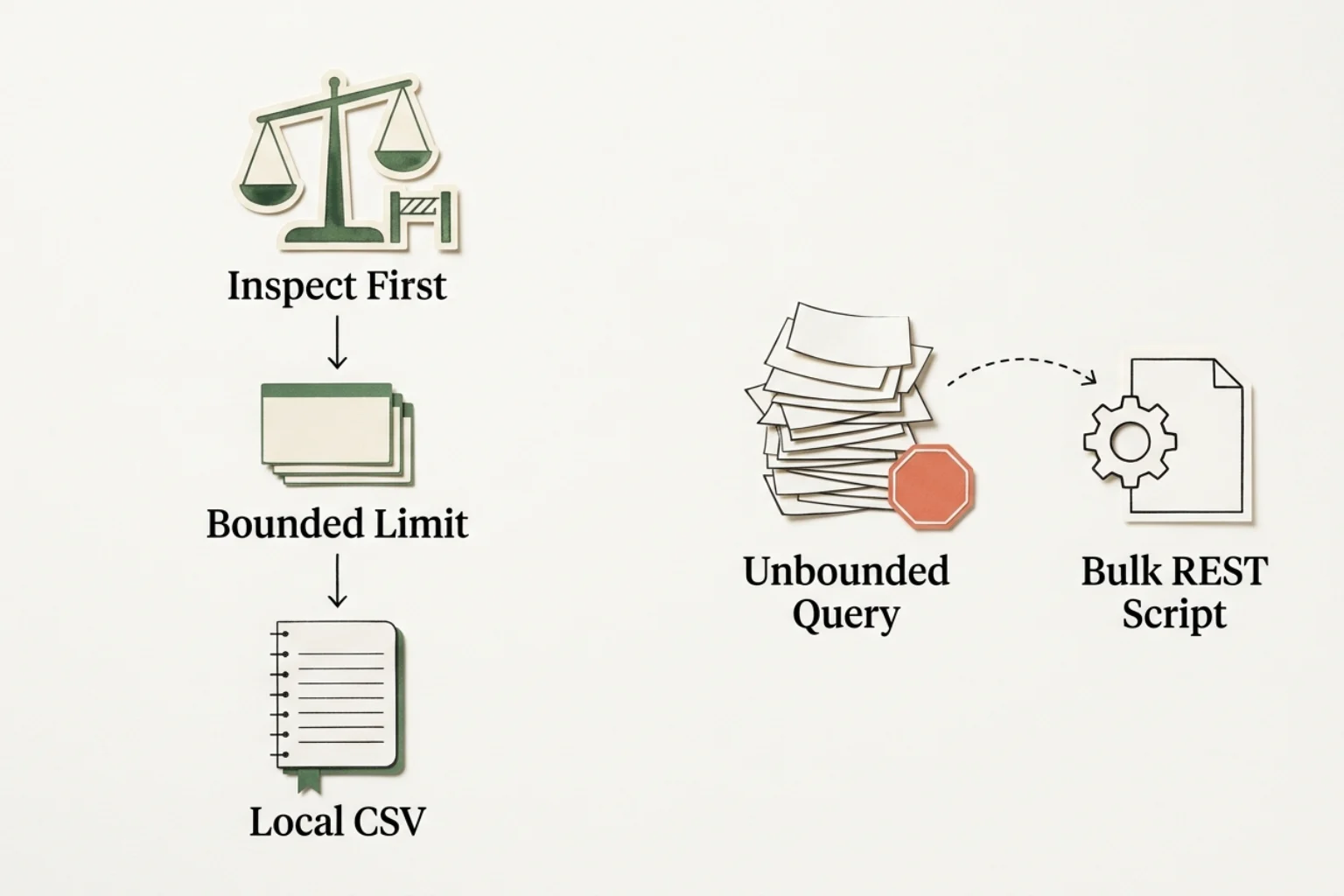
- **Run a free preflight check first:** BeatAPI exposes 12 SEO endpoints through `capabilities_search`, `capabilities_inspect`, and `capabilities_run`; searching and inspecting parameters and live quotes cost **$0**, so confirm `limit` before approving a paid run.
- **Use REST scripts for bulk jobs:** If you pull thousands of rows into a database on a nightly schedule, skip interactive chat and call `POST /v1/seo/*` from a plain Python or Node script with an `Idempotency-Key` header.
Pick the right SEO MCP before you touch any config file
Four SEO MCP options cover most Claude Code setups today. They all return keyword and backlink metrics; the real differences are **monthly minimums, context-window footprint, and whether your agent can also read the pages it discovers**.
| Option | Minimum spend | Connection method | Best fit & practical trade-off |
| --- | --- | --- | --- |
| **Ahrefs MCP** | Paid Lite plan (~$129/month, 200,000 API units) | Remote HTTP + Ahrefs account auth | Best if you already live in Ahrefs; Lite caps requests at 100 rows with a 50-unit minimum per call, so multi-step agent loops drain quota fast. |
| **Semrush MCP** | Qualifying plan (Starter ~$199/month, 50,000 API units) | Remote HTTP + `/mcp` OAuth flow | Best for existing Semrush teams; Traffic and Trends datasets require separate paid add-ons. |
| **DataForSEO MCP** | Pay-as-you-go ($50 minimum credit deposit) | Hosted HTTP or local `npx` stdio | Strong raw multi-module coverage (SERP, Labs, Backlinks), but wide tool lists add context overhead unless you trim enabled modules. |
| **BeatAPI MCP** | Pay-as-you-go, no monthly seat (`domain-rating` $0.005/call) | Remote HTTP (`https://beatapi.io/mcp`) + Bearer key | Best for lean teams and multi-step Claude Code briefs; 7 fixed tools keep startup tokens small and the same key unlocks `web_read` and `web_search`. |
Across `r/ClaudeCode` and GitHub discussions, the most common complaint about MCP is not installation—it is the **context tax**. Connecting large static servers dumps dozens of verbose JSON tool schemas into every turn before you type a word, sometimes burning 20,000 to 60,000 tokens upfront. BeatAPI avoids that trap by keeping a **7-tool manifest** (3 generic router tools plus 4 web tools) that discovers and inspects all 12 `data:seo.*` capabilities only when you ask for them.
Connect BeatAPI to Claude Code in three minutes (and avoid three common setup traps)
Export your key in your shell first, then add a project-scoped `.mcp.json` file at the root of your repository. Keeping the key in an environment variable lets your team commit `.mcp.json` safely without exposing secrets in Git.
```bash
export BEATAPI_API_KEY="your_beatapi_key"
```
```json
{
"mcpServers": {
"beatapi": {
"type": "http",
"url": "https://beatapi.io/mcp",
"headers": {
"Authorization": "Bearer ${BEATAPI_API_KEY}"
}
}
}
}
```
If you prefer the CLI over editing JSON by hand, register the same project-scoped entry with one command:
```bash
claude mcp add --transport http --scope project beatapi https://beatapi.io/mcp \
--header "Authorization: Bearer ${BEATAPI_API_KEY}"
```
Run `claude mcp list` to verify the server state. Based on Anthropic's [Claude Code MCP documentation](https://code.claude.com/docs/en/mcp), three small mistakes cause almost every first-time failure:
1. **Omitting `"type": "http"` in `.mcp.json`:** Whenever a JSON entry includes a `url` without `type`, Claude Code assumes it is a local `stdio` process, skips it, and prints `MCP server "beatapi" has a "url" but no "type"`.
2. **Stopping at `Pending approval`:** Project-scoped `.mcp.json` servers are never auto-trusted on first load. Open `claude` interactively inside that folder once and approve the server; only then will `claude mcp list` switch to `Connected`.
3. **Trailing whitespace or an unset shell variable:** Pasting an API key with a trailing newline triggers `Leading or trailing whitespace in: headers.Authorization`, and forgetting `export BEATAPI_API_KEY` leaves `${BEATAPI_API_KEY}` unexpanded so authentication fails.
Once `beatapi` shows as connected, start with a zero-cost read-only check so you confirm tool discovery before spending a cent:
```text
Use BeatAPI MCP capabilities_search to find SEO tools, then run capabilities_inspect on data:seo.keyword_ideas and data:seo.domain_rating to show required inputs and live prices. Do not call capabilities_run yet.
```
For full client flags, permission rules, and other editors, see the [Claude Code integration guide](/claude-code) and [BeatAPI Integrations](/integrations).
How per-call and per-row SEO pricing works—and how to cap every run
[BeatAPI SEO Data API](/seo) covers 12 endpoints split across three simple billing shapes. The one rule that protects your balance is setting an explicit `limit` on list endpoints—because list tools charge a small base fee per call plus a tiny fee per returned row.
| Task group | Capability references (`data:seo.*`) | Public retail rate | Example capped call |
| --- | --- | --- | --- |
| **Keywords & domain lists (7 tools)** | `keyword_overview`, `keyword_ideas`, `keyword_difficulty`, `domain_overview`, `ranked_keywords`, `top_pages`, `competitors` | `$0.018 / call + $0.0003 / row` | `limit: 20` (20 rows) = **$0.024** |
| **Backlinks (2 tools)** | `backlink_summary`, `backlinks` | `$0.035 / call + $0.0002 / row` | Summary (1 row) = **$0.0352**; 20 backlinks = **$0.039** |
| **Domain Rating** | `domain_rating` | `$0.005 / call` | **$1** buys **200** domain checks |
| **DR History** | `domain_rating_history` | `$0.004 / month` | 6 months of history = **$0.024** |
| **Site Traffic** | `site_traffic` | `$0.005 / quarter` | 4 quarters of history = **$0.020** |
Check [BeatAPI pricing](/pricing) if you need live quotes alongside model or social-data rates. In day-to-day Claude Code prompts, keep three habits in every request: name the two-letter country code (`us`, `gb`, `jp`), cap `limit` (`10` or `20` rows), and ask Claude to print the estimated total before running.
Three copy-ready Claude Code workflows with real cost math
Connecting an MCP server only pays off when the output lands directly in your working files. Each prompt below runs in a single Claude Code turn and writes structured output straight to your repository.
### 1. Build a prioritized keyword sheet (~$0.045)
Pull 20 related ideas with `keyword_ideas` ($0.024), score difficulty on the top 10 with `keyword_difficulty` ($0.021), and save a sorted CSV ready for editorial planning.
```text
Use BeatAPI SEO tools to fetch keyword_ideas for "ai video api" in country "us" with limit 20. Take the top 10 terms by search volume, check keyword_difficulty for those 10, sort by high volume and low difficulty, and save the result to ./seo-briefs/ai-video-api-keywords.csv. Print the estimated call cost at the end.
```
### 2. Find a competitor's top organic pages and read their actual article (~$0.068)
Pure SEO tools stop at URLs and traffic estimates, forcing you to open browser tabs manually. Because the same BeatAPI key unlocks [BeatAPI Web Search API](/web-search-api) (`web_read` at **$0.002 per readable URL**), Claude Code can pull `domain_overview` ($0.0183), `top_pages` (limit 10, $0.021), and `ranked_keywords` (limit 20, $0.024), then immediately read the top two ranking articles as clean Markdown ($0.004) to map heading gaps.
```text
For bare domain competitor.com in country "us", run BeatAPI domain_overview, top_pages (limit 10), and ranked_keywords (limit 20). Pick the top 2 organic content URLs, read both pages with web_read, and write ./seo-briefs/competitor-gap.md comparing their H2 structure and listing concrete angles they missed.
```
### 3. Vet an outreach or backlink partner before pitching (~$0.064)
A single Domain Rating snapshot hides sites that recently lost authority. Combining `domain_rating` ($0.005), `backlink_summary` ($0.0352), and six months of `domain_rating_history` ($0.024) flags sudden drops before you spend time writing a guest post.
```text
Check target.com with BeatAPI domain_rating, backlink_summary, and 6 months of domain_rating_history. Summarize whether authority is steady or declining and flag any abrupt backlink anomalies.
```
Four real-world gotchas—and when not to use MCP at all
- **Pass bare domains and two-letter country codes:** Send `example.com`, never `https://example.com/` or a subpage path. Use `us`, `gb`, or `jp` rather than `USA` or `UK`, or parameter validation will reject the call.
- **Brand-new terms often return null or zero search volume:** Keyword indexes need weeks to accumulate monthly averages. When a newly launched model or tool name returns empty volume, that is a normal coverage lag—not a broken endpoint. Run `web_search` ($0.005/call) on the same MCP connection to check live discussion instead.
- **Guard retries and reuse `request_id`:** When you move a workflow into a script calling `POST /v1/seo/*`, always send an `Idempotency-Key` header so timeout retries never double-bill. Inside Claude Code, reuse an existing `request_id` rather than rerunning the exact same query.
- **Skip interactive MCP for bulk nightly pulls:** If your pipeline scrapes 500 domains or 10,000 keyword rows every night into a warehouse, do not drive it through an interactive Claude Code chat—you will pay unnecessary LLM reasoning tokens on top of data calls. Have Claude Code write a small Python script against `POST /v1/seo/*` and schedule that script instead.
Start small: add `.mcp.json` to one content repository, run a free `capabilities_inspect` check, and test Workflow 2 against a single competitor for under seven cents. When you switch back to pure feature coding, toggle the server off for that project in Claude Code's `/mcp` menu so it adds zero overhead.
FAQ
### Does connecting BeatAPI SEO MCP change which Claude model Claude Code uses?
No. Adding an MCP server only gives Claude Code external tools to call. Your existing Claude subscription or API model configuration stays untouched.
### How do I stop Claude Code from running dozens of expensive SEO calls by accident?
Combine two guardrails: always include `limit: 20` and "run `capabilities_inspect` first and confirm cost before executing" in your prompt, and fund BeatAPI with a small prepaid USD balance so spend has a hard ceiling with no surprise monthly overage.
### Can I copy this exact `.mcp.json` config into Codex?
The remote endpoint (`https://beatapi.io/mcp`) and all 12 `data:seo.*` tools are identical, but Codex reads `~/.codex/config.toml` using TOML syntax and `bearer_token_env_var` instead of `.mcp.json`. Check the [Codex setup guide](/codex) for the exact snippet.
### What is the cheapest way to screen a list of 50 domains for authority?
Ask Claude Code to call only `data:seo.domain_rating` ($0.005 per domain, or $0.25 for 50 domains) instead of pulling full backlink tables, and inspect backlinks only on the few domains that pass your threshold.