# Web Search vs. Page Reader vs. Site Map vs. Deep Research: Choosing the Right Endpoint for AI Agents
> Compare BeatAPI Web Search, Page Reader, Site Map, and Deep Research across competitor sitemap monitoring, doc ingestion, and citation-backed research.
- Canonical HTML: https://beatapi.io/blog/web-search-api-vs-page-reader-vs-site-map
- Markdown: https://beatapi.io/blog/web-search-api-vs-page-reader-vs-site-map.md
- Entity: BeatAPI (https://beatapi.io) — unified capability layer for AI agents
- Published: 2026-11-24
- Author: BeatAPI Team (https://beatapi.io/about)
- Language: en
- Category: Comparison
- Topic cluster: SEO Data & Web Search (Pillar Hub: https://beatapi.io/seo)
- Reading time: 8 min read
- All blog posts for agents: https://beatapi.io/blog/llms.txt
---
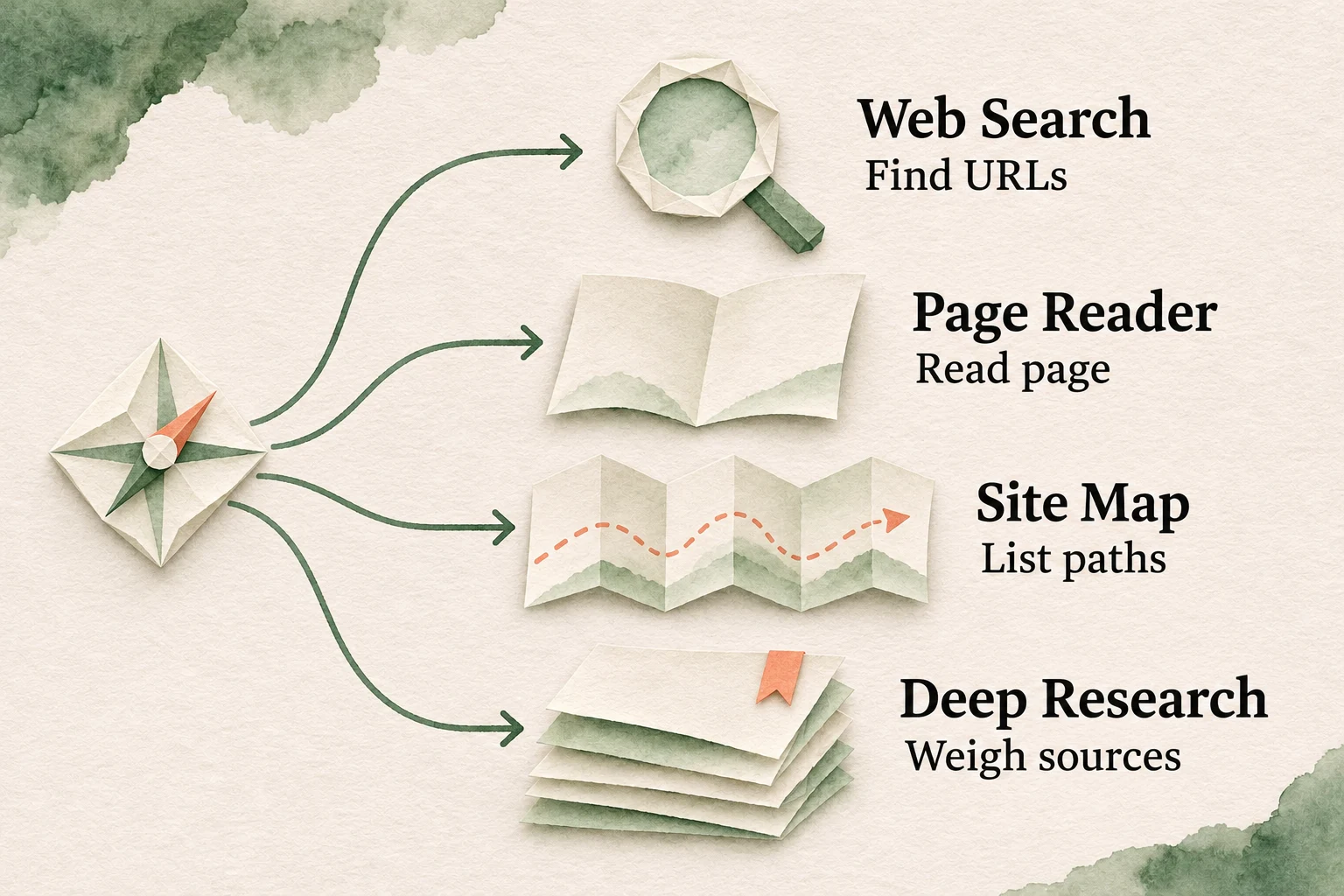
When you give an AI agent live web access, four distinct operations handle four separate jobs. **Web Search** returns candidate URLs and short snippets for a query. **Page Reader** extracts clean Markdown or plain text from specific public URLs. **Site Map** discovers internal URLs starting from a single public page on a target domain. **Deep Research** runs multiple searches and page reads in one asynchronous job and returns cited research notes.
[BeatAPI Web Search API](/web-search-api) exposes these four operations as four REST endpoints under one BeatAPI API key. You can call them directly over HTTP or connect the same four tools to Claude Code, Codex CLI, and Cursor through [BeatAPI MCP](/integrations).
Quick answer
- **Track new competitor pages or ingest a documentation site with BeatAPI Site Map and BeatAPI Page Reader.** Filter target sections with `select_paths`, diff against your previous URL list, and read only the new pages instead of re-crawling an entire domain.
- **Verify pricing updates, version numbers, or official policies with BeatAPI Web Search followed by BeatAPI Page Reader.** Search snippets omit conditions and `type: "news"` results carry no `snippet` field; reading the actual page with a focused `query` keeps citations accurate and input tokens small.
- **Reserve BeatAPI Deep Research for multi-source comparisons and public feedback synthesis.** `POST /v1/web/research` costs $0.05 and takes 30 seconds to 3 minutes; checking one known official site with `POST /v1/web/search` plus `POST /v1/web/read` costs under $0.01 and finishes in a few seconds.
- **Failed reads and empty maps cost $0, while partial research runs are billed.** BeatAPI charges nothing for URLs listed in `failed[]`, empty `web/map` responses, or `503` responses across all four endpoints. `POST /v1/web/research` bills $0.05 for both `complete` and `partial` runs, and only sources marked `read_status: "read"` should be cited.
Case 1: Monitor competitor new pages and SEO moves (Site Map + Page Reader + SEO Data API)
Tracking new URLs inside a competitor's high-value sections is a straightforward way to spot new comparison pages, landing pages, and product launches without scraping the whole site every week. You pull a fresh list of URLs for the sections you care about, diff it against last week's snapshot, and inspect only what changed.
Monitoring `sitemap.xml` timestamps (``) alone often triggers false alerts. When a CMS such as WordPress or Webflow updates a global header or footer, it refreshes `` across every page in the sitemap. Comparing newly added URLs first, then reading only those new pages, eliminates that noise.
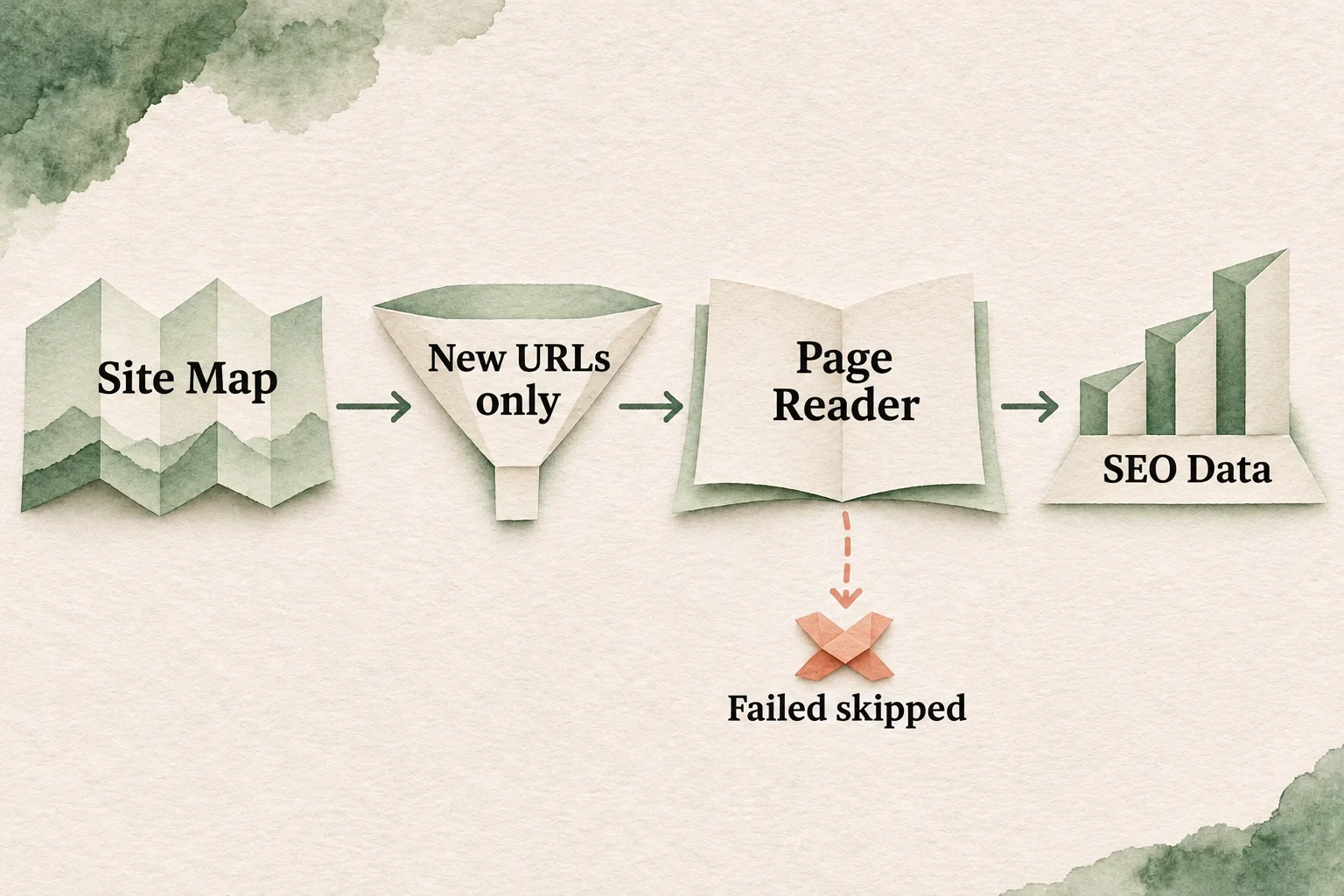
A weekly competitor monitor on BeatAPI runs in three steps:
1. **List target sections with BeatAPI Site Map and compute the diff.** Call `POST /v1/web/map` with `select_paths` scoped to high-signal directories (such as `["/blog/.*", "/alternatives/.*", "/integrations/.*"]`), `max_depth: 2`, and `limit: 50`. Compare `urls` against last week's saved JSON file to isolate newly published URLs.
2. **Read only the newly added pages with BeatAPI Page Reader.** Pass the new URLs (for example, 5 pages) to `POST /v1/web/read` with `format: "markdown"` to extract headings, claims, and target comparisons. If a target site blocks a request, BeatAPI Page Reader places that URL in `failed[]` with `reason: "blocked"` at $0 cost instead of passing a 403 block page into your LLM prompt as article text.
3. **Check keyword demand with BeatAPI SEO Data API.** Using the same BeatAPI API key, call [BeatAPI SEO Data API](/seo) (`/v1/seo/keyword-overview` or `/v1/seo/top-pages`) to pull search volume and difficulty for the topics those new pages target, then send a concise digest to Slack or your local report folder.
```bash
curl -sS https://api.beatapi.io/v1/web/map \
-H "Authorization: Bearer $BEATAPI_API_KEY" \
-H "Content-Type: application/json" \
-d '{
"url": "https://competitor.example",
"select_paths": ["/blog/.*", "/alternatives/.*"],
"exclude_paths": ["/tag/.*", "/page/.*"],
"max_depth": 2,
"limit": 50
}'
```
 `POST /v1/web/map` returns at most 100 deduplicated URLs per call and follows links up to `max_depth: 3`, so it does not guarantee full coverage of a large domain. If a starting page builds its links strictly with client-side JavaScript, BeatAPI Site Map returns an empty `urls` list with a `note` explaining why and charges $0. For domains with thousands of pages, parse the site's `sitemap.xml` to isolate new URLs and pass those URLs directly to `POST /v1/web/read`.
Case 2: Verify external pricing or API changes while capping LLM token cost (Web Search + Page Reader)
In web-enabled agent loops, downstream LLM input tokens are usually the largest cost driver. Feeding raw HTML into a model fills the context window with navigation bars, scripts, and styling markup. Feeding only two-line search snippets causes the model to guess missing conditions, effective dates, or pricing tiers.
Separating link discovery from page extraction solves both problems:
1. **Find the official source with BeatAPI Web Search.** Call `POST /v1/web/search` with `include_domains` locked to the vendor's domain and `max_results` set to 3 or 5. Pick the matching `type` (`web`, `news`, `images`, `videos`, `scholar`, `patents`, `shopping`, or `places`). Keep two field differences in mind: `news` results include no `snippet` field, and `places` results include no `url` field. When both `country` and `language` are omitted, queries in Chinese, Japanese, or Korean search in that language and region automatically.
2. **Extract only relevant passages with BeatAPI Page Reader.** Pass 1 to 10 selected URLs to `POST /v1/web/read` with `format: "markdown"`, a `query` of up to 400 characters, and a bounded `max_chars` (default `20000`, range `500` to `100000`). The endpoint returns only the Markdown sections relevant to your query.
```bash
curl -sS https://api.beatapi.io/v1/web/read \
-H "Authorization: Bearer $BEATAPI_API_KEY" \
-H "Content-Type: application/json" \
-d '{
"urls": ["https://spec.openapis.org/oas/v3.1.0"],
"query": "webhooks object",
"format": "markdown",
"max_chars": 4000
}'
```
The same discover-then-read split works when syncing third-party API documentation into Claude Code, Cursor, or a local RAG index: run `POST /v1/web/map` with `select_paths: ["/docs/.*"]`, then batch the returned URLs in groups of up to 10 through `POST /v1/web/read`. Readable pages return in `results[]` while blocked pages land in `failed[]` at $0 cost. If a long page returns `truncated: true`, rerun `POST /v1/web/read` for that single URL with a higher `max_chars` or a narrower `query`.
Case 3: Run multi-source vendor or community research with verified citations (Deep Research + Page Reader)
When an autonomous research agent hits timeouts or blocked pages and silently omits those failures from a polished report, verifying every claim by hand takes longer than researching the topic yourself.
When a question requires weighing multiple independent sources (such as comparing policy changes across several vendors or summarizing public discussion after a release), call `POST /v1/web/research`. BeatAPI Deep Research runs multiple search and read steps in one job, typically taking 30 seconds to 3 minutes, and returns `research_notes` alongside up to 20 ranked `sources[]`. Set `"include_x": true` to include public posts on X; when omitted, X is searched only if the query mentions X, Twitter, or tweets.
Apply two client rules when calling `POST /v1/web/research`:
1. **Set a 90–100 second client timeout and handle HTTP 202 polling.** `POST /v1/web/research` holds the HTTP connection for up to 85 seconds (for example, pass `curl --max-time 100`). If the job runs longer than 85 seconds, BeatAPI Deep Research returns HTTP `202` with `status: "running"` and a `next` object. Send `next` to `POST /v1/capabilities/run` every 10 to 15 seconds until `data.status` is `succeeded`, then read `data.output`.
2. **Cite only `read_status: "read"` sources and surface gaps.** Treat `research_notes` as leads rather than verified facts. Each item in `sources[]` carries a `read_status` of `read`, `snippet`, `cited`, or `failed`; only `read` means BeatAPI Deep Research actually read the page. Because total returned page text per run is capped, a `read` source may omit `content`. Pass that URL to `POST /v1/web/read` ($0.002) whenever you need exact quotes. When top-level `status` is `partial`, keep `partial_reasons` in your final brief so coverage gaps stay visible.
**Billing rule:** `POST /v1/web/research` charges **$0.05** for any successful run, whether `status` is `complete` or `partial`. Failed runs cost $0.
Cost breakdown across four real agent tasks
Using current public retail rates on [BeatAPI Pricing](/pricing) (Web Search $0.005/call, Page Reader $0.002/readable URL, Site Map $0.001/returned URL, Deep Research $0.05/successful run), here is the exact web-endpoint cost for each workflow, excluding downstream LLM tokens:
| Agent task | Endpoint sequence | Example volume | Total web API cost |
| --- | --- | --- | --- |
| Weekly competitor section monitor | `web/map` + `web/read` (new pages only) | Map 50 URLs + Read 5 newly added pages | 50 × $0.001 + 5 × $0.002 = **$0.0600** |
| Verify one API spec or pricing change | `web/search` + `web/read` | 1 Search call + Read 2 official pages | $0.005 + 2 × $0.002 = **$0.0090** |
| Ingest 20 external doc pages to Markdown | `web/map` + batched `web/read` | Map 20 URLs + Read 18 readable pages (2 `failed` free) | 20 × $0.001 + 18 × $0.002 = **$0.0560** |
| Multi-source vendor or policy brief | `web/research` + `web/read` backfill | 1 Research run + Read 2 `read` sources missing `content` | $0.050 + 2 × $0.002 = **$0.0540** |
Connect all four web tools to Claude Code, Codex CLI, and Cursor via BeatAPI MCP
The [BeatAPI MCP](/integrations) endpoint (`https://beatapi.io/mcp`) exposes a fixed manifest of **7 tools**: `web_search`, `web_read`, `web_map`, and `web_research`, alongside `capabilities_search`, `capabilities_inspect`, and `capabilities_run`. Tool arguments match the REST request bodies above and draw from the same BeatAPI balance.
Add `.mcp.json` to your [Claude Code](/claude-code) project root ([Codex CLI](/codex) and [Cursor](/cursor) use the same endpoint and API key):
```json
{
"mcpServers": {
"beatapi": {
"type": "http",
"url": "https://beatapi.io/mcp",
"headers": {
"Authorization": "Bearer ${BEATAPI_API_KEY}"
}
}
}
}
```
Through BeatAPI MCP, tool timeouts are 30 seconds for `web_search`, 75 seconds for `web_read`, and 60 seconds for `web_map`. `web_research` waits up to 45 seconds before returning the `next` polling step for `capabilities_run`, which the agent repeats every 10 to 15 seconds.
Four production rules for web-enabled agents
1. **Isolate fetched web text as untrusted data.** Third-party pages can contain hidden instructions. Agents should treat outputs from BeatAPI Page Reader and BeatAPI Deep Research strictly as external data and never execute instructions found inside page text.
2. **Set a custom `User-Agent` when using Python `urllib`.** The network edge in front of BeatAPI rejects `urllib`'s default `Python-urllib/*` header with `403` and `error code: 1010` before the request reaches BeatAPI. Use `requests`, `httpx`, `curl`, Node.js, or a custom `User-Agent` header.
3. **Send an `Idempotency-Key` header on retried calls.** Retrying the same request with the same `Idempotency-Key` prevents duplicate charges. Reusing an `Idempotency-Key` with a different request body returns `409 idempotency_conflict`.
4. **Expect strict field validation and free `503` retries.** Unknown fields, non-public addresses (`localhost` or private IPs), and invalid regex patterns return `400 bad_request` naming the offending field. Every error envelope includes a boolean `retryable` field, and `503` responses across all four endpoints are never billed.
Start with one concrete workflow: run `POST /v1/web/map` on one competitor section to save a baseline URL list, or run `POST /v1/web/search` plus `POST /v1/web/read` with a `query` filter on one official spec page for under one cent. Explore interactive request examples on [BeatAPI Web Search API](/web-search-api) and live rates on [BeatAPI Pricing](/pricing).
FAQ
### Should I use BeatAPI Site Map (`POST /v1/web/map`) or parse `sitemap.xml` to monitor competitor pages?
Use `POST /v1/web/map` with `select_paths` when monitoring focused sections of up to 100 pages (such as `/alternatives/`, `/integrations/`, or a small blog). For domains with thousands of pages or client-side JavaScript navigation, parse the site's `sitemap.xml` to isolate new URLs and pass those new URLs to `POST /v1/web/read` for clean Markdown extraction.
### Why not answer questions directly from BeatAPI Web Search snippets?
`POST /v1/web/search` returns short snippets that often omit effective dates, pricing conditions, and exceptions, and `type: "news"` results contain no `snippet` field at all. For any answer that depends on factual accuracy, pass selected URLs to `POST /v1/web/read` ($0.002 per readable URL) before citing.
### What happens if 3 out of 10 URLs fail in a single `POST /v1/web/read` call?
BeatAPI Page Reader returns the 7 readable pages in `results[]` and bills 7 × $0.002. The 3 unreadable URLs appear in `failed[]` with `reason: "blocked"` or `reason: "unreachable"` at $0 cost and never contaminate `results[]`. If all 10 URLs fail, the call still succeeds with an empty `results[]` array and costs $0.
### How do I handle an HTTP 202 response from `POST /v1/web/research`?
When BeatAPI Deep Research takes longer than 85 seconds, it responds with HTTP `202` and a `next` object. Post `next` to `POST /v1/capabilities/run` every 10 to 15 seconds until `data.status` is `succeeded`, then read the final payload from `data.output`.
### Do BeatAPI MCP web tools cost the same as calling the REST endpoints directly?
Yes. `web_search`, `web_read`, `web_map`, and `web_research` over BeatAPI MCP use the same request schemas and per-call or per-URL retail rates as the REST endpoints and charge the same BeatAPI account balance.