# What Is Gemini 4 Argon? Benchmarks, Pricing, and API Access
> Explore Gemini 4 Argon benchmarks, inputs and migration changes, and compare Google's list price with BeatAPI's discounted rate.
- Canonical HTML: https://beatapi.io/blog/what-is-gemini-4-argon
- Markdown: https://beatapi.io/blog/what-is-gemini-4-argon.md
- Entity: BeatAPI (https://beatapi.io) — AI Agent Gateway (unified API and MCP tool router for AI agents)
- Published: 2026-10-14 (updated 2026-11-21)
- Author: BeatAPI Team (https://beatapi.io/about)
- Language: en
- Category: Insights
- Topic cluster: Unified Model APIs, Comparisons & Cost Control (Pillar Hub: https://beatapi.io/model)
- Reading time: 7 min read
- All blog posts for agents: https://beatapi.io/blog/llms.txt
---
[Gemini 4 Argon](/gemini-4-argon-api) is Google's first Gemini 4 reasoning model, built for long, multi-step work rather than quick chat. Gemini 4 Argon is generally available and is worth testing for large codebase changes, legal and financial research, and analysis across documents, charts and video.
The short answer
- Gemini 4 Argon is a reasoning-first model announced on September 30, 2026, with general availability from October 13, 2026.
- Gemini 4 Argon combines long-context reading, software engineering, professional research and multimodal analysis; no single benchmark establishes a winner across all these tasks.
- Gemini 4 Argon leads several Google-published knowledge-work and long-context tests, while GPT-6 Astra and Claude Opus 5.5 lead selected terminal and computer-use tests.
- Gemini 4 Argon has a 1,048,576-token shared context window and 65,536-token default synchronous output; Google's introductory price changes on December 1, 2026.
- Gemini 4 Argon requires checks for thinking settings, caching, history and continuation handling before migrating an existing Gemini integration.
Gemini 4 Carbon opened its paid public API on November 10 and is now available through BeatAPI as `gemini-4-carbon`. Try Carbon for complex reasoning; Argon generally uses fewer thinking tokens for everyday interaction. Compare [Gemini 4 Carbon vs Gemini 4 Argon](/blog/gemini-4-carbon-vs-argon) for a closer look at reasoning depth and cost, or [Gemini 4 Argon vs GPT-6 Astra vs Claude Fable 5.1 vs Muse Wonder](/blog/gemini-4-argon-vs-gpt-6-astra-vs-claude-fable-5-1-vs-muse-wonder) for workload-based selection.
Where Gemini 4 Argon fits
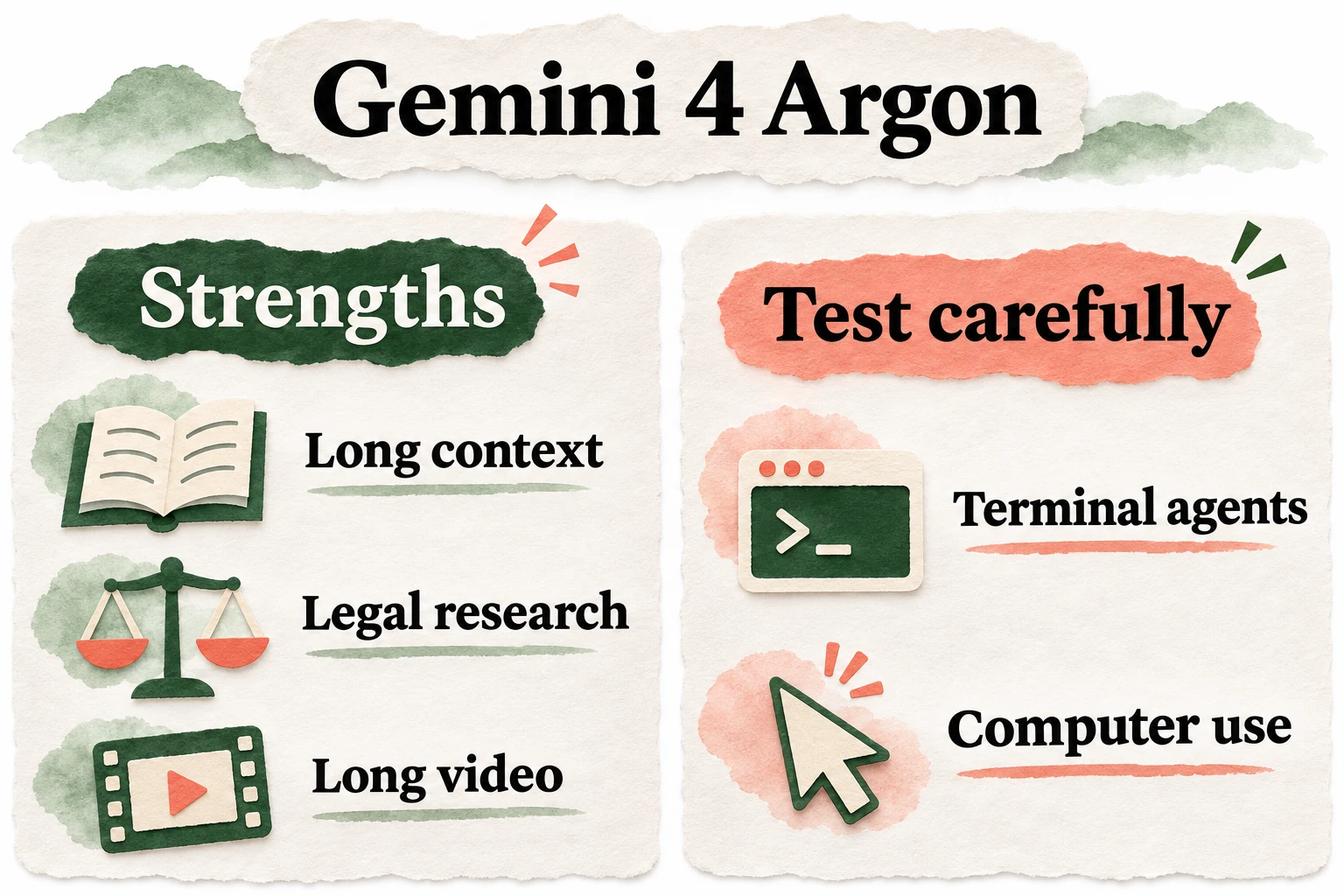
Gemini 4 Argon suits work that requires reading substantial evidence, reasoning through several steps and producing a coherent result. Legal research, financial-filings analysis and repository migration planning are sensible starting points. Video and chart analysis extend that work beyond plain text.
Gemini 4 Argon is not automatically the best choice for a CI agent that mostly runs shell commands, or an assistant that needs low-latency replies. Evaluate terminal execution, recovery from errors and accepted-task cost separately. A large output allowance is useful only when the deliverable genuinely needs the space.
Task-selection summary, not a measured ranking across every workflow.
Published benchmarks
Google's [Gemini 4 Argon](https://blog.google/innovation-and-ai/models-and-research/gemini-models/gemini-4-argon/) launch comparison reports the following results. These are published evaluation results, not tests run for this article.
| Benchmark | Gemini 4 Argon | GPT-6 Astra | Claude Opus 5.5 | Claude Fable 5.1 |
| --- | --- | --- | --- | --- |
| DeepSWE v1.1 | 77.9% | 74.1% | 74.2% | 67.4% |
| Vals Index | 68.9% | 63.1% | 67.0% | 65.8% |
| Harvey Legal Agent | 19.6% | 5.4% | 3.8% | 6.7% |
| GraphWalks 256K–1M | 84.2% | 71.8% | 66.8% | 65.0% |
| FrontierSWE v2 | 55.0% | 65.5% | 62.3% | 56.3% |
| Terminal-Bench 4.0 | 57.4% | 58.2% | 66.4% | 57.9% |
The pattern favors long-context and professional research work, not universal coding superiority. Test harnesses, tools and reasoning budgets matter; some competing scores were taken from published results rather than matched reruns.
As checked on November 10, 2026, [Artificial Analysis Intelligence Index](https://artificialanalysis.ai/models/gemini-4-argon) displays **50** for Gemini 4 Argon (High), using the current v5.0.1 index. Earlier index versions are not directly comparable. Token usage, latency and price basis also change the cost per task, so do not combine an older cost figure with a current score.
Pricing and specifications
Google's [Gemini API pricing](https://ai.google.dev/gemini-api/docs/pricing) lists an introductory standard rate through November 30, 2026. The standard rate changes on December 1.
| Per million tokens | Google through Nov 30 | Google from Dec 1 |
| --- | --- | --- |
| Input | $2 | $4 |
| Cache-hit input | $0.10 | $0.20 |
| Output, including thinking | $10 | $20 |
Gemini 4 Argon has been available on BeatAPI since October 13, 2026. BeatAPI currently charges **$0.60 input / $3.00 output per million tokens**, with cache-hit input at **$0.03**, 70% below Google's introductory rates; compare the matched billing items in the [BeatAPI pricing table](/pricing). BeatAPI's confirmed inputs are text, images and video.
The following specifications describe Google's [Gemini 4 Argon](https://ai.google.dev/gemini-api/docs/models/gemini-4-argon), not a promise that every provider exposes every capability.
| Specification | Google specification | Integration consequence |
| --- | --- | --- |
| Model ID | `gemini-4-argon` | Check the selected endpoint's request format |
| Inputs / output | Text, images, video, audio and PDF / text | Native model inputs are distinct from gateway-supported inputs |
| Shared context | 1,048,576 tokens | Input, thinking and output share the window |
| Default synchronous output | 65,536 tokens | Budget for the selected endpoint's output limit |
| Long-decode output | Up to 1,048,576 tokens | Requires continuation handling and available context |
| Thinking | LOW, MEDIUM, HIGH | Configure reasoning rather than trying to disable it |
| Caching | Implicit only | Remove explicit-cache dependencies before switching |
Long decode generates a logical response in segments. A `CONTINUATION` result carries a continuation token for the next request; the Google Gen AI SDK handles the sequence. Do not assume an OpenAI-compatible request automatically retrieves the full long response. Verify the endpoint and continuation behavior before designing around million-token output.
For a simple cost illustration at Google's introductory rate, 20K fresh input tokens, 80K cache-hit input tokens and 30K output tokens cost $0.040 + $0.008 + $0.300 = **$0.348**. This is arithmetic, not a measured repository-review bill. Repeated context, reasoning and retries determine actual usage.
Access and migration
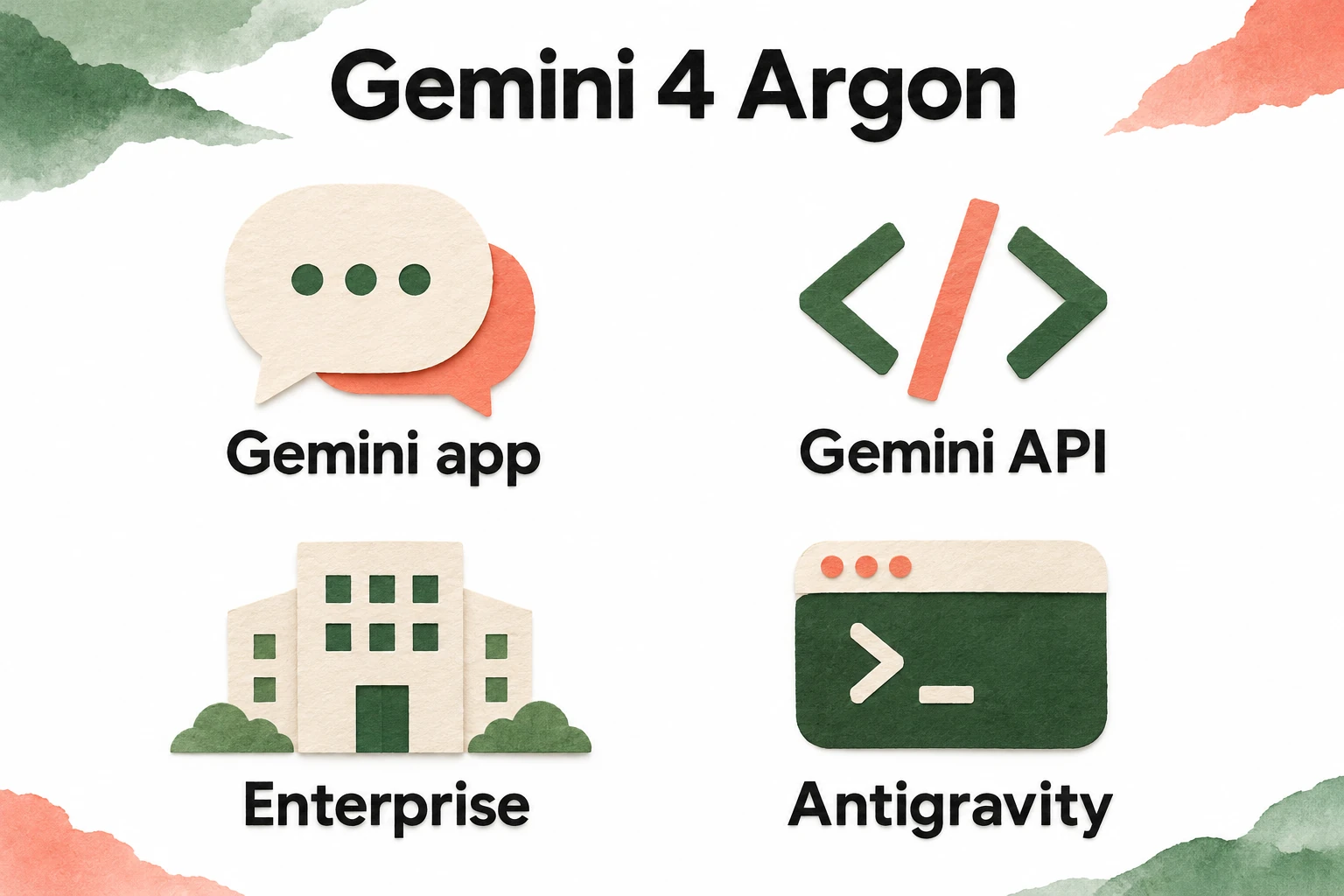
Gemini 4 Argon is accessible through the paid Gemini API, eligible Gemini app plans, Gemini Enterprise Agent Platform and [Google Antigravity](https://antigravity.google/docs/models). App subscriptions and API billing are separate; plan and trial restrictions still apply.
Choose an app for direct use or an API for integration; account eligibility remains separate.
Before switching from Gemini 3.1 Pro, follow [Gemini 4 Argon migration](https://ai.google.dev/gemini-api/docs/whats-new-gemini-4-argon):
1. Upgrade the Google Gen AI SDK before relying on continuation handling.
2. Replace `thinking_budget` and MINIMAL with a supported `thinking_level`.
3. Remove rejected parameters such as `frequency_penalty`, `presence_penalty` and `candidate_count`; do not rely on ignored sampling settings.
4. Remove explicit-cache calls and put reusable context first.
5. Remove prefilled model replies and test complete multi-turn histories.
6. Recalculate the shared context budget, then test streaming, tools, structured output and usage accounting before expanding traffic.
Set a per-task output budget and start at MEDIUM thinking. Increase reasoning only when the acceptance criteria require it. Preserve continuation state instead of restarting an uncertain long request.
FAQ
### Is Gemini 4 Argon free?
Google does not offer a free API tier for Gemini 4 Argon. Eligible app subscriptions and paid API usage have different billing and access conditions.
### Can Gemini 4 Argon output a million tokens?
Gemini 4 Argon supports up to 1,048,576 output tokens through long decode, within the shared context limit. The default synchronous output limit is 65,536 tokens, not a million tokens in one ordinary HTTP response.
### Does Google's December price change also apply to BeatAPI?
Google's published schedule applies to Google's rates. No BeatAPI adjustment date has been confirmed; use the current quoted rate rather than transferring Google's deadline to another provider.
### Is Gemini 4 Argon better than GPT-6 Astra or Claude Opus 5.5?
Gemini 4 Argon leads selected long-context and professional-work tests. GPT-6 Astra and Claude Opus 5.5 lead other execution tests. Use the same tasks, tools and acceptance criteria to choose.