# What Is Model Context Protocol (MCP)? How Agents Use It for Live Data, SEO, and Media Tasks
> Learn what Model Context Protocol (MCP) is, how stateless Streamable HTTP and dynamic 7-tool routing work, and when to use MCP vs REST APIs.
- Canonical HTML: https://beatapi.io/blog/what-is-model-context-protocol
- Markdown: https://beatapi.io/blog/what-is-model-context-protocol.md
- Entity: BeatAPI (https://beatapi.io) — AI Agent Gateway (unified API and MCP tool router for AI agents)
- Published: 2026-11-28
- Author: BeatAPI Team (https://beatapi.io/about)
- Language: en
- Category: Insights
- Topic cluster: SEO Data & Web Search (Pillar Hub: https://beatapi.io/seo)
- Reading time: 8 min read
- All blog posts for agents: https://beatapi.io/blog/llms.txt
---
**Model Context Protocol (MCP) is an open communication standard that lets AI clients discover and call external tools and live data through one shared format, removing the need to build a custom plugin for every AI app.** Anthropic open-sourced MCP in November 2024, and it is now supported across [Claude Code](/claude-code), [Cursor](/cursor), [Codex CLI](/codex), OpenCode, and major agent frameworks, as tracked in [public MCP adoption data](https://mcpmanager.ai/blog/mcp-adoption-statistics/).
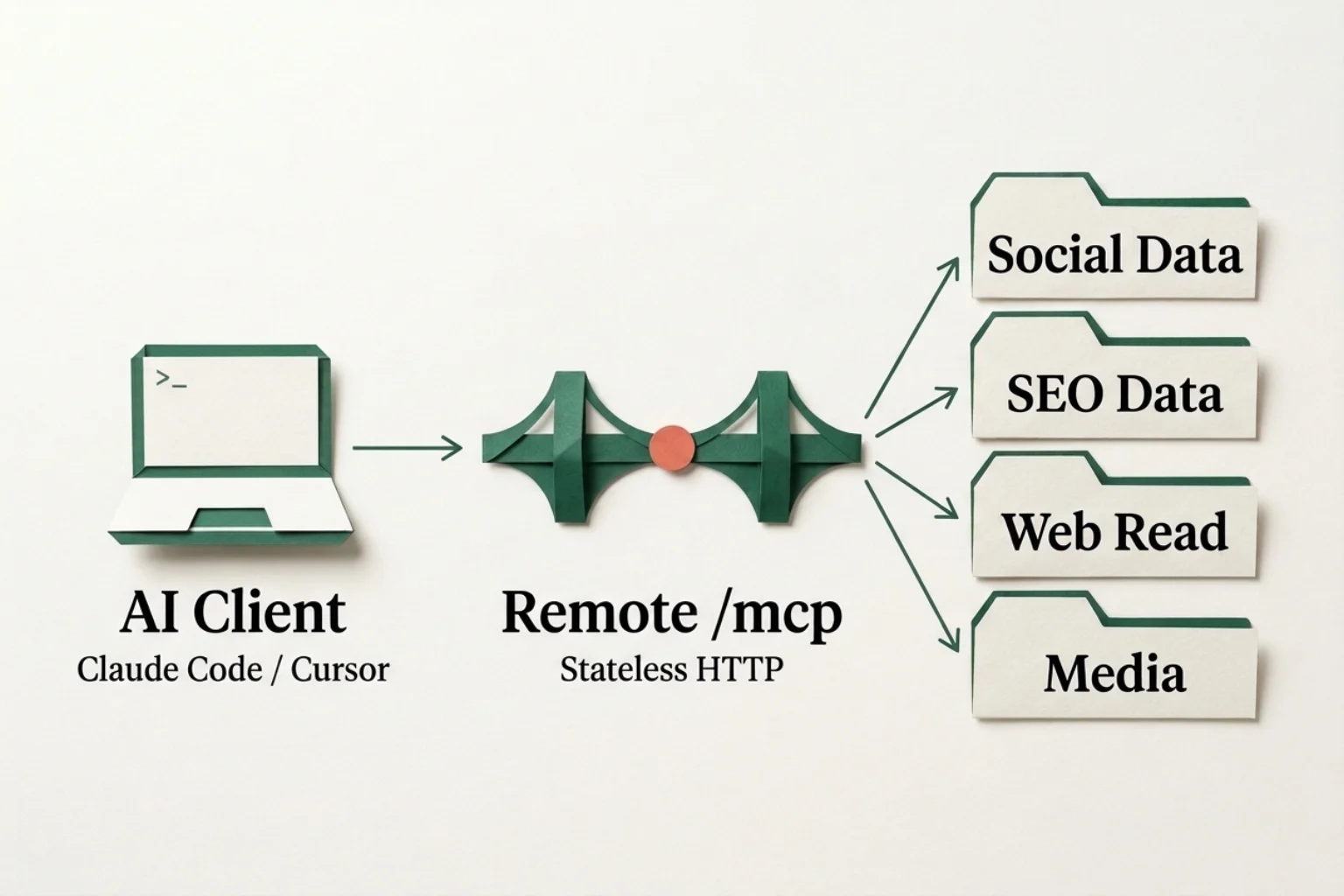
In day-to-day work, adding one remote MCP URL (such as [BeatAPI MCP](/integrations) at `https://beatapi.io/mcp`) lets an AI assistant pull public TikTok and Reddit posts, check SEO keywords and backlinks, read clean Markdown from competitor web pages, or start image and video generation tasks inside the same chat session. You do not have to export CSV files by hand or stitch together four separate scripts just to run a research brief.
Quick answer
- **MCP replaces one-off plugins with one shared interface.** Instead of writing separate adapters for every client and data source, a tool provider builds one MCP server and any MCP-compatible client can connect to it.
- **BeatAPI MCP covers four core agent workflows under one key.** With one remote URL (`https://beatapi.io/mcp`) and one BeatAPI API key, an AI client can vet influencers and engagement metrics, analyze social competitors on TikTok or Reddit, run SEO keyword and web page audits, and generate static or short-video ad creatives.
- **Use MCP for interactive research, and switch to REST for batch jobs.** BeatAPI MCP fits ad-hoc competitor research and creator screening inside Claude Code or Cursor. Once a workflow becomes a nightly job (such as pulling 5,000 SEO keywords or rendering 100 product videos), calling BeatAPI's REST API (`https://api.beatapi.io/v1/...`) with the same key avoids LLM token overhead.
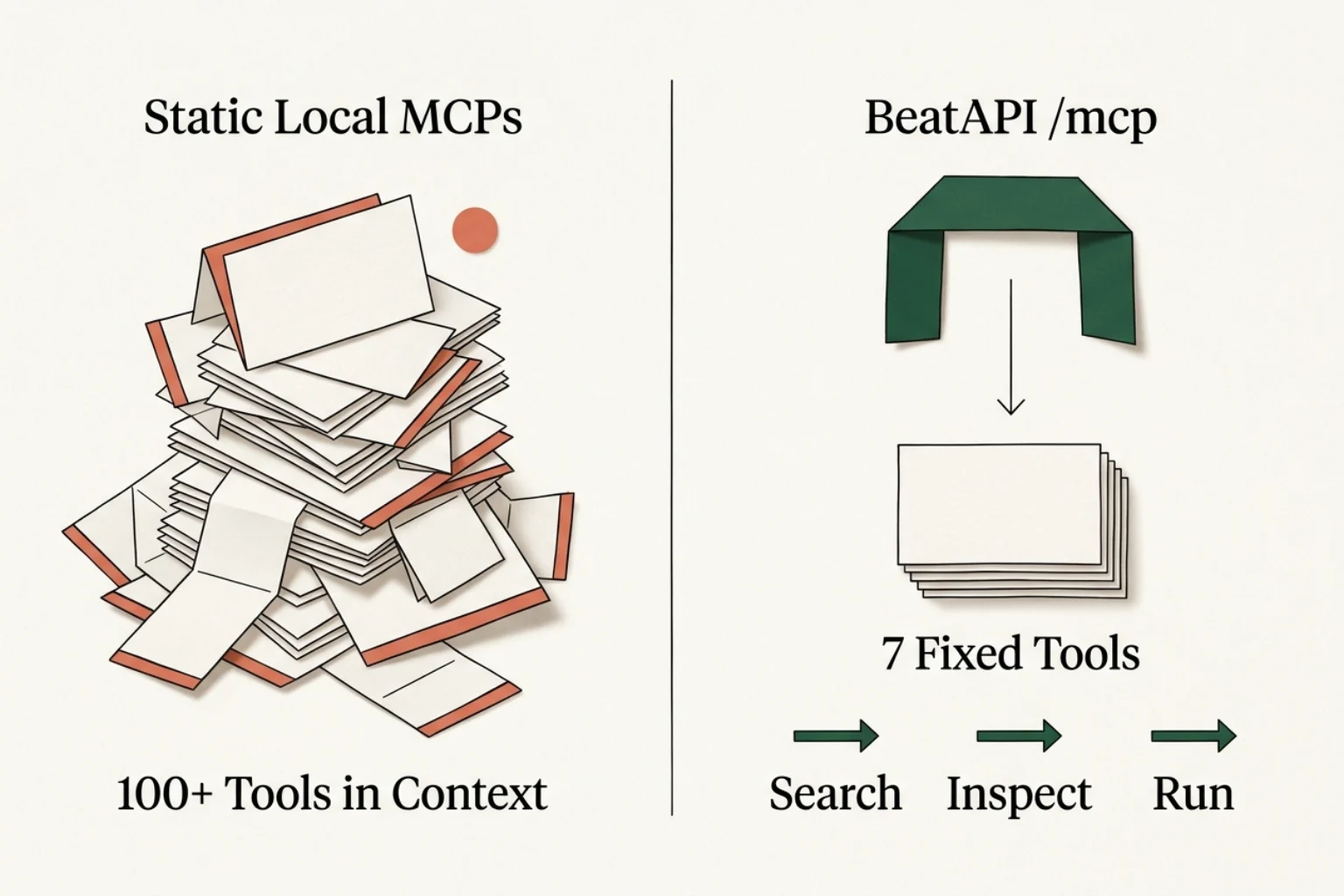
- **Dynamic 7-tool routing keeps context windows clean.** Under the [2026-07-28 MCP specification](https://modelcontextprotocol.io/specification/2026-07-28), remote servers use stateless Streamable HTTP. BeatAPI MCP exposes 7 fixed tools using a `Search → Inspect → Run` flow where schema and price checks cost $0, avoiding the context bloat caused by stacking multiple static local MCP servers.
How does MCP connect an AI client to external tools?
**MCP splits the connection into three roles (Host, Client, and Server) that exchange structured JSON-RPC 2.0 messages.** Walking through a concrete task makes the split clear. Suppose you ask Claude Code to pull recent TikTok videos from a competitor account and read the landing page linked in their bio:
1. **Host (the AI app you open).** Claude Code, Cursor, or Codex CLI acts as the host environment where you type the prompt and review results.
2. **Client (the built-in protocol layer).** Inside the host, the MCP client queries each configured server with `tools/list` to see what actions exist, then sends `tools/call` when the model selects a tool.
3. **Server (the service doing the work).** A remote server like [BeatAPI MCP](/integrations) receives the call, queries public social data for the competitor's recent posts, calls the web page reader to turn the linked URL into clean Markdown, and returns structured output to the model.
MCP supports two transport modes, and the right choice depends on where the data lives:
- **Local `stdio` transport.** The MCP server runs as a local child process on your machine and starts or stops with your editor. Use `stdio` when the agent needs local files, Git history, or a private development database. The trade-off is setup friction: every teammate must install local runtimes and manage local environment variables.
- **Remote stateless Streamable HTTP.** The [2026-07-28 MCP specification](https://modelcontextprotocol.io/specification/2026-07-28) made stateless Streamable HTTP the default for remote servers, a shift covered in this [overview of how MCP evolved in 2026](https://adcrunch.dev/blog/what-is-model-context-protocol-mcp-2026/). A remote server exposes a single HTTP POST endpoint (such as `https://beatapi.io/mcp`), processes each request independently without sticky sessions, and uses `Mcp-Method` and `Mcp-Name` headers so gateways can apply rate limits and logging. For cloud capabilities like [social media data](/data), [SEO data](/seo), [web search](/web-search-api), and media generation, remote MCP removes local dependency setup across a team.
How do Tools, Resources, and Prompts divide the work?
**An MCP server can expose three primitives (Tools, Resources, and Prompts), and the practical difference is who decides when to trigger each one.** Keeping these three roles separate prevents wasted model calls in daily engineering and growth work.
| Primitive | Who triggers it | Concrete examples | Role in a BeatAPI workflow |
| :--- | :--- | :--- | :--- |
| **Tools** | The AI model decides | Fetch a TikTok creator's last 10 videos, check competitor keyword gaps, read a competitor pricing page as Markdown, start an ecommerce video task | Core of BeatAPI MCP; the model invokes live public data, web, and media endpoints on demand |
| **Resources** | The client app loads it | Local database schemas, brand guidelines, read-only reference docs with a URI and cache TTL (`ttlMs`) | Supplies your team's internal criteria or context without turning static docs into a Tool the model calls repeatedly |
| **Prompts** | The user selects it | Saved slash commands or templates, such as a standard 10-creator vetting table with median views and engagement ratios | Standardizes team research formats so members do not retype long instructions |
When should you use MCP instead of a REST API?
**MCP does not replace REST APIs or model function calling.** Underlying data and media services still run over REST APIs, and the model still uses function calling to produce structured arguments. MCP standardizes how AI clients discover and reach those tools. In practice, decide based on whether a task is interactive exploration or scheduled batch processing:
| Task type | Best interface | Why it fits |
| :--- | :--- | :--- |
| Ad-hoc competitor research, creator screening, or spot-checking keyword difficulty inside Claude Code or Cursor | **BeatAPI MCP** (`https://beatapi.io/mcp`) | No boilerplate request code; the agent searches capabilities, reads live output, and drafts tables or briefs in one session |
| Scheduled nightly jobs: checking 5,000 SEO keywords, monitoring 200 social accounts, or turning 100 SKU photos into video ads | **BeatAPI REST API** (`https://api.beatapi.io/v1/...`) | Direct code-to-API execution skips LLM inference latency and token spend, and plugs cleanly into queues, cron jobs, and webhooks |
| A standalone internal app calling two or three fixed private functions | **Native Function Calling + REST** | Shorter execution path without maintaining an extra MCP server layer |
Because BeatAPI exposes both MCP and REST APIs under one API key and one balance, teams do not have to switch providers when a workflow matures. You can test a creator-screening or SEO brief workflow interactively through BeatAPI MCP, then move the exact same underlying endpoints into a scheduled REST script.
Why do several local MCP servers slow down your chat and raise token costs?
**The MCP protocol places no cap on how many tools a server registers, and clients send the full tool manifest to the model on every turn.** Connecting one small server barely registers, but cross-platform marketing and research workflows hit context limits quickly.
Consider a common growth task: mining Reddit complaints, checking TikTok creator stats, pulling SEO competitor keywords, and reading competitor web pages. Installing four separate static local MCP servers typically loads 100 to 200 endpoint definitions into the system prompt. Before you ask the first question, those JSON schemas can consume 30,000 to 75,000+ tokens per turn and increase tool-selection errors (see [Static Tool Lists vs. Dynamic Search-Inspect-Run for Social Data MCP](/blog/mcp-server-social-media-data) for the full breakdown).
Remote dynamic discovery (`Search → Inspect → Run`) solves this at the gateway layer. [BeatAPI MCP](/integrations) exposes **7 fixed tools** (`capabilities_search`, `capabilities_inspect`, `capabilities_run`, plus 4 web tools) regardless of how many social, SEO, web, and media endpoints sit behind it:
1. **Search ($0).** The agent searches for the capability matching the current task (for example, `tiktok creator profile` or `seo keyword overview`) without loading unrelated platforms into context.
2. **Inspect ($0).** Before spending money, the agent checks required input fields, sync vs. async execution mode, and live pricing so it does not guess parameter names.
3. **Run (pay per successful call).** The agent executes the confirmed call and receives a compact `preview` payload by default so large raw JSON responses do not fill the chat history. Full payloads remain retrievable for free for one hour using `request_id`.
For exact client configuration and troubleshooting steps, follow [Connect an Agent to BeatAPI MCP](/blog/connect-agent-beatapi-mcp).
Four things to lock down before rolling MCP out to your team
**Connecting AI agents to external tools introduces four practical failure modes: over-broad permissions, prompt injection triggering write actions, retry loops burning credits, and uncited numbers in research reports.** Set four boundaries before giving a team shared access:
1. **Separate public read-only data from private account writes.** Use a public data and model gateway like BeatAPI for public social posts, SEO metrics, web reading, and creative generation. Any workflow that reads private email, sends outreach messages, edits a CRM, or publishes social posts requires dedicated, scoped OAuth permissions and explicit human confirmation (for example, [scoped mailbox access via MCP](https://sickle.app/articles/what-is-mcp-server-in-ai)). BeatAPI does not perform private account writes, automated emailing, or auto-posting.
2. **Keep keys in environment variables and enforce `Origin` checks.** Never paste an API key into a tracked config file or chat prompt, and review broader [coding-agent security risks](https://www.ayautomate.com/blog/claude-code-security-risks) before granting terminal access. If your team hosts its own remote Streamable HTTP MCP server, validate the HTTP `Origin` header per the 2026 specification to block DNS rebinding attacks.
3. **Inspect parameters before paid runs and cap retries.** Instruct agents to confirm required inputs before calling paid endpoints and stop after bounded retries on empty results. On BeatAPI, `capabilities_search` and `capabilities_inspect` cost $0, and failed or empty social data and web read calls are not billed, which prevents most accidental retry spend.
4. **Log tool inputs and source URLs.** Keep a record of each `tools/call` payload and the original source URL returned. Every competitor price, keyword metric, or customer quote in a brief should trace back to a real API response rather than an estimate from model memory.
FAQ
### What business tasks can Claude Code or Cursor run directly through BeatAPI MCP?
Once connected to [BeatAPI MCP](/integrations) (`https://beatapi.io/mcp`), an agent can complete four common workflows in one session: vetting Instagram, TikTok, and YouTube creators by recent median views and public contact fields; mining Reddit threads and social competitor posts for customer pain points; checking SEO keywords, competitor backlinks, and clean Markdown from top-ranking pages; and generating or moderating static and short-video ad concepts. Private account posting and automated email outreach remain outside BeatAPI's scope.
### Why use an MCP data endpoint for influencer or SEO research instead of plain web search?
Plain web search cannot return structured metrics such as a creator's median views across their last 10 uploads, standardized keyword search volume, or grouped referring domains, and models often guess when those numbers are missing. Calling BeatAPI's [social data](/data) and [SEO data](/seo) endpoints over MCP returns structured fields from live responses, with free schema inspection and $0 charge on failed or empty calls.
### Is MCP only for Claude, and do I have to build my own MCP server?
No. Anthropic open-sourced MCP in November 2024, and Claude Code, Cursor, OpenAI Codex CLI, and OpenCode all support it. If your team needs public social data, SEO metrics, web page reading, or leading AI models, you can connect directly to a hosted remote MCP gateway like BeatAPI. You only need to build and maintain your own MCP server when an agent must query internal databases or private company systems.
### Why does Claude Code get slower and more expensive after adding several local MCP servers?
Static local MCP servers resend every registered tool name, description, and JSON schema on every chat turn. Removing unused local servers or consolidating data, web, and model tools behind a remote dynamic router like BeatAPI's 7-tool MCP endpoint lowers fixed per-turn token overhead.
### After proving a workflow with MCP, how do I turn it into a daily automated job?
BeatAPI MCP and BeatAPI REST APIs share the same API key and balance inside one [AI Agent Gateway](/blog/what-is-an-ai-agent-gateway). Once you verify the exact capability reference, parameters, and output fields inside Claude Code via MCP, call the matching `https://api.beatapi.io/v1/...` endpoint directly from a cron job or backend script without switching providers or paying per-turn LLM token costs.