Best Model for Claude Code in 2026: Opus 5.5, Sonnet 5.5, Fable 5.2, Haiku 5.5, and Effort Routing
Compare Claude Opus 5.5, Sonnet 5.5, Fable 5.2, and Haiku 5.5 in Claude Code: SWE-bench cost curves, effort tuning, prompt caching, and BeatAPI pricing.
Claude Opus 5.5 at its default medium effort is the best overall model for Claude Code in November 2026, while Claude Sonnet 5.5 is the lowest-cost daily default for clearly scoped edits on standard Anthropic pricing. Claude Fable 5.2 handles multi-hour autonomous runs and hard root-cause investigations that stall Opus 5.5, and Claude Haiku 5.5 handles narrow subagent searches and log summaries under 100K input tokens.
Choosing the best model for Claude Code requires separating three controls that govern quality and spend. The model sets the frozen reasoning weights, the effort level sets how many files, tool calls, and verification passes Claude runs per turn, and the Prompt Cache hit rate sets what you actually pay across a multi-turn session.
Quick answer: which model fits each Claude Code job
Choose Claude Opus 5.5 as your default all-round coding model: Anthropic sets Claude Opus 5.5 as the account default across Pro, Max, Ultra, Team, Enterprise, and Anthropic API plans in Claude Code v2.1.280 and later. On Anthropic's 478-problem SWE-bench Pro subset, Claude Opus 5.5 at medium effort solved 92.8% of tasks at $0.22 per solved task on official list pricing with a five-minute cache—and on BeatAPI's 50%-off pricing, a 90%-cached Opus 5.5 session costs the exact same $0.0602 per turn as an official cached Sonnet 5.5 session.
Choose Claude Sonnet 5.5 for fast, clearly specified daily work and coding subagents: Claude Sonnet 5.5 requires Claude Code v2.1.284 or later, responds faster than Opus 5.5, and cuts standard official token rates in half ($2 / $10 per million tokens versus $4 / $20, or $1 / $5 on BeatAPI). When a hard bug triggers repeated retries on Sonnet 5.5, moving up to Opus 5.5 usually lowers total spend per completed fix.
Choose Claude Fable 5.2 only for multi-hour autonomy and stubborn failures: Released November 9, 2026 and requiring Claude Code v2.1.321 or later, Claude Fable 5.2 costs $8 / $40 officially ($4 / $20 on BeatAPI) and reaches 49.1% on FrontierCode 2.0 at xhigh effort. No plan sets Claude Fable 5.2 as an account default, so switch explicitly with /model fable only after Opus 5.5 stalls at higher effort.
Choose Claude Haiku 5.5 for fast read-only subagents and verifiable micro-tasks: Claude Haiku 5.5 requires Claude Code v2.1.293 or later and charges $0.10 / $0.50 per million tokens officially ($0.05 / $0.25 on BeatAPI) for prompts up to 100,000 tokens. Keep Haiku 5.5 inputs under 100K tokens because crossing 100K triggers a 5x long-context price jump across the entire request.
Claude 5.x specs, CLI version requirements, and real monthly cost
All four current Claude 5.x models share a 1,000,000-token context window and a 128,000-token maximum output limit, so context size alone never separates them. They differ in minimum Claude Code CLI version, default effort behavior, cache-read discount multiplier, long-context pricing thresholds, and retail token rates across Anthropic direct and BeatAPI.
Model and API ID
Context / max output
Claude Code default effort (API default)
Anthropic official list price (in / out / cache read per 1M)
BeatAPI retail price on POST /v1/messages (in / out / cache read per 1M)
One detail in the Claude Code model configuration documentation trips up many guides: inside Claude Code, Claude Fable 5.2, Claude Opus 5.5, Claude Sonnet 5.5, and Claude Haiku 5.5 all start at medium effort by default, whereas direct Messages API calls default to high on Fable 5.2 and Sonnet 5.5. If any 5.5 or Fable 5.2 entry is missing from your /model picker, run claude update before troubleshooting your provider.
What one typical turn and one full month actually cost (uncached vs 90% cached)
To turn per-million rates into real developer spend, price a realistic coding turn of 30,000 input tokens and 5,000 output tokens repeated 100 times per day over 20 workdays (2,000 turns per month). Because healthy multi-turn Claude Code sessions read roughly 90% of their input from a five-minute prompt cache (27,000 cache-read tokens plus 3,000 new 5-minute cache-write tokens), comparing uncached list rates against 90%-cached rates on both Anthropic direct and BeatAPI reveals a sharp shift in effective cost.
Model
Uncached turn / month (Anthropic official)
90% cached turn / month (Anthropic official)
90% cached turn / month (BeatAPI retail)
Claude Haiku 5.5 (<=100K)
$0.0055 / $11
$0.0031 / $6.29
$0.0016 / $3.15
Claude Sonnet 5.5
$0.11 / $220
$0.0602 / $120
$0.0315 / $63
Claude Opus 5.5
$0.22 / $440
$0.1204 / $241
$0.0602 / $120
Claude Fable 5.2
$0.44 / $880
$0.2354 / $471
$0.1177 / $235
That cached-session arithmetic changes the default decision for BeatAPI users. Running Claude Opus 5.5 through BeatAPI at a 90% cache hit rate costs $0.0602 per turn ($120 per month)—identical to running Claude Sonnet 5.5 directly on Anthropic official pricing ($0.0602 per turn, $120 per month). Running Claude Fable 5.2 through BeatAPI ($0.1177 per turn, $235 per month) costs slightly less than running Claude Opus 5.5 directly on Anthropic official pricing ($0.1204 per turn, $241 per month), because BeatAPI cuts standard input, output, and cache-write rates by 50% and charges the same $0.10 per million cache-read tokens on Opus 5.5, Sonnet 5.5, and Fable 5.2.
Always compare models on total cost per finished change rather than raw token rate when upgrading from older generations. Anthropic notes that the tokenizer introduced in Claude 4.7 and later counts roughly 30% more tokens for identical text than Claude Haiku 4.5, yet newer models finish in fewer retries: on Anthropic's SWE-bench Pro subset, Claude Sonnet 5.5 cut cost per solved task by 87% compared with Claude Sonnet 5, and Claude Opus 5.5 cut cost per solved task by 78% compared with Claude Opus 5 ($5 / $25 official).
Claude Opus 5.5 vs Claude Sonnet 5.5: which should be your daily default?
Claude Opus 5.5 is the stronger default when avoiding rework matters most or when you route through BeatAPI's discounted pricing, while Claude Sonnet 5.5 is the cheaper daily default when you pay full official list rates on cleanly specified tickets. Anthropic sets Claude Opus 5.5 as the default model across Claude Code plans and positions Claude Sonnet 5.5 as the best balance of response speed and coding intelligence for routine development.
Tasks where Claude Sonnet 5.5 is enough
Claude Sonnet 5.5 matches Opus 5.5's 1M context window and 128K output limit at lower latency and half the official standard token rate, making /model claude-sonnet-5-5 a reliable fit for clearly bounded work:
Implementing a well-specified feature alongside its unit and integration tests.
Tracing a familiar stack trace or regression across a handful of known files.
Updating test suites and fixtures after a planned code change.
Reviewing a focused pull request for edge cases and contract mismatches.
Translating an approved technical spec into working modules.
Running parallel implementation or review subagents delegated from an Opus 5.5 lead session.
Context capacity does not equal diagnostic accuracy. One million tokens lets Claude Sonnet 5.5 hold an entire subsystem, yet if Sonnet 5.5 already has the relevant files and repeats the same mistake twice, switch to Opus 5.5 instead of pasting more code into the prompt.
Signals that you should start directly on Claude Opus 5.5
Claude Opus 5.5 pays for itself whenever reasoning quality outweighs typing speed. Start directly with /model claude-opus-5-5 when any of these conditions apply:
A bug crosses multiple services, queues, or async boundaries and the first obvious hypothesis already failed.
You are working inside an unfamiliar repository with open architectural trade-offs.
A database migration, public API contract, or state-machine edit carries high rollback cost.
A large refactor must preserve undocumented legacy behavior across dozens of call sites.
Security boundaries, billing math, or data-integrity invariants make missed edge cases expensive.
Claude Sonnet 5.5 had full context, verified its work, and still delivered an incorrect fix.
When Claude Fable 5.2 justifies its price, and when it wastes budget
Claude Fable 5.2 is Anthropic's strongest generally available model, launched on November 9, 2026 at $8 / $40 per million tokens officially ($4 / $20 on BeatAPI)—20% lower than Claude Fable 5.1's $10 / $50 rate and up to roughly 30% faster in output generation. In the Claude Fable 5.2 and Mythos 5.2 launch evaluation, Anthropic reported that Claude Fable 5.2 reached 49.1% on FrontierCode 2.0 at xhigh effort (ahead of Claude Opus 5.5 at 45.5% and Claude Fable 5.1 at 32.4%) and 69.9% on FrontierSWE v2 (ahead of Opus 5.5 at 62.3%). At high effort on FrontierCode 2.0, Claude Fable 5.2 scored 45.3%—matching Claude Opus 5.5 at max effort (45.5%) for roughly half the per-task cost.
Those frontier benchmarks still make Claude Fable 5.2 a specialist tier rather than a daily default. Repository size alone never justifies paying Fable 5.2 rates, because Haiku 5.5, Sonnet 5.5, Opus 5.5, and Fable 5.2 all provide 1M-token context windows and routine fixes that already pass on Opus 5.5 cost several times more on Fable 5.2 for the exact same diff. Switch explicitly with /model fable (or /model claude-fable-5-2 inside Claude apps gateway sessions) only when one of four conditions holds:
Claude Opus 5.5 investigated with complete context and still failed to isolate the root cause.
Claude Opus 5.5 at high or xhigh effort still fails your target evaluation suite.
The task requires multi-hour autonomous execution across many tools and files without losing the plan.
The cost of an incident or flawed design dwarfs a few extra dollars of token spend.
Three operational rules govern Claude Fable 5.2 in Claude Code. First, no subscription or cloud provider sets Fable as an account default, and on several subscription tiers Fable draws from separate usage credits rather than included plan limits. Second, Claude Fable 5.2 requires 30-day data retention and is unavailable under zero data retention (ZDR) without explicit Anthropic authorization. Third, requests flagged by cybersecurity or biology safety classifiers trigger automatic model fallback; see our Claude Fable 5.2 guide for migration breaking changes and how Fable 5.2 compares with Mythos 5.2.
Where Claude Haiku 5.5 saves money and how to pin a subagent
Claude Haiku 5.5 is the lowest-latency, lowest-cost model in the Claude 5.x lineup ($0.10 / $0.50 per million tokens officially, $0.05 / $0.25 on BeatAPI up to 100K input tokens) while still offering a 1M context window and adaptive thinking. On Anthropic's 79-task Claude Managed Agents suite, Claude Haiku 5.5 at medium effort passed 93% of attempts at roughly $0.011 per passed attempt, making it ideal for narrow tasks with fast deterministic checks:
Locating files, symbols, and call graphs before the main coding agent edits code.
Summarizing verbose CI failure logs or test runs down to the failing assertions.
Triaging and labeling issues, pull requests, or structured bug reports.
Applying repetitive, test-backed mechanical edits such as import rewrites.
Answering focused questions about code already loaded in context.
Two cost traps can erase Claude Haiku 5.5's savings if left unchecked. First, any single prompt exceeding 100,000 tokens triggers a 5x price jump across that entire request (rising to $0.50 / $2.50 officially or $0.25 / $1.25 on BeatAPI), so keep Haiku 5.5 prompts tightly scoped. Second, when Haiku 5.5 misses cross-file invariants and loops through failed retries, the combined token waste and developer review time quickly exceed solving the edit once on Sonnet 5.5.
Because Claude Code subagents inherit the main session model unless overridden, pin read-only research subagents explicitly to haiku in their subagent frontmatter so they never burn Opus 5.5 or Fable 5.2 rates while searching files:
---
name: quick-researcher
description: Locate files, trace symbol references, and summarize logs inside a scoped directory without editing core logic
model: haiku
---
Should you upgrade the model or raise effort? Reading the SWE-bench Pro curve
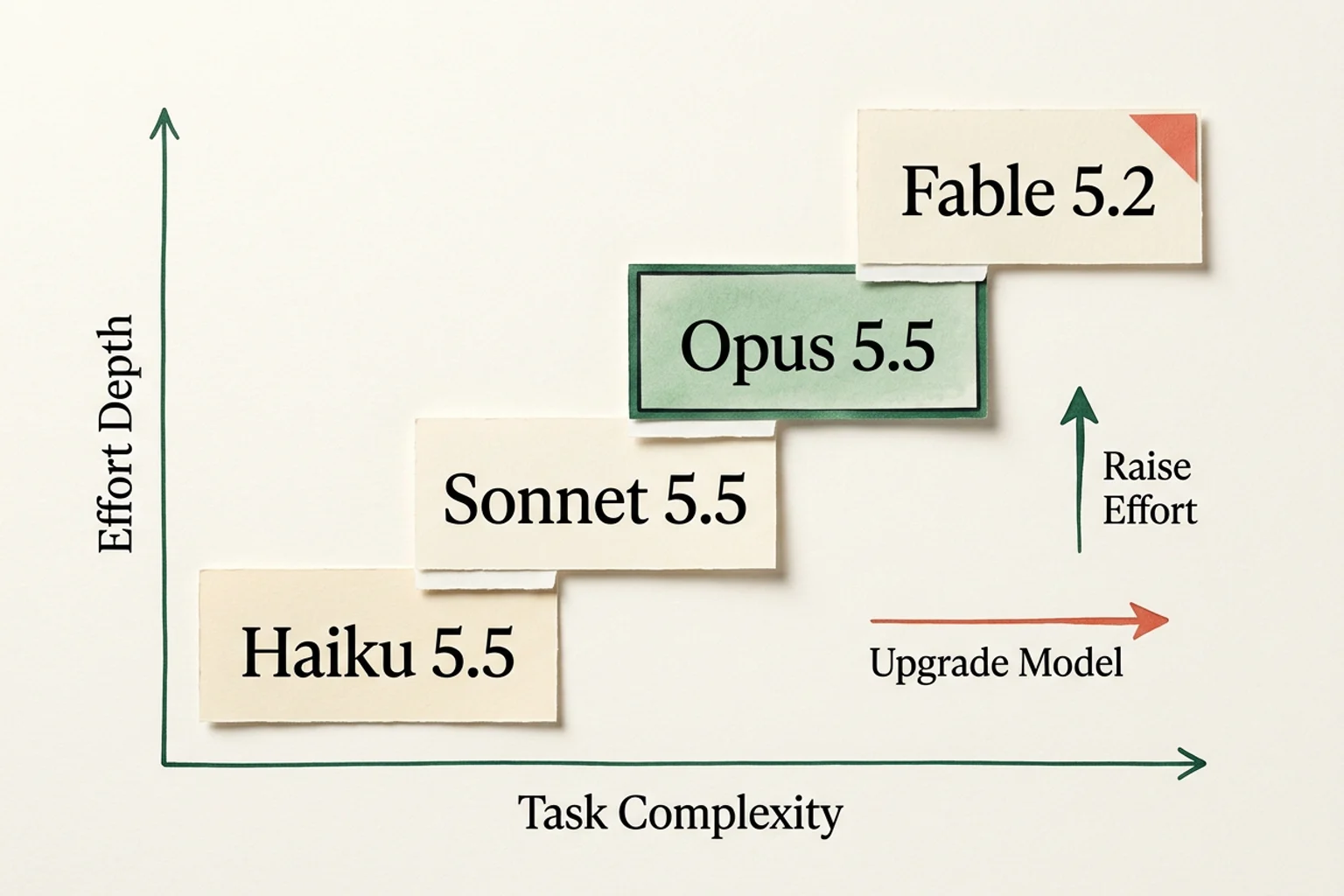
Model selection and effort tuning solve two different failure modes in Claude Code. Selecting a model swaps the frozen server-side weights that set the model's reasoning ceiling, whereas adjusting effort controls how many files Claude reads, how many tool calls it executes, and how thoroughly it verifies its own patch before replying. Anthropic's Claude Code model and effort guide summarizes the troubleshooting sequence in three steps:
Audit your context first: Vague requirements, stale CLAUDE.md instructions, missing files, or disconnected tools cause failures on every model tier.
Raise effort when Claude skipped work: If Claude missed a file, skipped running tests, or stopped halfway through a refactor, keep the same model and raise /effort.
Upgrade the model when Claude tried and still missed: If Claude had every relevant file, checked its work, and remained confidently wrong, step up along Haiku 5.5 -> Sonnet 5.5 -> Opus 5.5 -> Fable 5.2.
In September 2026, Anthropic published customer-billed SWE-bench Pro measurements (official list prices with a 5-minute prompt cache) in its cost and intelligence optimization guide. Placing model tiers and effort levels in one table shows why raw per-token price is a poor proxy for cost per finished fix:
Model and effort setting
Benchmark subset
Tasks solved
Cost per solved task (official list, 5m cache)
Practical takeaway
Claude Sonnet 5.5 (medium)
SWE-bench Pro (478 tasks)
80.3%
$0.07
Lowest cost, but drops ~7 points below Sonnet 5.5 high
Claude Sonnet 5.5 (high, API default)
SWE-bench Pro (478 tasks)
87.6%
$0.11
Strong budget baseline for clearly scoped edits
Claude Opus 5.5 (low)
SWE-bench Pro (478 tasks)
87.4%
$0.12
Twice the token rate, yet only ~7% more per solved task than Sonnet 5.5 high
Claude Opus 5.5 (medium, Claude Code default)
SWE-bench Pro (478 tasks)
92.8%
$0.22
Best single-model default: +5.4 points over low at a fraction of Fable spend
Claude Opus 5.5 (high)
SWE-bench Pro (478 tasks)
95.3%
$0.31
High-value escalation tier for multi-file refactors and tough bugs
Claude Opus 5.5 (xhigh)
SWE-bench Pro (463 offline-verifiable tasks)
96.5%
$0.75
Matches Fable 5.2 high (96.3%) for slightly over half the cost
Claude Fable 5.2 (low)
SWE-bench Pro (463 offline-verifiable tasks)
94.6%
$0.39
Outscores Fable 5.1 default high (92.4% / $1.17) at one-third the cost
Claude Fable 5.2 (high, API default)
SWE-bench Pro (463 offline-verifiable tasks)
96.3%
$1.39
Reserve for multi-hour autonomy and tail failures Opus 5.5 cannot crack
Match task ambiguity to the model tier first, then tune Effort Depth inside that tier before upgrading.
When your repository has reliable automated tests, Anthropic's low-then-high failure re-run policy beats any fixed effort setting on Claude Opus 5.5. Running all 478 SWE-bench Pro tasks at low effort (87.4% solved at $0.11 per task) and re-running only the 13% that fail tests at high effort reached roughly 97% total solve rate for about $0.17 per task—more than 40% cheaper than running everything at high (95.3% at $0.29 per task), including the cost of the failed first attempts. Two prerequisites apply: your test suite must reliably catch bad patches, and you must tolerate double wall-clock latency on the failing 13%.
Claude Code aliases, Prompt Cache resets, and the opusplan trap
Use aliases for fast interactive switching, but pin full model IDs in benchmarks, CI scripts, and incident logs because cloud providers do not resolve aliases to the same versions as the Anthropic API:
Alias
Resolution on Anthropic API
Operational caveat
default
Claude Opus 5.5 (Pro, Max, Ultra, Team, Enterprise, API)
Clears overrides back to account default; overridden by organization policy or ANTHROPIC_DEFAULT_MODEL
opus / best
Claude Opus 5.5
best maps to opus, not Fable 5.2
sonnet
Claude Sonnet 5.5
Resolves to Sonnet 4.5 or 4.6 on Amazon Bedrock and some cloud lines unless pinned via ANTHROPIC_DEFAULT_SONNET_MODEL
haiku
Claude Haiku 5.5
Resolves to Haiku 4.5 on several AWS and Google Cloud lines unless pinned via ANTHROPIC_DEFAULT_HAIKU_MODEL
fable
Claude Fable 5.2
Resolves to Fable 5 in Claude apps gateway sessions; use /model claude-fable-5-2 explicitly there
opusplan
Opus in Plan Mode, Sonnet in execution
Every plan-to-execute toggle switches models and invalidates the warm Prompt Cache
In long Claude Code sessions, Prompt Cache hit rate moves your monthly bill more than raw token price. Anthropic's production traffic shows a median 84% cache-read share across agent loops (94% or higher for top-decile loops), cutting SWE-bench Pro task cost by 3.1x to 3.3x and multi-turn research cost by 4.8x to 7.2x. Per the Claude Code prompt caching documentation, four rules keep that discount intact:
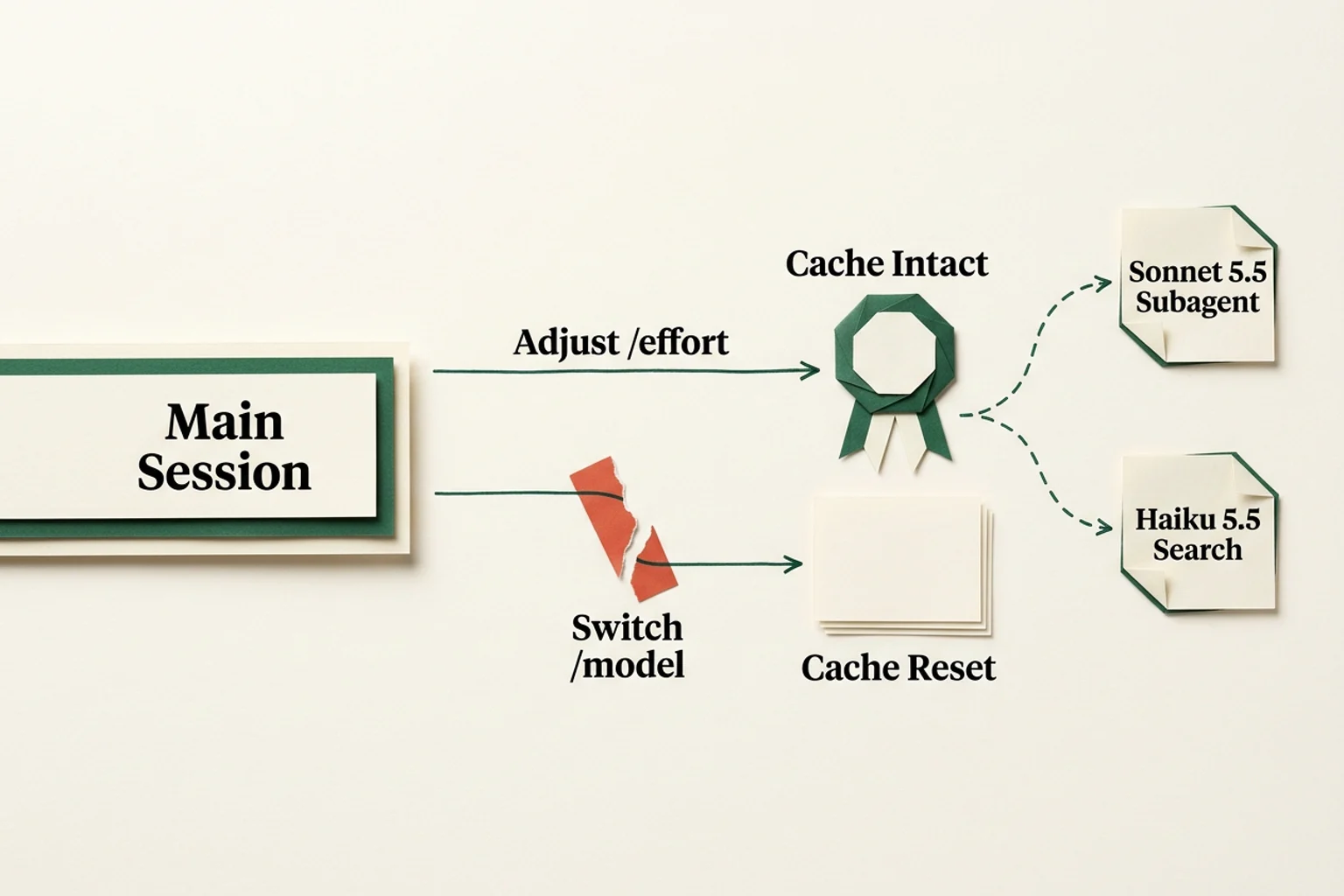
Mid-session /model switches break the entire warm cache: Each model maintains an isolated cache, so switching models forces the next turn to rewrite the full conversation prefix at 1.25x input price—equal to 25 cache reads on Opus 5.5 and Sonnet 5.5, or 50 cache reads on Fable 5.2.
Repeated opusplan toggles penalize long contexts: Because opusplan flips between Opus and Sonnet every time you enter or exit Plan Mode, using it in a 50K-token conversation repeatedly rebuilds both models' caches and often wipes out Sonnet's output-rate savings.
Adjusting /effort preserves the warm cache on Claude 5.x models: With an API key or Claude subscription, changing /effort mid-session on Claude Fable 5.1/5.2, Opus 5.5, Sonnet 5.5, and Haiku 5.5 keeps the cached prefix intact with no confirmation prompt (exceptions: Amazon Bedrock, Google Cloud Agent Platform, HIPAA workspaces, or CLAUDE_CODE_DISABLE_EXPERIMENTAL_BETAS).
Fast Mode (/fast) uses a separate cache and doubles token prices: Fast Mode boosts output speed up to 2.5x on Claude Fable 5.2 ($16 / $80 official) and Claude Opus 5.5 ($8 / $40 official) with identical model quality, so enable it at session start instead of toggling mid-thread. Teams still running Fast Mode on Claude Opus 4.8 must switch before its November 30, 2026 removal using our Claude Opus 4.8 Fast Mode to Opus 5.5 migration guide.
Run /usage inside Claude Code v2.1.251 or later to inspect the Prompt cache (main) hit ratio and last miss reason. Whenever your main session drops below 80% cache reads, check for mid-session /model switches, /fast toggles, or changes to non-deferred MCP tool definitions before downgrading your model.
A six-step model switching order and multi-agent routing setup
Switch models at clean task boundaries with /clear rather than every few turns so you keep prompt caches warm and avoid carrying stale context into a new tier:
Pick one clean starting tier: Start on claude-opus-5-5 (medium) when optimizing for first-pass reliability or running on BeatAPI's 50%-off pricing; start on claude-sonnet-5-5 when paying full official rates on tightly scoped tickets.
Pin read-only search subagents to Haiku 5.5: Keep file discovery, symbol lookups, and log summaries on claude-haiku-5-5 with prompts strictly below 100K tokens.
Start high-risk tickets directly on Opus 5.5: Open cross-service debugging, schema migrations, auth changes, and architecture work on claude-opus-5-5 from turn one.
Escalate with /effort before switching models: If Opus 5.5 skips a check or needs deeper verification, raise /effort to high in place without losing the warm cache.
Escalate to Fable 5.2 at a fresh boundary: When Opus 5.5 stalls even at high effort—or when starting a multi-hour autonomous refactor—run /clear and switch to /model fable.
Drop back to Sonnet 5.5 for mechanical finish work: Once architectural choices are locked and only boilerplate tests or repetitive call-site edits remain, start a clean session on claude-sonnet-5-5.
Multi-agent delegation: where subagents save 31% and where Advisor falls flat
Anthropic's multi-agent benchmarks show that adding a second model only beats single-model effort tuning when work exceeds one context window or fans out across independent files. On a 22-million-token Python codebase defect-search benchmark split across 201 parts:
Claude Opus 5.5 orchestrator + Claude Sonnet 5.5 subagents: Scored 0.831 F1 for $139—matching Claude Opus 5.5 alone (medium to high, 0.827–0.850 F1 at $200–$236) while cutting total spend by 31%.
Claude Opus 5.5 orchestrator + Claude Haiku 5.5 subagents: Lowered spend to $47, but dropped F1 sharply to 0.677; on an internal coding suite, adding Haiku 5.5 subagents saved 32% while losing roughly 4 percentage points of pass rate—roughly equivalent to lowering Opus 5.5 effort directly.
Advisor tool (executor consulting a frontier model on demand): On Anthropic's internal coding suite, pairing Opus 5.5 (high) with a Fable 5.1 advisor added only 1.7 points at 2.1x total cost, landing roughly on Opus 5.5's own effort curve while adding ~1,000 prompt tokens per turn for the advisor tool schema even when never consulted.
Tune /effort inside the main session to keep the prefix cache warm, and isolate lower-cost subagents via CLAUDE_CODE_SUBAGENT_MODEL.
Because subagents run in isolated conversations with their own caches, pinning CLAUDE_CODE_SUBAGENT_MODEL to claude-sonnet-5-5 cuts fan-out costs without disturbing your main Opus 5.5 prompt cache:
How to benchmark Claude Code models fairly on your own repository
Public leaderboards narrow your shortlist, but your own repository determines the exact cost-quality threshold. To run a fair comparison, freeze the Git commit, prompt text, tool permissions, and pass criteria across candidates, run each task two to three times to absorb agent variance, and never change both model and effort in the same test round—compare models at default effort first, then sweep effort on your winner.
Task type
Concrete sample task in your repo
Metrics to record
Routine feature edit
Add a validated request field and matching unit tests
First-pass rate, wall-clock time, human fix-up minutes
Subtle bug fix
Reproduce and fix a cross-module or async regression
Root-cause accuracy, retry count, test runs needed
Multi-package refactor
Change a shared interface signature across packages and pass build
Missed call sites, typecheck and build status
Pull request review
Review a PR with known edge-case defects
True bugs caught, false-positive count
Architecture and migration
Draft a reversible schema or API rollout plan
Missing constraints, rollback completeness
Scoped subagent search
Trace a call graph inside one subsystem and summarize
Answer accuracy, whether prompt stayed under 100K, latency
Record input tokens, cache reads, cache writes, output tokens, and human cleanup minutes side by side. A model with double the per-token price still wins if it saves 15 minutes of manual debugging, and a cheaper model wins whenever it clears the exact same automated check.
Running Claude 5.x and Messages-compatible models in Claude Code via BeatAPI
Claude Code speaks the Anthropic Messages wire protocol (POST /v1/messages), which BeatAPI serves directly with no translation proxy—cutting standard Claude 5.x input, output, and cache-write rates by 50% while preserving native prompt caching. Follow our Claude Code integration setup (or read our full pay-as-you-go Claude Code without a subscription guide) by merging these keys into ~/.claude/settings.json:
Avoid three common setup errors when routing through a gateway. First, set ANTHROPIC_BASE_URL to https://api.beatapi.io with no /v1 suffix, because Claude Code appends /v1/messages automatically. Second, ANTHROPIC_BASE_URL only changes where requests go—verify which IDs are active for your key via GET /v1/models rather than assuming every alias maps identically. Third, if you previously signed in to a claude.ai subscription and see an Auth conflict warning on startup, run /logout inside Claude Code to drop the session token and keep your API key; see our Claude Code privacy checklist for keeping credentials safely out of project files.
Non-Claude models on BeatAPI POST /v1/messages and their honest boundaries
In addition to Claude 5.x, BeatAPI's POST /v1/messages endpoint accepts several non-Claude coding and reasoning models under the same API key for ultra-low-cost scripting or cross-model verification:
Non-Claude model (BeatAPI model ID)
Context / max output
BeatAPI retail price (in / out / cache read per 1M)
General reasoning and low cache-read code generation
Keep protocol boundaries clear before routing non-Claude IDs into Claude Code. Anthropic builds Claude Code specifically for Claude models and does not support routing Claude Code to GPT or Gemini. While BeatAPI serves DeepSeek, GLM, Kimi, and Qwen on POST /v1/messages (reachable in Claude Code via ANTHROPIC_CUSTOM_MODEL_OPTION or an explicit ID), request-format compatibility does not guarantee Anthropic-specific adaptive thinking, Fast Mode, preserved-thinking prefix checks, or experimental anthropic-beta headers. Meanwhile, GPT models on BeatAPI run on OpenAI Chat Completions and Responses rather than /v1/messages, so run GPT models in Codex CLI or another OpenAI-native agent through BeatAPI integrations using the exact same BeatAPI key.
Frequently asked questions
What is the best model for Claude Code in 2026?
Claude Opus 5.5 (medium effort) is the best overall model for Claude Code in 2026 ($4 / $20 official, $2 / $10 on BeatAPI) and is Anthropic's built-in account default. Choose Claude Sonnet 5.5 ($2 / $10 official, $1 / $5 on BeatAPI) for clearly scoped daily edits when paying full official rates, Claude Fable 5.2 ($8 / $40 official, $4 / $20 on BeatAPI) for multi-hour autonomous runs and hard bugs that stall Opus 5.5, and Claude Haiku 5.5 ($0.10 / $0.50 up to 100K official, $0.05 / $0.25 on BeatAPI) for fast, narrow subagents.
Is Claude Opus 5.5 better than Claude Sonnet 5.5 for coding?
Claude Opus 5.5 outperforms Claude Sonnet 5.5 on ambiguous, multi-file debugging and architecture work, while Claude Sonnet 5.5 is faster and half the official per-token rate on straightforward edits. On Anthropic's 478-task SWE-bench Pro subset, Claude Opus 5.5 at low effort matched Sonnet 5.5 at high (87.4% vs 87.6%) for only 7% more per solved task ($0.12 vs $0.11), and on BeatAPI both models share a $0.10 per million cache-read rate so a 90%-cached Opus 5.5 session costs the same as an official cached Sonnet 5.5 session.
Do I need to upgrade Claude Code to use Claude 5.5 or Fable 5.2?
Yes. Claude Opus 5.5 requires Claude Code v2.1.280 or later, Claude Sonnet 5.5 requires v2.1.284 or later, Claude Haiku 5.5 requires v2.1.293 or later, and Claude Fable 5.2 requires v2.1.321 or later. Run claude update and re-open /model if any model is missing.
Should large repositories always use Claude Fable 5.2?
No. Claude Haiku 5.5, Sonnet 5.5, Opus 5.5, and Fable 5.2 all share a 1,000,000-token context window, so repository size alone does not justify paying $8 / $40 officially ($4 / $20 on BeatAPI). Give Opus 5.5 or Sonnet 5.5 focused context and reliable tests first, and switch to Claude Fable 5.2 only when Opus 5.5 still fails after raising effort.
Which model should Claude Code subagents use, and why can Haiku 5.5 get expensive?
Set CLAUDE_CODE_SUBAGENT_MODEL to Claude Sonnet 5.5 for implementation and review subagents (which cut total cost by 31% at matched accuracy in Anthropic's 22M-token Python defect-search test), and pin read-only file-search or log-triage subagents to Claude Haiku 5.5. Haiku 5.5 bills jump unexpectedly when a single prompt crosses 100,000 tokens—triggering a 5x long-context rate jump—or when hard tasks cause repeated failed retries.
Does raising effort make a model smarter, and what resets Claude Code's Prompt Cache?
Raising effort does not change a model's underlying weights; it increases how many files Claude reads, how many tool calls it runs, and how thoroughly it verifies its changes. Switching models mid-session with /model or toggling Plan Mode under opusplan invalidates the warm Prompt Cache and forces a 1.25x cache write, whereas adjusting /effort mid-session on Claude Fable 5.1/5.2, Opus 5.5, Sonnet 5.5, and Haiku 5.5 preserves the warm cache on API keys and Claude subscriptions.
Can Claude Code use GPT or Gemini models?
Anthropic builds Claude Code for Claude models and does not support routing Claude Code to GPT or Gemini. Use Codex CLI or another OpenAI-compatible coding agent for GPT models (all supported under one key on BeatAPI integrations). While BeatAPI accepts DeepSeek, GLM, Kimi, and Qwen on POST /v1/messages, non-Claude models do not guarantee Claude Code's Anthropic-specific adaptive thinking or Fast Mode behavior.
Three steps to dial in your Claude Code setup today
Stop guessing between models and verify your own baseline in one afternoon. First, pin your main session to claude-opus-5-5 at default medium effort, set CLAUDE_CODE_SUBAGENT_MODEL to claude-sonnet-5-5, and lock read-only search subagents to haiku under 100K input tokens. Second, finish two real pull requests and run /usage to confirm your Prompt cache (main) hit ratio stays above 80%, switching models only after /clear instead of mid-thread. Third, route Claude Code through BeatAPI Claude Code integration to cut Claude 5.x token rates by 50%, check live model tiers on BeatAPI pricing, or compare subscription caps against API spend in our Claude Max vs Ultra breakdown.