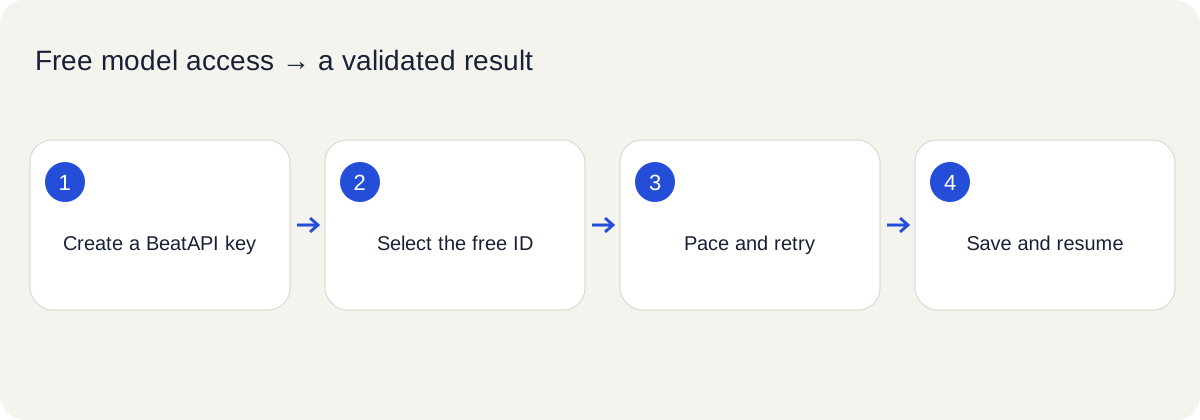
Where can I get a free DeepSeek API?
BeatAPI provides a free DeepSeek API through its DeepSeek V4.1 Flash route. It uses deepseek-v4.1-flash-free, with $0 input and output. The account limit is one successful request per minute before the first top-up and up to ten afterward. A small automation should therefore queue requests, wait after HTTP 429, and save each completed result before starting the next item.
- Create a BeatAPI key in the default
auto group and select the free model explicitly.
- Send one request at a time, with spacing appropriate to your account's free limit.
- Retry rate limits a bounded number of times; stop on an authentication or configuration error.
- Resume unfinished items instead of rerunning the whole batch.
- Keep paid fallback disabled unless you have deliberately budgeted for it.
Start with the DeepSeek V4.1 Flash API. The public gateway price book lists the explicit free model separately from the paid model. The gateway capability catalogue confirms its current routes and limits; the landing page may still show the paid model by default. Select the free ID in this guide explicitly, and recheck availability before depending on it. This guide focuses on a small, resumable text workflow. The broader OpenAI SDK migration guide covers changing an existing application.
Follow the connection and validation steps in order. On mobile, swipe horizontally to read the diagram.
Free DeepSeek API access: the exact configuration
| Question | BeatAPI route |
|---|
| Where do I get the key? | Dashboard → API keys, default auto group |
| Which model is free? | deepseek-v4.1-flash-free |
| OpenAI-compatible base URL | https://api.beatapi.io/v1 |
| Request formats | Responses or Chat Completions |
| Free input and output pricing | $0 |
| Initial frequency limit | One successful request per minute per account |
| After any top-up | Up to ten successful requests per minute; model remains free |
A free DeepSeek API is different from a free chat website, an open-weight download, free cached input, or a one-time credit grant. Those options do not automatically provide hosted, zero-priced input and output for your application. Match the key issuer, endpoint, model ID, and current terms before comparing offers.
For the free DeepSeek API in this guide, the distinctive question is whether a paced workload fits the allowance. The next sections show how to preserve progress, rather than treating free access as unlimited capacity.
Compare free DeepSeek API allowances before choosing
The same search can return three different offers. Check the exact model and the unit in which the allowance is measured:
| Route | Published allowance checked October 2, 2026 | What to compare |
|---|
| Cloudflare Workers AI | 10,000 Neurons daily | Its listed R1 distill is a different model; V4 Flash and Pro require a paid billing method |
| Hugging Face Inference Providers | $0.10 in monthly credits for free accounts, subject to change | A credit budget, rather than zero-priced inference; verify model availability separately |
| Fireworks | $1 starter credits | Initial trial funding; the pricing page does not promise a recurring refill |
| BeatAPI free DeepSeek API | $0 input and output on the explicit free Flash model | Account-wide frequency limits govern a paced workload; availability may change |
Choose a free DeepSeek API by workload, not just the word “free.” A daily compute allowance can suit experiments with a distill; a credit grant can fund a brief model evaluation. BeatAPI's route is worth evaluating when you specifically want Flash with zero-priced input and output and can tolerate a slow queue. Do not convert Neurons or dollars into guaranteed calls without a measured token budget.
Why free DeepSeek API automations keep restarting
A developer reported in the QwenPaw project that free DeepSeek requests were hitting rate limits during multi-step jobs, causing repeated restarts. That report concerns their configured service, rather than a test of BeatAPI, but the workflow question is useful: how should an automation preserve progress when model access pauses?
HTTP 429 means the current request cannot proceed under the service's rate policy. It does not mean every previous result is invalid. Restarting the entire workflow repeats successful work and adds more requests precisely when capacity is constrained.
Split the job into individually identifiable units. For a batch of release notes, use one record per note, with a stable input ID, status, model ID, result, and request identifier if supplied. Mark a record complete only after validating and saving its answer.
What fits the free DeepSeek API rate limits?
| Task | Free route fit | Application design |
|---|
| Try one prompt or summarize one note | Useful starting point | One request; inspect the answer |
| Process a small backlog without a deadline | Reasonable experiment | Paced queue and saved progress |
| Interactive assistant with many simultaneous users | Poor fit at the initial limit | Measure demand and choose an appropriate service tier |
| Long autonomous loop with repeated tool calls | Requires careful evaluation | Count calls per task and plan pause/resume behavior |
Ten successful calls require roughly ten minutes of capacity at one call per minute, or roughly one minute at ten calls per minute. These are planning estimates, not delivery promises: latency, retries, other workers on the same account, and changing availability add time.
The limit is account-wide. Starting five workers with different keys does not create five independent free allowances. A scheduler must coordinate all callers that share the account.
Test the free DeepSeek API before building the queue
Set BEATAPI_API_KEY in your server environment, then run:
curl --fail-with-body https://api.beatapi.io/v1/chat/completions \
  -H "Authorization: Bearer $BEATAPI_API_KEY" \
  -H "Content-Type: application/json" \
  -d '{
    "model": "deepseek-v4.1-flash-free",
    "messages": [{
      "role": "user",
      "content": "Summarize this release note in one sentence: We added CSV export and fixed duplicate rows in downloads."
    }],
    "max_tokens": 128
  }'
This is a request example, not a published live benchmark. Inspect the HTTP status and returned content in your own environment. A 200 response alone does not prove the summary is correct. Keep the key out of browser code and workflow exports.
The live gateway capability catalogue also lists POST /v1/responses for the free route. Choose one format for your experiment; do not infer that every format available on a paid model is also available on its free route. See the DeepSeek model documentation.
Queue free DeepSeek API calls and resume unfinished work
Use this application-side algorithm as a starting point:
Read the next unfinished item from durable storage.
Wait until the shared account scheduler grants a request slot.
Call the explicitly configured free model.
If 200: validate the answer, save it, and mark this item complete.
If 429: honor Retry-After when present; otherwise back off.
Retry the same item at most three times, then leave it pending.
If a permanent request/authentication error occurs: stop and fix it.
After a timeout: record the uncertainty before deciding to retry.
For one worker on an account with no top-up, spacing requests at least 60 seconds apart is a conservative starting policy. Slightly more spacing can absorb clock and scheduling differences. It is not a guarantee against 429. After a top-up, the documented upper limit is ten successful calls per minute; keep coordination account-wide.
In n8n, the HTTP Request node exposes batch size and batch interval controls. One item per batch and a suitable interval can pace a single execution. Overlapping executions still need shared coordination; a node setting does not create an account-wide scheduler.
Configure a maximum waiting budget too. If the job can wait five minutes, let it remain pending after that budget rather than sleeping indefinitely or discarding its completed records. Save progress in your own storage; BeatAPI does not provide your application's queue.
Free DeepSeek API example: twelve release-note summaries
Assume twelve notes, each processed independently. The first four summaries have been validated and saved, then the fifth request receives 429.
The correct recovery starts with note five. Keep notes one through four complete; apply the service's waiting guidance and retry note five within your retry budget. If recovery is exhausted, retain notes five through twelve as unfinished. The next run reads those records and continues.
At the initial one-per-minute limit, budget roughly twelve minutes of request capacity for the full run, plus generation and recovery time. This workload is a useful free experiment if it can wait. A five-second response deadline for all twelve notes calls for another design.
Track three outcomes separately: request success, answer acceptance, and record completion. An empty or unusable answer should not become a completed note merely because the request succeeded.
Keep free DeepSeek API calls separate from paid fallback
| Mistake | Fix |
|---|
Send deepseek-v4.1-flash while expecting free usage | Pin deepseek-v4.1-flash-free in the request configuration |
| Retry 429 immediately in a tight loop | Wait and enforce both attempt and elapsed-time budgets |
| Restart all twelve items after one failure | Persist completion per input ID |
| Add more API keys to increase capacity | Coordinate the account's callers |
| Automatically switch to a paid model when blocked | Make paid fallback an explicit, budgeted policy |
Adding balance raises the free route's documented frequency allowance; it does not automatically change the request's model. Paid calls require an explicit switch to deepseek-v4.1-flash and are billed separately. Keep that decision visible in configuration.
Free DeepSeek API FAQ
Is free DeepSeek V4.1 Flash unlimited?
No. Free token pricing and request frequency are different properties. The route also depends on continued availability.
Does the free DeepSeek API need a top-up?
The free route is intended to work without an initial top-up. Use a BeatAPI key in the default auto group and the exact free model ID.
Does HTTP 429 mean I need to buy credits?
It indicates a rate-policy block. Inspect the response and current account conditions before deciding what to change. Immediate payment is not a substitute for a scheduler.
Can a free DeepSeek API run a scheduled task?
Small tasks that tolerate waiting can fit the route. Your scheduling, hosting, and storage may have their own costs, and the free route may change.
Will a timeout retry duplicate a request?
Possibly. The server may have completed work before the client timed out. Do not assume a universal idempotency guarantee; preserve input IDs and avoid repeating downstream writes.
Where can I check free DeepSeek API access and limits?
Use the DeepSeek V4.1 Flash API, the public price book, and its linked documentation. Start with one small request, then decide whether the queue's waiting time fits your task.