Kling Image 4.0 vs MiniMax H3-Image: Quality, Text, References, and Price
Compare Kling Image 4.0 and MiniMax H3-Image on 8K vs 4K output, in-image typography, 16-reference editing, open weights, Elo benchmarks, and API cost.
Kling Image 4.0 is Kuaishou Kling AI's closed-weight still-image model released on November 17, 2026, built around native 8K resolution, up to 2,000 characters of multilingual in-image typography, and dedicated image-set and long-page layouts. MiniMax H3-Image is MiniMax's open-weight still-image model released on November 11, 2026, built on a 33.1B-parameter 6-step distilled architecture for fast 4K generation, up to 16 reference images, and token-based pricing. Kling Image 4.0 and MiniMax H3-Image generate and edit still images only; Kling 4.0 and MiniMax H3 are separate video models with different endpoints and pricing.
Model selection comes down to the asset you need to ship. Start with Kling Image 4.0 when a deliverable requires a native 8K hero file, dense poster typography, a visually consistent multi-image carousel, or a single-call long product page. Start with MiniMax H3-Image when a workflow combines 11 to 16 separate reference assets in one scene, needs exact pixel dimensions without cropping, requires self-hosted open weights, or runs high-volume 4K drafts at a lower unit cost.
Quick answer
Resolution and framing controls differ sharply: Kling Image 4.0 delivers native 2K, 4K, and 8K standard stills (dedicated long pages cap at 2K) using preset aspect ratios; MiniMax H3-Image caps at 4K (up to 20 megapixels) but accepts exact WIDTHxHEIGHT pixel dimensions such as 3000x1200.
In-image typography favors Kling Image 4.0: Kling Image 4.0 handles up to 2,000 characters, 70+ commercially licensed preset fonts, and seven languages; MiniMax H3-Image renders large headlines cleanly but loses legibility on small secondary text and distant faces.
Multi-reference editing splits by workflow: MiniMax H3-Image accepts up to 16 reference images in one request for multi-object scenes; Kling Image 4.0 accepts up to 10 combined reference images and named multi-view elements (2 to 4 angles per subject).
The benchmark gap narrows sharply on editing: On Artificial Analysis snapshots from November 21, 2026, Kling Image 4.0 leads MiniMax H3-Image by 115 Elo in text-to-image (1181 vs 1066), while the gap shrinks to 47 Elo in image editing (1183 vs 1136), where MiniMax H3-Image ranks #1 among open-weight models on both boards.
Core Specs: Kling Image 4.0 vs MiniMax H3-Image
Kling Image 4.0 is engineered for design-ready deliverables with high pixel ceilings and rich layouts, whereas MiniMax H3-Image is engineered for multi-reference photorealism, fast 4K iteration, and deployment flexibility. The table below compares Kling Image 4.0 and MiniMax H3-Image side by side:
Spec
Kling Image 4.0
MiniMax H3-Image
Creator & Release Date
Kuaishou Kling AI (November 17, 2026)
MiniMax (November 11, 2026)
Architecture & Weights
Native unified understanding and generation autoregressive model; closed hosted API
33.1B H3-derived DiT (audio removed, Qwen3-VL text encoder, 6-step CFG-free distillation); open weights under Community License
Resolution & Size Control
Native 2K, 4K, and 8K standard stills; 9 preset aspect ratios, no exact pixel size
1K, 2K, and 4K (up to 20 MP); supports exact WIDTHxHEIGHT (up to 3:1 aspect ratio)
In-Image Text & Layout
Up to 2,000 characters, 15,000-token prompts, 70+ commercial fonts, 7 languages (EN, ZH-Hans, ZH-Hant, JA, KO, ES, PT)
Strong large headlines and neon signs; no font library or character ceiling claimed; small text degrades
Reference Inputs
Up to 10 combined reference images and named multi-view elements (2–4 views each); JPEG/PNG inputs
Up to 16 reference images per request; PNG, JPEG, or WebP inputs
Standout Extras
1–9 variations per task, 2–10 consistent image sets (series), 1K/2K e-commerce and webpage long images, 110+ color presets
Downloadable weights for local inference; hosted Standard and Highspeed lines; SSE per-image streaming on native API
Pricing Model
Fixed per-image price by resolution tier plus a fixed fee per reference item
Token-based billing across text input, reference-image input, and image output
Key Limitations
No transparent PNGs, no exact pixel dimensions; tends to add unrequested margin text in posters
No 8K, no mask-based inpainting, no transparent PNGs; Community License restricts US/EU/UK/KR use and third-party hosting
In daily production, dimension controls and reference formats separate Kling Image 4.0 and MiniMax H3-Image immediately. When a storefront banner requires an exact 3000x1200 pixel frame or catalog assets already live in WebP, MiniMax H3-Image avoids format conversion and post-generation cropping. When a team needs to lock one physical product across multiple angles as a reusable @Bottle element and generate several framing options together, Kling Image 4.0's named-element design fits better.
Resolution and Speed: Native 8K vs Fast 4K
Kling Image 4.0 pushes standard single-image detail up to native 8K for print and heavy cropping, while MiniMax H3-Image uses 6-step distillation to make 4K generation fast enough for routine creative iteration.
One resolution limit on Kling Image 4.0 catches buyers early: in Kling AI's Kling Image 4.0 release, native 8K output applies only to standard stills and image sets, whereas Kling Image 4.0's dedicated e-commerce and webpage long-image modes cap at 2K. For mobile product thumbnails or standard web cards, paying roughly twice as much for 8K rarely changes what shoppers see; reserve 8K for large-format print, fine fabric and leather textures, or master shots planned for multiple close-up crops. For a full mode-by-mode breakdown, see our Kling Image 4.0 overview.
MiniMax's MiniMax H3-Image release reports 4096 × 4096 (16.78 MP) generation in under 10 seconds, placing MiniMax H3-Image Standard at 1.5–2× and Highspeed at 3–4× the speed of mainstream image models. Real-world queue times still vary with traffic, so teams should measure end-to-end download times rather than treating 10 seconds as a fixed SLA. Combining 6-step distilled speed with exact pixel sizing (655,360 to 20,000,000 pixels, never rounded) makes MiniMax H3-Image efficient for fixed-dimension ad placements. For native API parameters and local SGLang workflow details, see our MiniMax H3-Image overview.
In-Image Text and Layout: Posters vs Product Graphics
Whenever an image must carry headlines, structured copy blocks, and clean visual hierarchy in one render, Kling Image 4.0 delivers markedly stronger results than MiniMax H3-Image.
Kling Image 4.0's unified autoregressive architecture accepts prompts up to 15,000 tokens, renders up to 2,000 characters in a single frame, and includes 70+ commercially licensed fonts plus 110+ color grading presets across seven languages. EachLabs tested Kling Image 4.0 on November 18, 2026 with a 2K Swiss-style jazz concert poster: Kling Image 4.0 spelled every requested headline and venue line accurately with clean grid alignment in roughly 60 seconds. EachLabs's poster test also exposed a recurring quirk: Kling Image 4.0 invented extra margin text—series numbers, subtitles, and footer lines—that never appeared in the brief. For commercial posters, explicitly add "no other text besides the lines above" in the prompt, and still set regulated fine print, prices, and ingredient lists manually in a design editor.
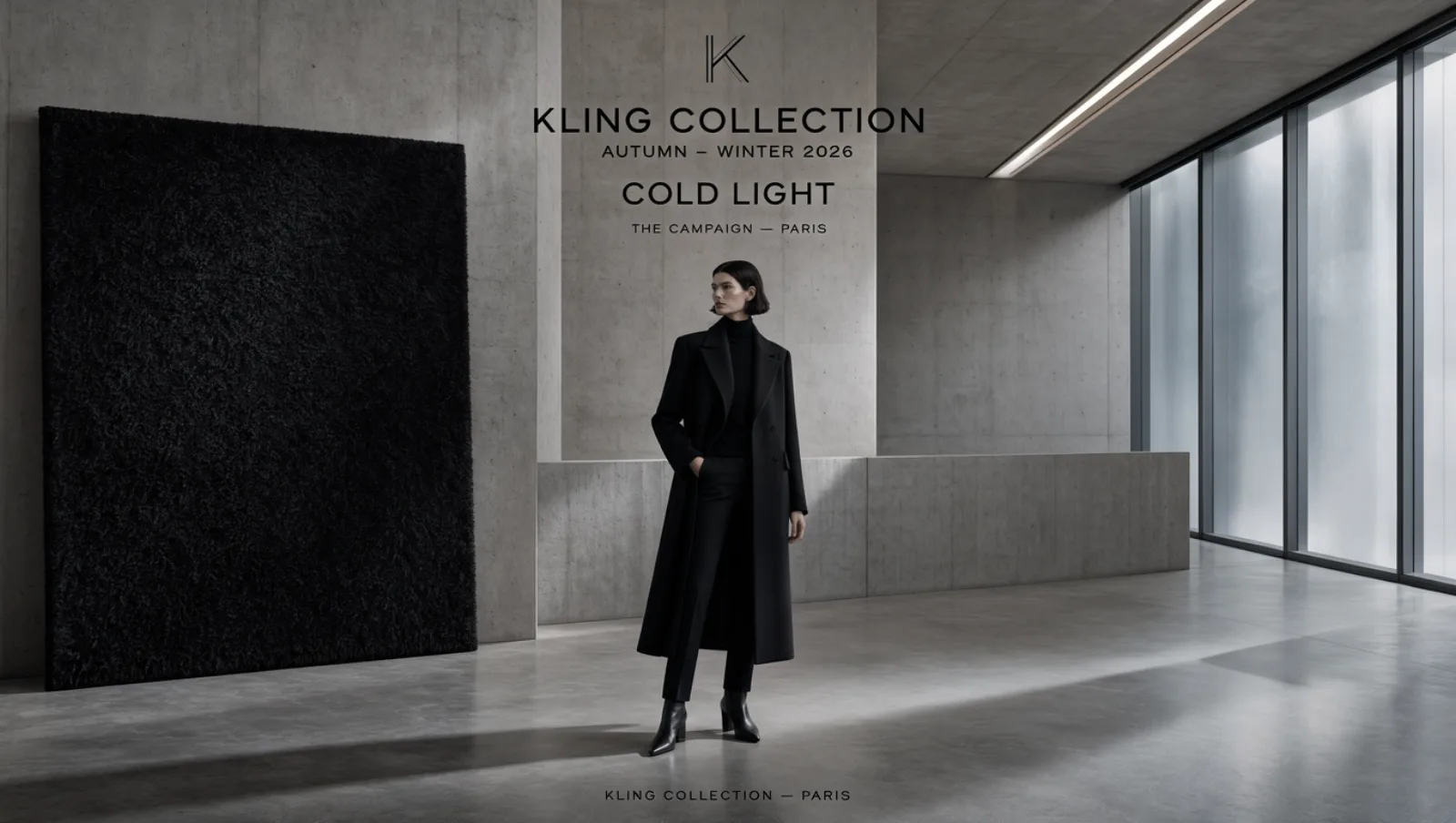
Kling Image 4.0 campaign still pairing editorial photography with structured English typography. Official Kling AI example, not a BeatAPI test.
MiniMax H3-Image splits cleanly between strong large text and fragile small print. MindStudio benchmarked MiniMax H3-Image and found that large neon signs, poster headlines, and handwritten city names on a five-fingered palm rendered cleanly and legibly, whereas smaller secondary poster lines and background crowd faces blurred or garbled. MiniMax H3-Image works well for photography paired with one bold headline, whereas multi-block graphic copy belongs on Kling Image 4.0.
Multi-Reference Composition and Editing: Holding Subject Identity
Kling Image 4.0 and MiniMax H3-Image both support reference-driven background swaps, styling changes, and multi-object scenes, but MiniMax H3-Image handles larger pools of separate assets while Kling Image 4.0 excels at locking one subject from multiple angles.
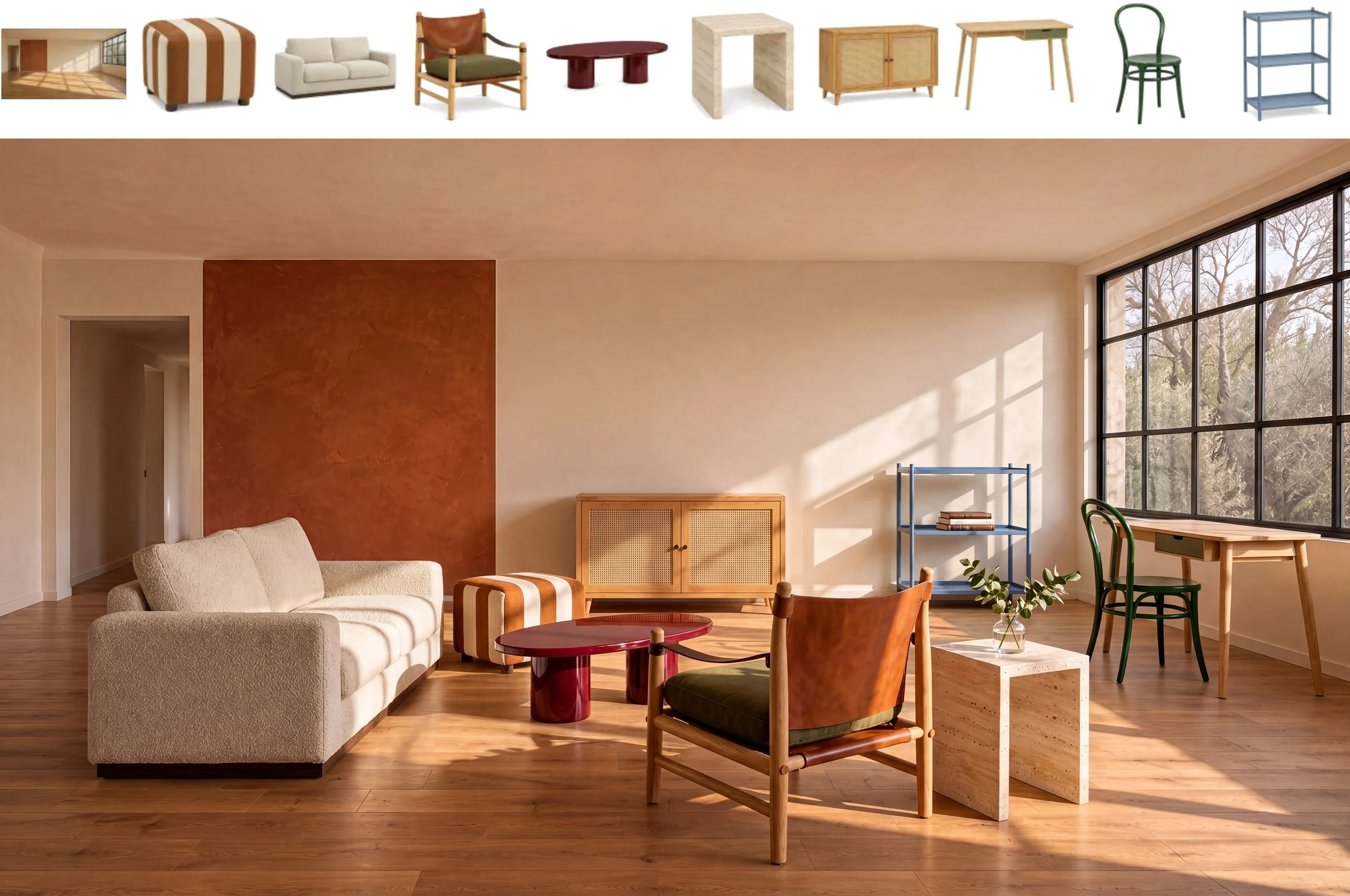
MiniMax H3-Image handles text-to-image and editing inside a single checkpoint and accepts up to 16 reference images per call. An interior designer combining one empty room photo with 12 separate furniture photos can submit all 13 assets in one MiniMax H3-Image request, whereas Kling Image 4.0 caps standard inputs at 10 items. MiniMax's 10-reference living-room sample and MindStudio's edit tests both show solid perspective alignment, lighting continuity, and facial-identity retention. Two hard API gaps remain: MiniMax H3-Image does not support mask-based inpainting and does not produce transparent PNGs (setting output_format: "png" changes only the file container, not alpha transparency).
MiniMax H3-Image combining an empty room and nine separate furniture items into one coherent living room. Official MiniMax example, not a BeatAPI test.
Kling Image 4.0 accepts up to 10 combined reference items, addressed directly in prompts via @image_1, @image_2, or named multi-view elements (@Bottle) bundling 2 to 4 angles of one subject. In EachLabs's product-shot run, prompting Kling Image 4.0 for a terracotta ceramic coffee dripper from text alone drifted into a conical cup shape. Always anchor physical SKUs with real product photos as @image_1 and check Kling Image 4.0 prompts for tested reference-binding patterns.
Sets, Long Pages, and Open Weights: Each Model's Unique Edge
Beyond single stills, Kling Image 4.0 and MiniMax H3-Image diverge into different specialty workflows: Kling Image 4.0 expands into finished design deliverables, while MiniMax H3-Image expands into open-weight self-hosting.
On Kling AI's direct platform, Kling Image 4.0 offers two specialized modes MiniMax H3-Image does not match. Series mode generates 2 to 10 visually coherent standalone files from one prompt—EachLabs ran a 4-frame 2720 × 1536 storyboard (about four minutes total) in which Kling Image 4.0 held the same silver-haired woman and yellow raincoat steady from a rainy night bus stop to a coastal sunrise, with only one unrequested Chinese bus-stop sign where the prompt omitted signage language. Long Image mode turns 1 to 3 product photos or a webpage brief into a single 1K or 2K vertical layout for e-commerce detail pages or web concepts; EachLabs's test showed Kling Image 4.0 Long Image mode can insert extra sections (returning six tea products when asked for three columns) and outputs a flat bitmap rather than editable web code.
MiniMax H3-Image stands out as an open-weight 4K model that teams can run locally via SGLang, vLLM-Omni, Diffusers, or ComfyUI when strict data residency or custom pipelines matter. Open weights are not free infrastructure: full local deployment of MiniMax H3-Image requires downloading 68.65 GB for the base weights plus 66.7 GB for the H3 text encoder (135.35 GB total), plus an optional 17.9 GBMiniMax-H3-Image-PE prompt expander to match cloud prompt enhancement, and runs near 48 GB VRAM at full quality in ComfyUI. Legal terms require careful review as well: the MiniMax H3-Image Community License excludes the EU, UK, South Korea, and United States from the default territory grant and requires separate written permission above $1 million in annual revenue or for any third-party hosted API service regardless of revenue.
Benchmarks and Real-World Weak Spots
Public blind leaderboards help prioritize which image model to test first, but a higher Elo score never guarantees accurate product labels or compliant e-commerce photography.
As of November 21, 2026, Artificial Analysis's AA-Image-T2I v2.1 leaderboard ranks Kling Image 4.0 at 1181 ± 13 Elo (#7 overall across 5,626 comparisons), 115 points ahead of MiniMax H3-Image Standard at 1066 ± 14 Elo (#27 across 3,326 comparisons) and MiniMax H3-Image Highspeed at 1070 ± 14 Elo (#26 across 3,439 comparisons). On Artificial Analysis's separate AA-Image-Editing v2.1 leaderboard, Kling Image 4.0 scores 1183 ± 13 Elo (#6) while MiniMax H3-Image climbs to 1136 ± 16 Elo (#14), narrowing the editing gap to 47 points—with MiniMax H3-Image holding the #1 open-weight rank on both Artificial Analysis boards (as well as #1 open-weight on LMArena Multi-Image Edit at 1365 ± 8 on November 12, 2026).
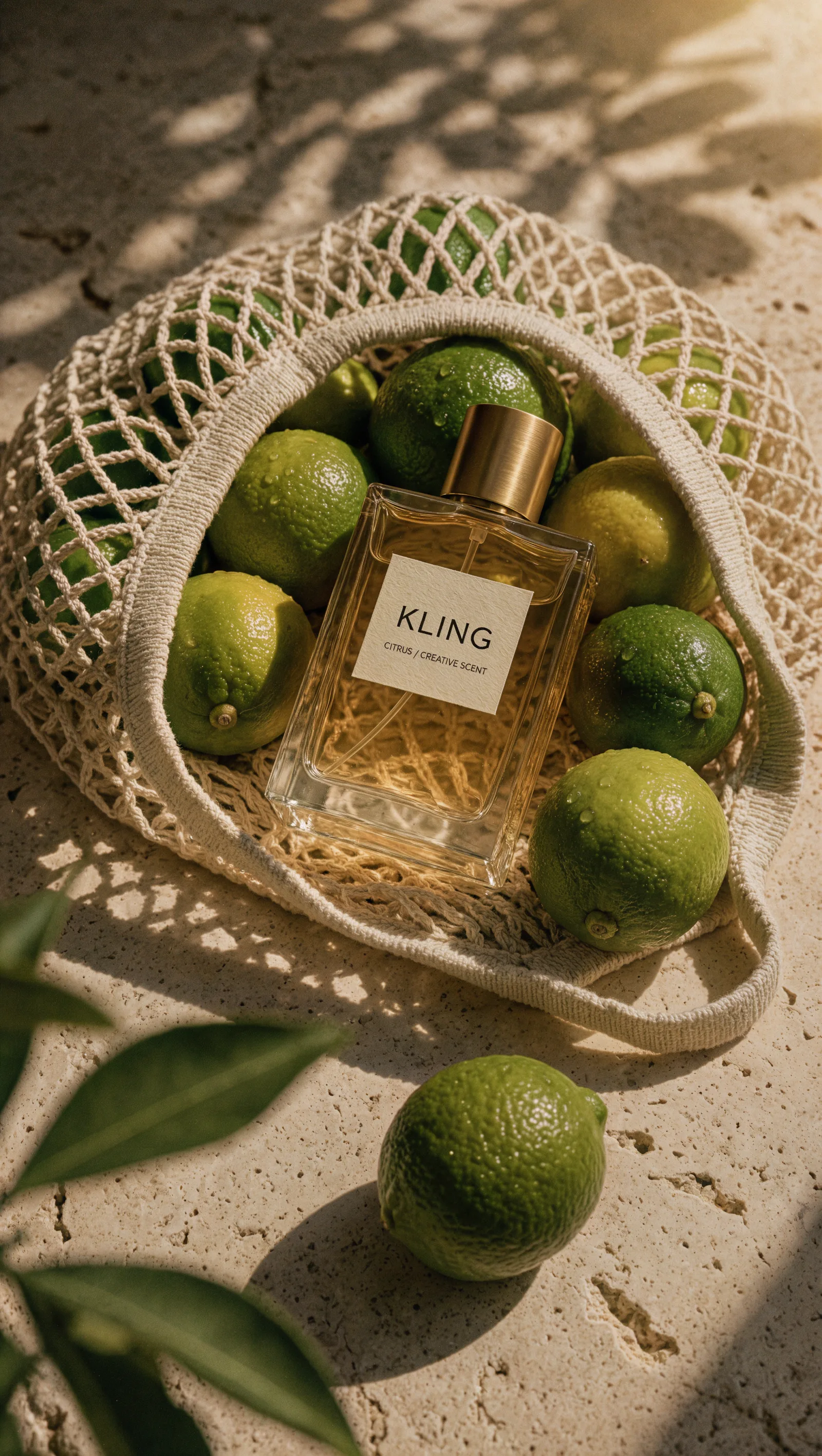
Artificial Analysis's paired text-to-image and editing boards point to a practical split: Kling Image 4.0 holds a wide visual lead when generating concepts from scratch, while MiniMax H3-Image closes much of that gap once reference photos anchor the generation. Inspect vendor samples for defect risk rather than overall polish—examine label crispness and glass reflections in Kling Image 4.0's perfume and lime sample, and check object silhouette distortion under occlusion in MiniMax H3-Image's furniture scene. Before publishing marketplace listings, enforce strict fidelity checks matching Amazon product image requirements: a studio-lit image that alters a bottle cap or misspells a brand label still fails marketplace approval.
Teams managing multiple creative lines should also evaluate generation speed, commercial rights, and asset provenance alongside visual quality across AI image generator models, while verifying final commercial permissions directly against Kling AI's current terms of service and MiniMax's Community License.
Pricing: Official Rates, Real Batch Math, and API Access
Kling Image 4.0 charges a predictable fixed price per image tier plus a small reference fee, while MiniMax H3-Image bills by actual text and image tokens. On bare 4K text-to-image renders, MiniMax H3-Image Standard typically costs 30% to 45% less per render than Kling Image 4.0—until rejection rates enter the math.
On direct vendor APIs, Kling AI image pricing lists standard stills and image sets at $0.063 (2K), $0.094 (4K), and $0.157 (8K) per image plus $0.003 per reference item, with dedicated webpage long images at $0.549 (1K) / $0.596 (2K) and e-commerce detail pages between $0.235 and $0.862 depending on length. MiniMax API pricing bills MiniMax H3-Image Standard at $2.30 text input, $1.50 image input, and $3.80 image output per million tokens (example 4K text-to-image cost: $0.06879; 3-reference 4K edit: $0.07914), while MiniMax H3-Image Highspeed doubles image input and output rates to $3.00 / $7.60 (example 4K render: $0.13001). MiniMax's launch-week 50% discount on 4K+ renders ended on November 17, 2026 at 8:00 AM PT, so current budgets should use standard list rates.
Output Tier
Kling Image 4.0 (Official / BeatAPI)
MiniMax H3-Image Standard (Official Example / BeatAPI Estimate)
MiniMax H3-Image Highspeed (Official Example / BeatAPI Estimate)
1K
Not offered
~$0.02179 / $0.015725
~$0.03529 / $0.026621
2K
$0.063 / $0.0593
~$0.02333 / $0.015725
~$0.03622 / $0.026621
4K
$0.094 / $0.0893
~$0.06879 / $0.048411
~$0.13001 / $0.091993
8K
$0.157 / $0.1486
Not offered
Not offered
Budget by cost per accepted image (total generation + reference + retry spend ÷ approved outputs) rather than sticker price alone. For 100 no-reference 4K drafts at current BeatAPI pricing, Kling Image 4.0 costs $8.93 flat while MiniMax H3-Image Standard estimates around $4.84. If a text-heavy brief yields 90 usable images from Kling Image 4.0 (~$0.099 per accepted asset), MiniMax H3-Image Standard must deliver at least 49 usable images to beat Kling Image 4.0 on effective generation cost. Multi-variant reference batches also narrow the gap: generating four 2K variations in one Kling Image 4.0 task bills the reference fee once rather than four times.
For engineering integration, teams that want to test and route both Kling Image 4.0 and MiniMax H3-Image without managing separate vendor accounts can call both through BeatAPI's unified POST /v1/images/tasks endpoint (roughly 5% below Kling AI list rates with $0.0026 per reference item, 30% below MiniMax token rates, and automatic full refunds on failed tasks; third-party aggregators such as APIMart price under their own account tiers). Teams that prefer exposing repeatable brand-canvas pipelines to business apps rather than wiring raw model endpoints operate one layer higher—for example, Sprello Workflow API wraps visual workflows behind callable POST /v1/workflows/{workflowId}/run endpoints. At every integration layer, keep API keys in server environment variables or a secrets manager, never in client bundles or Git commits.
Frequently Asked Questions
What if one product needs both a native 8K hero shot and 13 reference assets?
Kling Image 4.0 caps standard inputs at 10 combined references and elements, while MiniMax H3-Image accepts 16 references but tops out at 4K. If native 8K is non-negotiable, merge multiple angles of the same subject into one Kling Image 4.0 named element or trim secondary references down to 10 items. If all 13 assets must stay separate, deliver and approve the 4K master in MiniMax H3-Image rather than mislabeling a post-upscaled file as native 8K.
Should one model handle hero images, carousels, and long detail pages?
No—splitting tasks by deliverable usually lowers total spend. Use Kling Image 4.0 for typography-heavy hero posters or 8K crops, MiniMax H3-Image Standard for multi-reference scenes and high-volume 4K exploration, and Kling AI's direct series and long-image modes specifically when a team needs coordinated carousels or full vertical page layouts.
Can either model output transparent PNGs or run mask-based inpainting?
Neither Kling Image 4.0 nor MiniMax H3-Image outputs an alpha transparency channel through standard API endpoints, and MiniMax H3-Image does not accept inpainting masks to restrict pixel edits. Pair Kling Image 4.0 or MiniMax H3-Image with a dedicated background-removal or mask-editing step whenever transparent assets or pixel-locked retouching are required.
How to Decide Quickly: Test One Hard Product Image
Skip text-free landscape demos when committing a production budget. Pick one real product photo with tricky packaging text, reflective materials, or fine accessories, and run the exact same "keep the product unchanged, replace only the background" prompt at 4K on both Kling Image 4.0 and MiniMax H3-Image. Count how many outputs pass with zero label typos and zero shape drift, add retouching minutes to the settled bill, and divide by approved images—that single 4K product-edit test gives your team the real per-approved-image split between Kling Image 4.0 and MiniMax H3-Image.