GLM-5.4 is Z.ai's flagship coding and multimodal reasoning model, and the first GLM model built on a Loop Transformer. GLM-5.4 takes the already pre-trained, roughly 750B-parameter GLM-5 base and runs 28 of its layers twice with shared weights, and it adds native image input that the text-only GLM-5.3 flagship lacked. Z.ai opened GLM-5.4 to all GLM Coding Plan subscribers on the evening of November 22, 2026 PT, alongside ZCode and Z.ai Chat. A pay-as-you-go API, open weights and an official benchmark card for the full model have not been released.
Our read: GLM-5.4 is a slow model that is willing to redo its work. Z.ai itself warns that GLM-5.4 tends to fall into long "marathon thinking" loops, and day-one tests confirm it: at max effort, a single-file SVG animation commonly took 19 to 35 minutes, and one run used about 4.58 million tokens. GLM-5.4 suits a multi-step engineering task with a clear acceptance check that you can hand off and leave. For quick interactive edits, drop GLM-5.4 to low or use a faster model. Teams that need a metered API today can call GLM 5.3 (text) or GLM 5.3 Flash (multimodal) on BeatAPI.
Quick answer
Where GLM-5.4 runs: GLM-5.4 is available in the GLM Coding Plan, ZCode and Z.ai Chat. The model name is glm-5.4[1m] in Claude Code and glm-5.4 in other tools. Z.ai says API access follows a safety evaluation and open weights follow safety hardening, with no dates for either.
What changed in the architecture: GLM-5.4 loops layers 27–54 of the GLM-5 base twice and controls cost with per-token gates, a 128-token sliding-window KV cache for the second pass and reused sparse-attention indices. Z.ai reports up to 200 tokens/s off-peak and 70–80 tokens/s at peak.
How GLM-5.4 performs: The independent KingBench 4 suite scores GLM-5.4 at 33.2 out of 60 at max, 5.7 points above GLM-5.3 but below Claude Fable 5.2, Gemini 4 Neon, GPT-6.2 Sol and Claude Opus 5.5. Day-one users report long runs driven by repeated visual self-checks.
What the quota boost means: Z.ai set GLM-5.4's Coding Plan credit multipliers at two-thirds of GLM-5.3's, so the same credits buy 50% more tokens on V2, V3 and Team plans. Legacy V1 plans, which have no weekly cap, are not included.
What is available and what is not
As of November 23, 2026, GLM-5.4's components stand as follows.
Component
Status
Source or limit
Positioning
Z.ai's first Loop Transformer flagship, aimed at "Generalized Coding" and long-chain reasoning
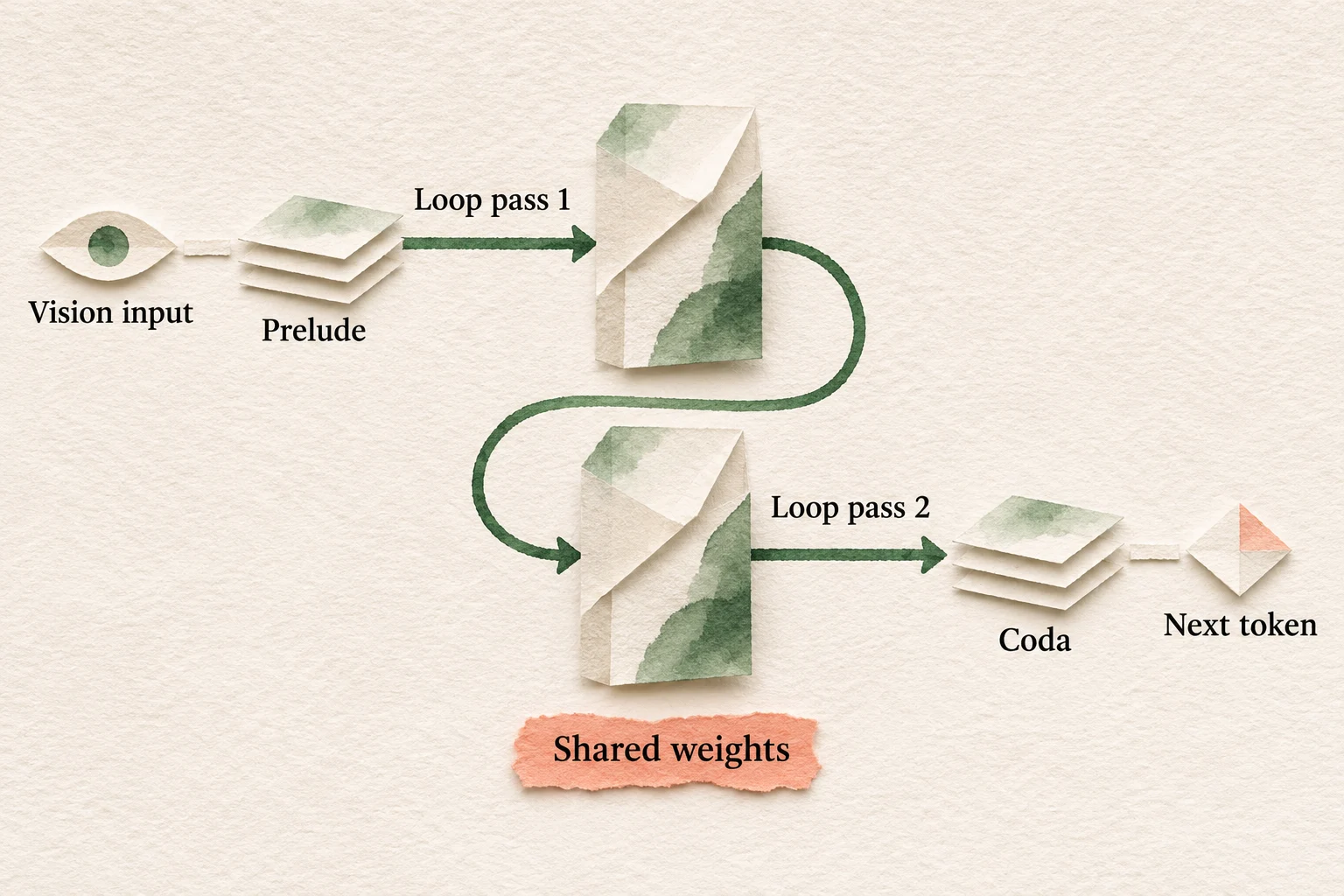
GLM-5.4 turns the pre-trained GLM-5 base into three stages: a single-pass front, a middle block that runs twice, and a single-pass back. Z.ai's argument is that memory-heavy tasks benefit from more parameters, while long causal chains such as large software projects, security work, 3D modeling and physical control benefit from more computation per token. Looped models trained from scratch still trail unshared models at the same pre-training budget, so Z.ai continued training the existing GLM-5 base instead of starting over.
The middle block runs twice with the same weights. Based on Z.ai's architecture diagram.
Stage
Layers
What it does
Input embedding
Text embeddings plus projected 24-layer ViT features
Puts text and image features in one representation, so GLM-5.4 reads screenshots and designs directly
Prelude
Layers 1–26
Runs once per token and builds the base state x₀
Loop pass 1
Layers 27–54
Builds global context and writes back conservatively through gate x₁ = x₀ + β₁(h₁ − x₀)
Loop pass 2
Layers 27–54 again, same weights
Reads pass-1 sparse KV plus its own 128-token window, then refines through gate x₂ = x₁ + β₂(h₂ − x₁)
Coda
Layers 55–78, final norm, LM head
Decodes x₂ into the next token
Three changes keep the second pass affordable. Per-token damp gates stop activations from blowing up when a pass overwrites the hidden state; after training, pass 1 writes small updates and pass 2 writes full ones, and harder tokens get larger pass-1 updates. Shared KV plus a sliding window means the second pass costs one 128-token window of cache instead of a full 1M-token copy. Index reuse lets pass 2 use the sparse-attention indices pass 1 already selected, with no extra indexing cost.
One implication is easy to miss: the loop adds depth per token; it does not shrink the token count of a whole agent task. In Z.ai's 30B experiment, the looped model wrote 10–15% shorter answers. In an agent harness, every extra self-check adds another round of reading and writing, so total task tokens follow the number of checks. The day-one tests below show exactly that.
What "Generalized Coding" means in practice
GLM-5.4 combines vision and code in one model, so code becomes the way GLM-5.4 produces video, 3D scenes and engineering models. With GLM-5.3, image work went to the smaller GLM-5.3-Flash or a vision MCP; GLM-5.4 handles UI replication, visual debugging and spatial modeling itself. Z.ai's launch showcases (not reproduced by BeatAPI) include:
A self-narrated music video, "Hello World," drawn entirely by front-end code, with GLM-5.4 planning prompts for a third-party music model.
An interactive 3D macro bird-watching scene built from pure geometry and custom GLSL shaders, with no external models or textures.
A six-axis robotic arm modeled in FreeCAD and animated in Blender.
A complete game covering movement, physics, maps, combat and art assets.
Benchmarks: what the numbers do and do not show
Keep three sources apart: Z.ai's 30B ablation, third-party tests of the real model, and the 750B benchmark card Z.ai has not published. Reading the 30B table as GLM-5.4's own scores is the most common mistake in launch coverage.
Z.ai's 30B ablation
Z.ai compared a 30B model with the same architecture as the 750B base, with and without the loop, at identical parameter counts and about 10% more training compute (thinking enabled, after 200K long-context SFT):
Benchmark (30B model)
Baseline
+ Loop
Change
Avg. output length
AIME25
19.17
30.42
+11.3
−2%
GPQA-Diamond
47.58
56.26
+8.7
−11.7%
AA-LCR
40.33
47.67
+7.3
−9.7%
MMLU-Pro
71.65
75.05
+3.4
−14.9%
IFBench
50.20
53.47
+3.3
−13.0%
The gains are largest on long reasoning chains, and part of the reasoning moves from visible chain-of-thought into the extra loop depth.
KingBench 4
AICodeKing's early-access review ran GLM-5.4 through six full-stack app builds at four effort levels. The channel links a Coding Plan affiliate code and states it is not sponsored.
Long builds: GLM-5.4 scored 33.2/60 at max, ahead of GLM-5.3 (27.5), Kimi K3.1 Pro (32.2), DeepSeek V4.1 Flash (31.0) and Qwen 4 Max (30.6), and 7th of 19 models behind Claude Fable 5.2 (42.0), Gemini 4 Neon (37.9), GPT-6.2 Sol (37.0) and Claude Opus 5.5 (34.7).
Short tasks flip the effort order: with a 180-second limit, low solved 25/25 in 66.5 seconds while high and max timed out.
Tooling: cache hit rate reached 98.4%, and all 31 strict parallel tool-call schema checks passed.
Safety gap: GLM-5.4, like Claude Fable 5.2 and Gemini 4 Neon, failed to block symlink escapes; the GPT-6.2 models blocked them.
Day-one tests: what developers actually saw
Early users agree on three points: GLM-5.4 fixes its own output through repeated visual checks, each task takes a long time and many tokens, and GLM-5.4 looks like a stepping stone to a larger model. These are single, uncontrolled runs with different prompts and tools; they show behavior, not scores.
The pelican-on-a-bicycle test
Developers on LINUX DO, a large Chinese developer forum, ran the common "SVG pelican riding a bicycle" prompt in ZCode at max effort:
One run took 18 minutes 59 seconds and about 4.58 million tokens.
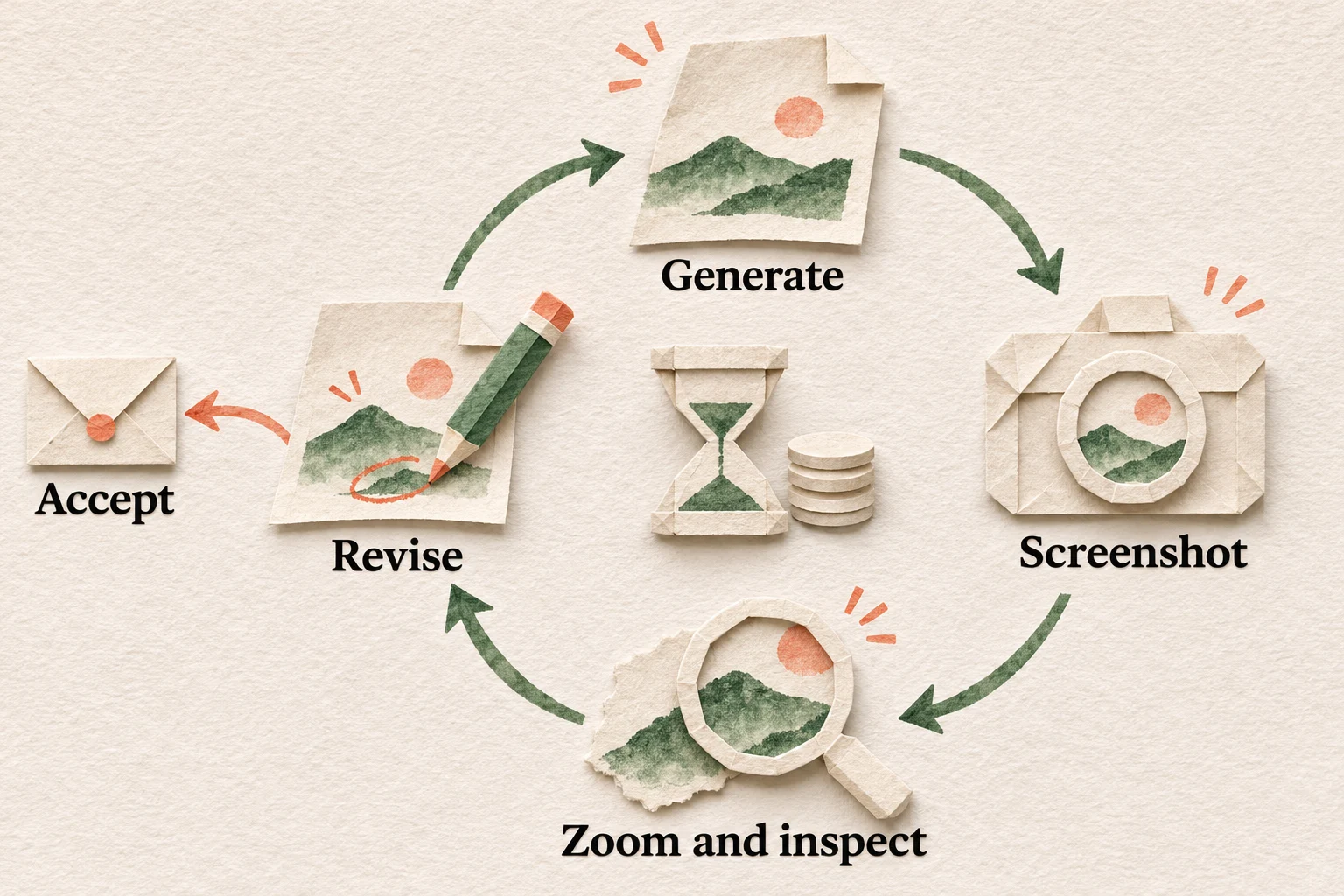
Another took 29 minutes 43 seconds. GLM-5.4 produced a first version in about 10 minutes, then screenshotted its output, zoomed into the wings and feet at 4x, and revised four times.
A third run with the instruction "no testing needed" still took about 35 minutes.
Most of GLM-5.4's run time comes from repeating this cycle, not from slow generation.
The pattern matters more than any score: GLM-5.4's long runs come from a generate, screenshot, inspect, revise cycle, not from slow token output. The checks visibly improve the result, and they cost time and quota. In the same threads, other users called the output "average" or noted that DeepSeek uses fewer tokens.
Against DeepSeek V4.1 Flash
A user on r/ZaiGLM asked DeepSeek V4.1 Flash 1017 and GLM-5.4, both at max effort, to debug the same codebase issue and was "not impressed at all so far" with GLM-5.4. Combined with KingBench 4, the picture is consistent: GLM-5.4 edges out DeepSeek V4.1 Flash on long full-stack builds, while DeepSeek V4.1 Flash is faster and cheaper on single-issue debugging.
Other early notes
Knowledge cutoff: users found GLM-5.4's cutoff matches GLM-5.3's, consistent with continued training on the same base.
Local use:r/LocalLLaMA moderators treat GLM-5.4 as off-topic until weights ship.
The next model: Z.ai's blog says its next, "significantly larger" model "will be ready soon." Claims that it is a 3T-parameter GLM-5.5 due in December come from leaks and have not been confirmed by Z.ai.
How to use GLM-5.4: model names, endpoints and effort
The GLM Coding Plan is the only stable way to use GLM-5.4, and only inside supported tools. Plan quota does not apply to API calls made outside those tools, and since October 16, 2026, Coding Plan keys are separate from standard API keys.
Claude Code: endpoint https://api.z.ai/api/anthropic. In ~/.claude/settings.json, set the default Haiku, Sonnet and Opus models to glm-5.4[1m] and CLAUDE_CODE_AUTO_COMPACT_WINDOW to 1000000. Update Claude Code if it rejects the [1m] suffix.
Codex: endpoint https://api.z.ai/api/v1.
Cline, OpenCode and other OpenAI-compatible tools: endpoint https://api.z.ai/api/coding/paas/v4, custom model glm-5.4, context 1000000, and Support Images enabled.
Effort: GLM-5.4 defaults to max. Disabling thinking drops GLM-5.4 to low rather than turning reasoning off. In the Coding Plan mapping, minimal/low become low, medium/high become high, and xhigh/max become max. KingBench 4 reported separate medium and high results, so check the level your tool actually sends.
How much a GLM-5.4 task costs in Coding Plan credits
The "1.5x quota" comes from lower credit multipliers, not extra credits. Z.ai staff clarified that 1.5x refers to the tokens you can consume relative to GLM-5.3, that a separate 1.5x promotion for ZCode and AutoClaw has ended, and that legacy V1 plans keep GLM-5.4 access without the boost (thread with the staff replies).
Per the Coding Plan overview, credits = (input × input multiplier + cached input × cached multiplier + output × output multiplier) ÷ 10,000. Usage costs full credits from 2:00–6:00 PM UTC+8 on weekdays (10:00 PM–2:00 AM PT, Sunday through Thursday) and half credits at all other times.
Model
Input / cached / output multiplier
Lite ($18/mo, 10,000 credits/wk)
Pro ($80/mo, 60,000/wk)
Max ($168/mo, 140,000/wk)
GLM-5.4
4.6 / 1.1 / 16
78M–156M tokens/wk
470M–941M
1,097M–2,195M
GLM-5.3
6.9 / 1.7 / 24
52M–104M
313M–627M
731M–1,463M
GLM-5.3-Flash
2.3 / 0.56 / 8
158M–317M
950M–1,900M
2,217M–4,433M
Token ranges assume a 98% cache hit rate, from all-peak to all-off-peak usage, as published by Z.ai. Five-hour windows hold 2,000 (Lite), 12,000 (Pro) and 28,000 (Max) credits.
Worked example: one 4.58M-token run
The day-one pelican run did not report its token mix. Assuming 95% cached input, 3% uncached input and 2% output:
credits per token = (0.95 × 1.1 + 0.03 × 4.6 + 0.02 × 16) ÷ 10,000 = 1.503 ÷ 10,000
one run           = 4,580,000 × 1.503 ÷ 10,000 ≈ 688 credits at peak, ≈ 344 off-peak
Under that assumption, one such run at peak uses about 34% of a Lite five-hour window and 7% of its weekly credits, or about 6% of a Pro five-hour window. A higher output share raises this quickly, because the output multiplier is 14.5 times the cached one. To stretch the plan, run long tasks off-peak, keep GLM-5.4 working in the same context so the cache stays warm, and use low for short tasks.
Ignore third-party "GLM-5.4 prices"
No per-token price for GLM-5.4 is official yet. Two misleading listings circulated on launch day: a self-hosted gateway showing $75 input and $75 output, which is that software's default for a model with no price configured, and a third-party coding-glm-5.4 listing at $0.06 / $0.22 that showed 0% uptime. Until Z.ai publishes API pricing, budget from Coding Plan credits, and use the GLM-5.3 family for metered production traffic.
Which API to use until GLM-5.4 opens
Prices are USD per million tokens, checked November 23, 2026.
Situation
Model
Input / cached / output
Why
Multi-step work inside ZCode, Claude Code or Cline; a monthly plan and five-hour limits are acceptable
GLM-5.4
Coding Plan, $18–$168/mo
The only official way to use the loop architecture and native vision
Metered backend work on code, logs or security review (text only)
Faster and cheaper on short debugging in early comparisons
One BeatAPI key calls GLM 5.3, GLM 5.3 Flash, Kimi K3.1 Pro, DeepSeek V4.1 Flash and Claude Opus 5.5 through OpenAI- or Anthropic-compatible endpoints, so you can run the same tasks across models and compare results and spend. Keep the model ID in configuration; when Z.ai opens the GLM-5.4 API, switching becomes a one-line change to evaluate.
FAQ
Does GLM-5.4 have an API? Can I call it on BeatAPI?
Not yet. As of November 23, 2026, Z.ai has not opened a pay-as-you-go GLM-5.4 API or published a price; GLM-5.4 runs only in the GLM Coding Plan and Z.ai's own and partner apps. BeatAPI will evaluate GLM-5.4 once Z.ai opens the API. For metered use today, call GLM 5.3 or GLM 5.3 Flash.
Is GLM-5.4's context window 200K or 1M?
1M tokens. Z.ai's guide uses glm-5.4[1m] with a 1,000,000-token compaction window in Claude Code and a 1,000,000-token context in Cline. Reports of a 200K context and 64K output do not match Z.ai's documentation. Z.ai has not stated the maximum output length.
Why does a GLM-5.4 task take 20 to 30 minutes?
GLM-5.4 defaults to max effort and uses vision to screenshot, inspect and revise its own output, sometimes several times. Z.ai acknowledges the "marathon thinking" tendency, and day-one SVG tests took 19 to 35 minutes. Set low for time-limited tasks and keep high or max for long, multi-module work.
Do legacy V1 Coding Plan users get the 1.5x quota?
No. V1 users can use GLM-5.4, but the 1.5x applies only to V2, V3 and Team plans. Z.ai says V1 already has no weekly cap.
Is GLM-5.4 open source?
Not yet. Z.ai plans to release the weights after safety hardening, with no date. Hugging Face still lists GLM-5.3 and GLM-5.3-Flash as Z.ai's newest models.
How is GLM-5.4 different from GLM-5.3?
GLM-5.4 loops layers 27–54 twice, while GLM-5.3 is a non-looped post-training update on the same base. GLM-5.4 accepts images; GLM-5.3 accepts text only. In the Coding Plan, GLM-5.4 costs two-thirds of GLM-5.3's credits per token.
Next step: If you have a Coding Plan, set your tool to glm-5.4 (glm-5.4[1m] in Claude Code) and run one mid-sized task with an acceptance check at low and at max during off-peak hours, noting time and credits before choosing a default. If you need a metered API, build on GLM 5.3 or GLM 5.3 Flash through BeatAPI now and keep the model name in an environment variable.