
What Is MAGI-2? Sand.ai's 480B Video Model, Demos, Limits, and Pricing
MAGI-2 is Sand.ai's 480B native audio-video model (~28B active) with 30s 1080p clips and 20 references. See real demos, limits, API gotchas, and prices.
Share to



MAGI-2 is Sand.ai's 480B native audio-video model (~28B active) with 30s 1080p clips and 20 references. See real demos, limits, API gotchas, and prices.
Share to
MAGI-2 is a native audio-video generation model released by Sand.ai on November 24, 2026 (PT), built on a 480B-parameter (~28B active) single-stream Transformer with Multi-Head Latent MoE. In Sand.ai's lineup, MAGI-1 was the 2025 open-source autoregressive video model, MAGI-2 Preview was the August 2026 open-weights research model (114B total, ~6B active), and MAGI-2 is the full-scale flagship version built by scaling Preview more than 4x.
MAGI-2 generates 4 to 30 seconds of synchronized 1080p, 25 fps audio and video in a single request. You can feed it up to 20 reference images, videos, and audio clips, direct shot cuts on a timeline, or edit parts of an existing video.
Both Sand.ai's official API and Higgsfield's API price MAGI-2 at $0.08 per second at 1080p (0.5 CNY/s in China). An 8-second 1080p clip costs $0.64, which sits well below other multi-reference flagship models. Even so, you cannot wire MAGI-2 into high-concurrency production traffic yet. Sand.ai's API platform does not offer self-serve top-ups, Higgsfield caps every account at 1 concurrent job across all MAGI-2 modes, and the 480B open weights are not out. Solo creators can test 30-second shots and multi-reference workflows today on VidMuse, Higgsfield, or LibTV. Engineering teams that need metered, high-concurrency video generation today still need live APIs such as Seedance 2.5, Wan 3.0, Kling 4.0, or MiniMax H3.
sand-ai still lists only Apache 2.0 MAGI-1 and MAGI-2-preview. Sand.ai has not published the 480B weights, a release date, or a license.The three clips below cover MAGI-2's main production tasks: locking a character across multiple scenes, shifting styles across a single 30-second take, and directing multi-character dialogue with scene references. A fourth clip in the pre-training section shows what the base checkpoint does with prompt rewriting turned off.
Sand.ai's Into the Giant Flower World demo takes character sheets plus three floral location references (an iris hillside, a pink rose garden, and a lily valley). MAGI-2 alternates between close-ups, low-angle POVs, and wide shots while keeping the character's face, wardrobe, and each setting's palette intact, using leaves and petals to bridge scene transitions.

Sand.ai's Through Five Art Styles clip conditions MAGI-2 on five classic paintings, including The Starry Night, Water Lilies, and A Sunday Afternoon on the Island of La Grande Jatte. The model holds a single 30-second take with continuous camera motion, smooth brushwork transitions, and matching music from start to finish.
Higgsfield published a structured-prompt test set in a crowded 1920s jazz bar. The script binds two leads to @Image 1 and @Image 2, locks the U-shaped marble bar, brass rail, and lighting to @Image 3, and blocks a continuous path across the dance floor, along the back wall, and into a narrow corridor while the two characters talk.



The prompt lays out the exact walking route first (declining a dance, crossing the dance floor, turning right along the back wall, turning left into the corridor), assigns @Image 1, @Image 2, and @Image 3 to specific roles, and limits everyone else in the room to unnamed extras.
Beyond generation from scratch, Sand.ai also showed timeline shot-cut control and targeted video editing, such as keeping a screen recording intact while turning the cursor into an eraser that wipes out selected text before transitioning to a new frame. Treat all launch clips as an upper bound with clean reference sheets and explicit scripts. High-speed action or short, vague prompts still need testing on your own material.
Launch-day coverage disagreed on parameter count, exclusivity, and open-weights status. This table separates verified status from marketing shorthand using Sand.ai's MAGI-2 blog, Sand.ai's pricing docs, Higgsfield, and public leaderboard pages.
| Area | Current status | Where accounts conflict |
|---|---|---|
| Size and architecture | 480B total, ~28B active, single-stream Transformer + Multi-Head Latent MoE | Higgsfield's launch post rounds this to "400B"; it is not a smaller distilled variant |
| Pre-training data | 4T tokens (~1B samples, ~4k tokens average) | Roughly 3x MAGI-2 Preview, labeled in 3 weeks |
| Web access | Live on VidMuse, Higgsfield web, and LibTV (China) | Higgsfield's "exclusively on Higgsfield" claim reflects early third-party distribution; Sand.ai's VidMuse and LibTV also run MAGI-2 |
| Sand.ai API | Native v2 and Ark-compatible docs live at $0.08/s (1080p); no self-serve top-up | Initial API onboarding favors strategic partners; self-serve billing is not open |
| Higgsfield API | Live for T2V, I2V, and Reference-to-Video at $0.08/s | Higgsfield's API Playground caps accounts at 1 concurrent job across all MAGI-2 modes (higher limits require sales); UI uploads cap at 10 images/videos |
| Open weights and paper | Not released, no target date | Hugging Face sand-ai only hosts MAGI-1 and MAGI-2-preview (both Apache 2.0); no license announced for the 480B weights |
| Artificial Analysis | Sand.ai reports 1150.3 average Elo across 4 tasks; 480B is not on AA's public tables yet | AA-Video-T2V v2.1 and AA-Video-I2V v2.1 still list MAGI-2 Preview (T2V 1039, I2V 967) |
MAGI-2 generates video and audio together inside one single-stream Transformer sequence. Motion, lip-sync, ambient sound, foley, and music come out of the same backbone. For shots where sound has to land on an exact visual beat, like a box lid snapping shut, a character speaking mid-turn, or rain carrying over a cut, you skip separate audio post-sync.
Single requests cover 4 to 30 seconds at 1080p and 25 fps. A 30-second window lets you block a setup, action beat, and reaction close-up inside one generation instead of stitching 5-second clips where wardrobe, lighting, and room tone drift apart.
Four hard limits apply before you write any code:
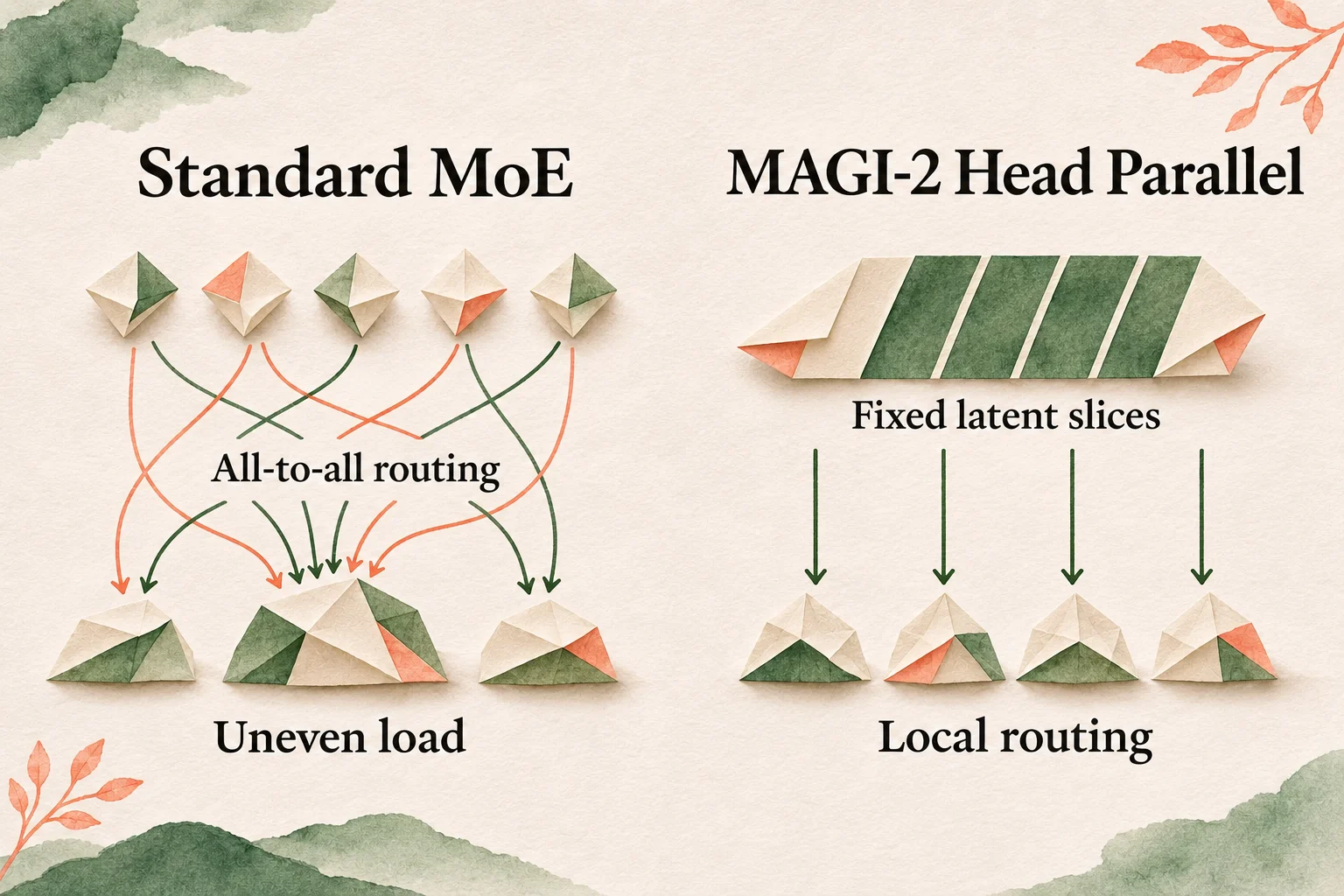
21:9, 16:9, 4:3, 1:1, 3:4, 9:16). You cannot drop to 480p or 720p for cheaper prompt iteration.first_frame and last_frame (making text optional), but forbids mixing them with general image, video, or audio references. The native v2 endpoint does not support start or end frames at all.Scaling a video model to 480B usually breaks on cluster communication and load imbalance. Standard Expert Parallel runs data-dependent top-k routing first, then sends full tokens across GPUs via All-to-All traffic. Because video sequences mix image patches, audio frames, and reference clips, dynamic routing crowds some GPUs while starving others, and cross-GPU traffic scales linearly with top-k.
Starting with MAGI-2 Preview, Sand.ai left MAGI-1's chunked autoregressive design behind and moved to a single-stream Transformer with Multi-Head Latent MoE. Each token splits into independent heads, and each head has its own router and expert pool. Multi-GPU training uses Head Parallel: GPUs exchange fixed-shape latent slices by head assignment first, then run data-dependent top-k routing locally on each GPU. Cross-GPU traffic stays fixed at N · H_latent, decoupled from top-k, which eliminates dynamic load skew.
Sand.ai rewrote its training stack around that layout. MagiFSDP decouples static slice exchanges from sharded expert parameters, gradients, and optimizer states. MagiMoE speeds up local execution across thousands of fine-grained experts per layer and overlaps shared-expert compute, activation recomputation, and gradient communication. MagiMuon extends the Muon optimizer to sharded expert matrices. At 480B scale with matched total FLOPs and optimal configs for each model, Multi-Head Latent MoE trains about 22% faster than single-head LatentMoE. In matched-parameter ablations, an 8-head setup reaches the same validation loss with about 23% less compute than single-head LatentMoE and stays ahead of Standard MoE throughout.
Two data and upscaling choices do just as much work on visual quality:
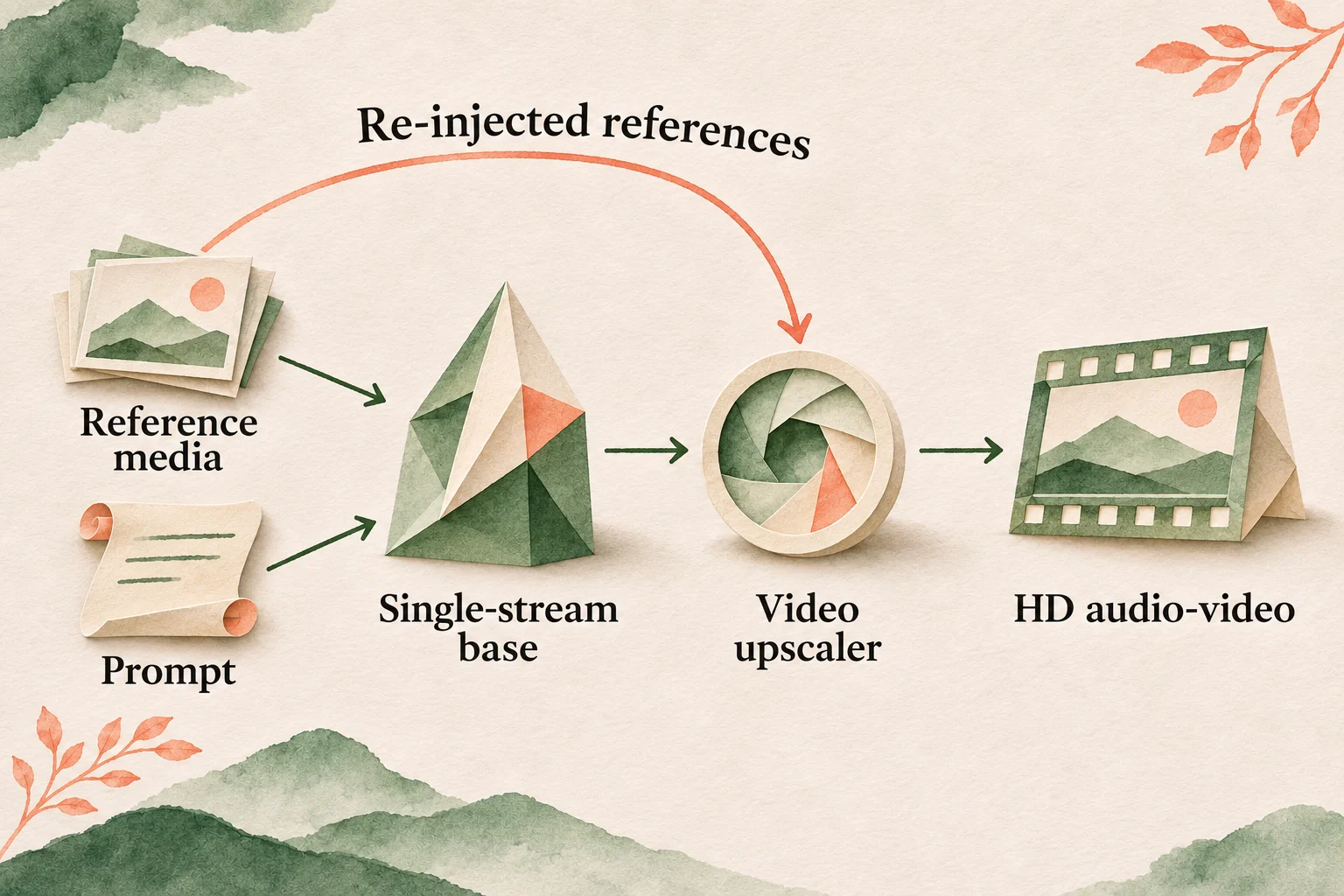
On the hardware side, MAGI-2 already runs on domestic Chinese accelerators including Hygon and Moore Threads (vLLM-Omni also previously ran MAGI-2 Preview on 8 Moore Threads MTT S5000 GPUs). Once Sand.ai opens the 480B weights, teams outside NVIDIA clusters will have a viable deployment path.
When Sand.ai tested the 480B pre-trained checkpoint, the team turned external LLM prompt rewriting (Prompt Enhancement, or PE) off to verify what the video model itself had learned. With PE off, three unprompted behaviors showed up. First, basic visual reasoning: on shape-marking, symmetry, maze, and 9x9 Sudoku tests, the base model kept given numbers intact and filled empty cells by the rules, though errors still occurred. Second, autonomous directing: given only character/scene images and high-level story beats, it chose framing, shot-reverse-shot angles, and close-ups on its own. Third, direct cross-lingual dialogue: it translated speech and synced lips in another language without an LLM rewriting the script first.
This test gives the 480B pre-trained checkpoint character/scene references and three story beats for a boat conversation between Lu Su and Zhuge Liang, with no camera angles, shot sizes, or cut points specified. The base model plans the wide establishing shot, reverse angles, and close-ups on its own.
After fine-tuning and RL on a few thousand curated cinematic clips, visual polish jumped sharply, while those reasoning, autonomous directing, and cross-lingual behaviors became much harder to trigger. Sand.ai compares this to the "alignment tax" seen in LLM post-training: a small, aesthetics-heavy dataset narrows the output distribution for cleaner visuals at the cost of broader pre-trained generalization.
In practice, do not expect the shipped MAGI-2 release to handle logic puzzles or full shot planning from a short raw prompt. When you care about camera angles, blocking, and dialogue order, turn enhance_prompt on or use a text model upstream to break your brief into timed beats, explicit reference tags, and sound cues. That matches MAGI-2-preview's split architecture (which uses Qwen3.5-27B as its text encoder): let a text model write the script and let MAGI-2 render it.
Two separate rankings circulated at launch, and they measure different slices of performance.
On Artificial Analysis Video Arena v2.1, Sand.ai reports a 4-task average Elo (I2V, I2V-Silent, T2V-Silent, and T2V) of 1150.3, up 151.8 points from MAGI-2 Preview's 998.5. However, Artificial Analysis's public AA-Video-T2V v2.1 and AA-Video-I2V v2.1 leaderboards do not include the 480B model yet; the newest Sand.ai entry there is still Preview (T2V 1039±12, I2V 967±15). On those public tables, T2V's top four are Wan 3.0 (1175), Utopai X (1173), MiniMax H3 768p (1163), and Dreamina Seedance 2.5 (1155). I2V's top five are Dreamina Seedance 2.5 (1161), Utopai X (1151), Boreal-H3 (1148), Dreamina Seedance 2.0 (1141), and MiniMax H3 768p (1137), with Wan 3.0 at 1112. Where MAGI-2 lands on pure T2V versus I2V will only be clear once AA publishes its split rows.
The second ranking is Higgsfield Video Arena (November 24, 2026, 16:00 UTC snapshot), where directors, animators, and designers voted blind across 6 models scored with a Bradley-Terry model:
| Rank | Model | Higgsfield score | Overall win rate | MAGI-2 head-to-head |
|---|---|---|---|---|
| 1 | Seedance 2.5 | 1219 | 63.9% | MAGI-2 wins 39% (Seedance 2.5 wins 61%) |
| 2 | MAGI-2 | 1146 | 60.5% | — |
| 3 | Seedance 2.0 | 1006–1008 | 49.0% | MAGI-2 wins 71% |
| 4 | Wan 3.0 | 920–923 | 41.4% | MAGI-2 wins 79% |
| 5 | Kling 4.0 | 872–878 | 41.5% | MAGI-2 wins 83% |
| 6 | MiniMax H3 | 832–833 | 34.8% | MAGI-2 wins 83% |
Read Higgsfield's board with two caveats. First, Higgsfield is MAGI-2's launch distribution partner. Second, the same models swap places sharply across the two boards: Wan 3.0 and MiniMax H3 sit #1 and #3 on AA's public T2V board, yet drop to #4 and #6 on Higgsfield's 6-model board. Prompt mix (especially long multi-reference shots) and voter taste move rankings dramatically, so no single arena settles every workload.
MAGI-2 also has four acknowledged flaws right now. Extreme high-speed motion can still produce trajectory breaks or continuity glitches. Medium and wide 2D animation shots can look overly smooth in small local movement. Complex multi-source soundscapes still lack physical depth and layering. And post-training dampens pre-trained reasoning and autonomous directing. If your work centers on fast fight choreography or wide 2D anime scenes, run a small batch of your own motion-heavy prompts before committing.
Four channels currently expose MAGI-2, each built for a different user and concurrency budget:
| Channel | Format and audience | Published pricing | Main limits |
|---|---|---|---|
| Sand.ai API Platform | Official REST and SDK API (teams and enterprises) | $0.08/s (1080p) | No self-serve top-up yet; initial access favors strategic partners. Default org quota is 5 concurrent jobs, 20 req/60s |
| Higgsfield API / Web | Third-party API and web studio | API $0.08/s; web 2.5 credits/s | API caps each account at 1 concurrent job across all MAGI-2 modes (higher limits require sales); UI reference picker caps at 10 images/videos |
| VidMuse | Sand.ai's creator web app (with Canvas) | Subscriptions (Pro from $33/mo billed yearly) and credit packs | Reference limits depend on workflow and can differ from the raw API |
| LibTV | Consumer web access in China | In-platform billing | Individual creative use only; no developer API |
If you already have a Sand.ai API key for api.sand.ai, watch out for five documented constraints before writing your client:
POST /v2/generations) passes 1 required text part plus media references in parts[], rejects role, and does not support keyframes. If you need first_frame, last_frame, or drop-in compatibility with the Volcengine Ark Python SDK (volcenginesdkarkruntime), call the Ark-compatible endpoint (POST /compatible/ark/api/v3/contents/generations/tasks) with base_url set to https://api.sand.ai/compatible/ark/api/v3.watermark completely: Both endpoints reject the watermark field with HTTP 400, even when you explicitly pass "watermark": false. The Ark endpoint also rejects non-null values for unsupported fields such as frames, callback_url, draft, and return_last_frame.202 Accepted or a task ID, and retrying after a network timeout or 5xx can bill twice. Inspect the response for details.generation_id before polling or retrying.content.video_url links expire in 1 hour (re-fetching the task refreshes the signed URL).POST /v1/assets returns an id as an int64 JSON number. Standard JS JSON.parse can lose precision; parse int64 IDs losslessly into exact decimal strings before passing assetId or asset://<ID>.This table converts MAGI-2's official rate and BeatAPI's live metered video models to the same unit: one 8-second, 1080p clip (plus MAGI-2's full 30-second cost). BeatAPI will evaluate adding MAGI-2 once Sand.ai opens stable self-serve metered billing, with pricing announced at launch.
| Model | 8-second 1080p API cost | Key specs and inputs | Metered API status |
|---|---|---|---|
| MAGI-2 (Sand.ai / Higgsfield list rate) | $0.64 ($0.08/s; 30s $2.40) | 4–30s, 1080p only, native audio, up to 20 multimodal references | Sand.ai lacks self-serve top-up; Higgsfield API capped at 1 concurrent job |
| Seedance 2.5 | BeatAPI $3.8692 (no video ref) / $4.6109 (with video ref); Fal $9.0979 / $10.9175 | #1 on AA I2V and Higgsfield; strong multi-reference control; 480p/720p/1080p | Live on BeatAPI, pay-as-you-go |
| Seedance 2.0 | BeatAPI $2.5627 (no video ref) / $3.1074 (with video ref); Fal $5.4432 / $6.6886 | 480p to 4K plus video reference | Live on BeatAPI, pay-as-you-go |
| Kling 4.0 | BeatAPI $1.84 (no video ref) / $2.24 (with 8s video ref); Kling official $1.88 / $2.256 | Up to 30s output, reference media, start/end frames | Live on BeatAPI, pay-as-you-go |
| Wan 3.0 | BeatAPI $1.088 (720p $0.568); Fal $1.60 | #1 on AA-Video-T2V v2.1 (Elo 1175); 480p/720p/1080p | Live on BeatAPI, pay-as-you-go |
| Grok Imagine Video 1.5 | BeatAPI $0.72 (720p $0.40); Fal $2.00 | Text-to-video and image-to-video with cheaper 720p drafts | Live on BeatAPI, pay-as-you-go |
| Gemini Omni 1.2 Flash | BeatAPI $0.5824 (720p $0.392; 4K $1.1704) | AA T2V 1153; 720p through 4K tiers | Live on BeatAPI, pay-as-you-go |
| MiniMax H3 | BeatAPI $0.376 (768p $0.24; 2K $0.40); MiniMax official $0.64 | Open-weights #3 on AA T2V (768p Elo 1163); built for low-cost batches | Live on BeatAPI, pay-as-you-go |
| Veo 3.1 | BeatAPI $0.25 (Lite) / $0.40 (Fast) / $1.90 (Quality); Fal $0.64 / $1.20 / $3.20 | Native audio across 720p, 1080p, and 4K speed/quality tiers | Live on BeatAPI, pay-as-you-go |
For long 1080p takes with heavy multimodal references, MAGI-2's $0.64 per 8 seconds undercuts its closest rivals by a wide margin: roughly one-sixth of BeatAPI's Seedance 2.5 ($3.87), one-fourth of Seedance 2.0 ($2.56), and about one-third of Kling 4.0 ($1.84).
For routine 8-second 1080p batches without heavy reference stacks, MAGI-2 is not the cheapest option. MiniMax H3 ($0.376), Veo 3.1 Fast ($0.40), and Gemini Omni 1.2 Flash ($0.5824) all cost less per clip on BeatAPI. Teams that draft storyboards cheaply at 480p or 720p before rendering finals also need Wan 3.0 or the Seedance lineup, because MAGI-2 locks output to 1080p.
If your product needs high-concurrency metered video generation today, one BeatAPI key lets your async pipeline route jobs across Seedance 2.5, Wan 3.0, Kling 4.0, MiniMax H3, and Veo 3.1 Fast. Keep the model ID in config so you can benchmark MAGI-2 against the exact same prompt set once self-serve metered access opens.
480B. Sand.ai specifies 480B total parameters and ~28B active parameters, more than 4x larger than the 114B / ~6B MAGI-2 Preview. Higgsfield's "400B" figure is a rounded shorthand, not a smaller model.
Not yet. Hugging Face under sand-ai currently hosts only MAGI-1 and MAGI-2-preview (both Apache 2.0). Sand.ai plans to open-source MAGI-2 and publish a full technical report later, with no release date or 480B license announced.
No. Higgsfield's "exclusively on Higgsfield" phrasing covers its early third-party distribution partnership. Creators can also use MAGI-2 on Sand.ai's own VidMuse web app and LibTV in China, and developers can apply directly through Sand.ai's API Platform.
Both the native v2 and Ark-compatible endpoints fix output at 1080p and 25 fps with no 480p or 720p draft tier. Since a full 30-second clip costs $2.40 at $0.08/s, test character likeness, pacing, and sound cues with 4- to 8-second runs ($0.32–$0.64) first, then raise duration to 15–30 seconds once your reference set works.
Use native v2 (POST /v2/generations) when your job centers on multimodal references (up to 10 images, 5 videos, and 5 audio clips). Switch to the Ark-compatible endpoint (POST /compatible/ark/api/v3/contents/generations/tasks) whenever you need first_frame or last_frame control, or already use the Volcengine Ark Python SDK. Remember that keyframe mode cannot be combined with general references, and both endpoints forbid the watermark field.
Test MAGI-2 when you want 15- to 30-second single takes with heavy multimodal references near $0.08/s at 1080p (best suited to solo work or small test batches right now). Pick Seedance 2.5 for top blind-test quality when budget allows, Wan 3.0 for text-to-video and 480p/720p/1080p cost tiers, Kling 4.0 for high-concurrency 30-second production jobs with reference video today, and MiniMax H3 or Veo 3.1 Fast for high-volume 1080p batches at the lowest per-clip cost.
Next step: If you are making clips by hand, run one 15- to 30-second test on VidMuse or Higgsfield with a character sheet, a location photo, and one line of dialogue tied to a clear physical sound, then inspect faces past the 20-second mark and any fast-motion frames. If you are wiring an app backend, check the five API constraints above against your concurrency and keyframe needs; if you need metered production traffic today, start on Seedance 2.5, Wan 3.0, or MiniMax H3 through BeatAPI and keep the model ID in an environment variable so you can benchmark MAGI-2 on the same script once public metered billing opens.