With GPT-6.1 Sol, choosing between OpenAI's mid-tier model and Anthropic's flagship was straightforward: Sol won on budget, and Opus won on hard tasks. GPT-6.2 Sol, released on November 17, 2026 at unchanged token prices ($2.00 input / $10.00 output up to 272K context), breaks that old split. GPT-6.2 Sol now beats Claude Opus 5.5 on scientific terminal work, legal and consulting deliverables, CAD modeling, and medium-effort reasoning—while Claude Opus 5.5 still holds an eight-point lead in autonomous repository coding and stronger factual completeness.
The real buying decision comes down to three concrete thresholds: which reasoning-effort tier you run, whether your prompts cross 272,000 input tokens, and whether automated tests can catch an omission before it ships. Both models offer 1M+ context windows, 128K-token output ceilings, text and image inputs, and live access under one key on BeatAPI.
Quick answer
Run GPT-6.2 Sol at medium effort as your high-volume default. At medium on Artificial Analysis, GPT-6.2 Sol beats Claude Opus 5.5 on the Intelligence Index (53 vs. 48) and FrontierCode-AA 2.0 (41.4% vs. 33.1%) at one-sixth the task cost ($0.41 vs. $2.45) and less than half the wait time (3.3 min vs. 7.0 min).
Keep Claude Opus 5.5 for autonomous codebase agents and fact-critical reviews. On Coding Agent Index v2.1, Claude Opus 5.5 (max in Claude Code) scores 58 against 50 for GPT-6.2 Sol (xhigh in Codex), and Opus 5.5 leads AA-Omniscience v1.1 (48 vs. 40 at max).
Watch GPT-6.2 Sol's 272K-token price cliff. Passing 272,000 input tokens reprices the entire gpt-6.2-sol request to $4.00 / $15.00 on OpenAI ($1.60 / $6.00 on BeatAPI), wiping out most of its official price edge over Claude Opus 5.5.
BeatAPI resets the cross-model price floor. BeatAPI discounts gpt-6.2-sol by 60% ($0.80 / $4.00 up to 272K) and claude-opus-5-5 by 50% ($2.00 / $10.00)—so Claude Opus 5.5 on BeatAPI matches OpenAI's official standard price for GPT-6.2 Sol.
Stop comparing at max effort: how both models scale from low to max
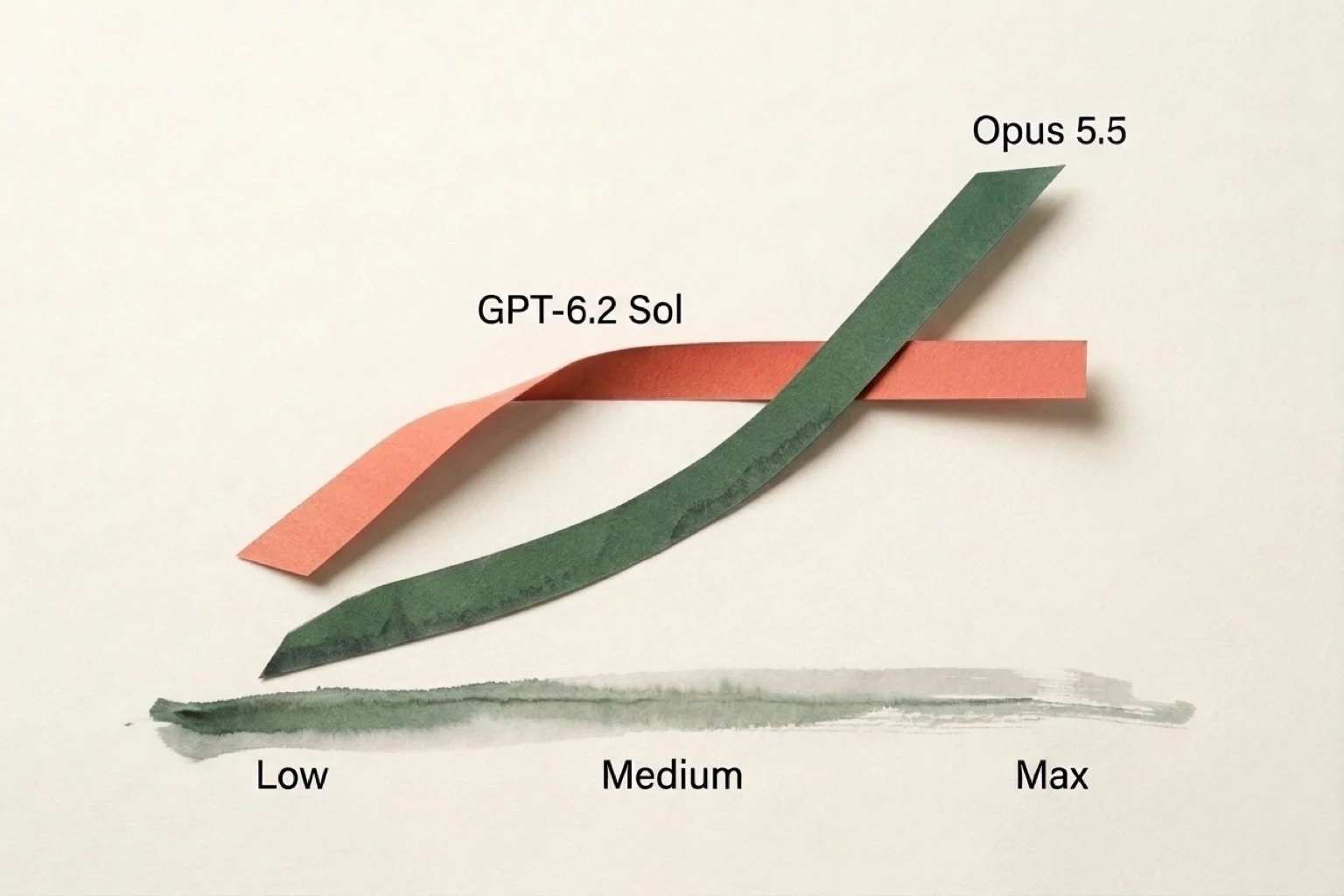
Most benchmark charts pit max against max, hiding how differently these two models respond to reasoning budgets. Both expose five effort settings (low, medium, high, xhigh, max), yet their quality curves cross near the top:
GPT-6.2 Sol captures most of its reasoning gain by Medium effort; Claude Opus 5.5 continues climbing through Max at a steep latency and cost penalty.
Effort tier
Claude Opus 5.5 (Index · Cost · Time)
GPT-6.2 Sol (Index · Cost · Time)
low
35 · $0.98 · 3.1 min
41 · $0.18 · 1.6 min
medium
48 · $2.45 · 7.0 min
53 · $0.41 · 3.3 min
high
52 · $3.46 · 9.4 min
55 · $0.56 · 4.7 min
xhigh
57 · $6.05 · 16.1 min
56 · $0.65 · 5.4 min
max
59 · $10.04 · 25.1 min
57 · $1.01 · 8.9 min
Stepping gpt-6.2-sol from low to medium buys +12 Intelligence Index points (41 → 53) for an extra $0.23 per task. Pushing all the way from medium to max adds only +4 points (53 → 57) while more than doubling task cost and wait time. Meanwhile, Claude Opus 5.5 streams faster per second than GPT-6.2 Sol (103–115 tok/s vs. 64–75 tok/s), yet finishes 2.8 times slower at max effort (25.1 min vs. 8.9 min) because it writes far longer reasoning traces.
Choosing strictly by the highest max score ignores latency ceilings and verification cost. The same principle behind algorithm decisions beyond accuracy benchmarks applies to effort selection: standardize on gpt-6.2-sol at medium or high, and reserve Opus 5.5 xhigh/max for tasks where an error is genuinely expensive.
The benchmark split: science and office work flipped, coding agents did not
Rather than one model sweeping the board, independent and launch evaluations divide cleanly between verifiable domain deliverables and open-ended codebase comprehension:
Evaluation
Claude Opus 5.5 (max)
GPT-6.2 Sol (max)
What it signals
Terminal-Bench-Science 0.1
59.0% (AA) · 63.3% (OpenAI)
67.6% (AA) · 68.0% (OpenAI)
Sol reversed GPT-6.1's 6-point deficit at ~1/10th task cost
Sol clears strict legal criteria more often at 1/9th cost
BenchCAD 2.1 Core (CAD modeling)
65.3% ($20.00/task)
73.1% ($1.60/task)
Strong Sol lead on structured engineering geometry
Agents' Last Exam v1.1
71.6% ($17.57/task)
73.0% ($1.32/task)
Sol at high already matches Opus max
AutomationBench-AA
69.5%
71.3%
Sol suits high-volume multi-app agents
Terminal-Bench 4.0
59.6%
60.1%
Near tie at max effort
FrontierCode-AA 2.0
46.4% (med: 33.1%)
44.4% (med: 41.4%)
Opus leads at max; Sol leads at medium
AA Coding Agent Index v2.1
58 (Claude Code)
50 (Codex, xhigh)
Sol regressed vs. GPT-6.1 due to SWE-Atlas-QnA omissions
AA-Omniscience v1.1
48
40
Opus preserves factual completeness better
Claude Opus 5.5 also holds first place among 63 evaluated models at 69.69% on the Vals Index, where GPT-6.2 Sol has no comparable entry. The Coding Agent Index regression is the critical warning for software teams: GPT-6.2 Sol's concise output saves money on bounded patches with unit tests, but when an agent must trace an unfamiliar repository without a pre-written test, omitted facts are far harder to spot than a syntax error. For how OpenAI separates GPT-6.2 Sol and GPT-6.2 Astra inside the 6.2 release, see the family overview.
The 272K input cliff and three real engineering budgets
GPT-6.2 Sol offers a 1.05M-token context window (922K max input, 128K max output), while Claude Opus 5.5 provides a 1M-token context window and 128K-token synchronous output. Both handle long documents, yet their pricing curves behave very differently past 272,000 input tokens.
Running three fixed-token engineering workloads through those rates (assumed-usage calculations holding token counts equal, excluding taxes and tool fees) exposes two budgeting surprises:
Engineering workload (equal tokens assumed)
Official: Opus 5.5 vs. Sol
BeatAPI: Opus 5.5 vs. Sol
100 component patches (30K in + 6K out each, uncached)
$24.00 vs. $12.00 ($0.24 vs. $0.12 each)
$12.00 vs. $4.80 ($0.12 vs. $0.048 each)
8-turn cached UI session (60K prefix written turn 1 + 7 hits; 4K new in + 8K out/turn)
First, crossing 272,000 input tokens reprices the entire GPT-6.2 Sol request—not just the excess tokens—collapsing the official long-context gap to five cents ($1.35 vs. $1.40). On BeatAPI, Sol keeps a wider 22.9% discount ($0.54 vs. $0.70). Second, on the 8-turn cached UI session, BeatAPI's Claude Opus 5.5 ($0.896) costs the exact same dollar amount as OpenAI's official GPT-6.2 Sol ($0.896), while BeatAPI's GPT-6.2 Sol drops to $0.3584.
Still, treat token math as a floor rather than the final bill. Measure production spend by cost per accepted result:
Cost per accepted result = (Total token spend + Retry & repair spend + Verification cost) / Accepted outputs
One cheap patch that fails schema checks twice or forces an engineer into a 20-minute rollback immediately erases a $0.07 token saving.
Running both in one hybrid router (and watching for post-launch drift)
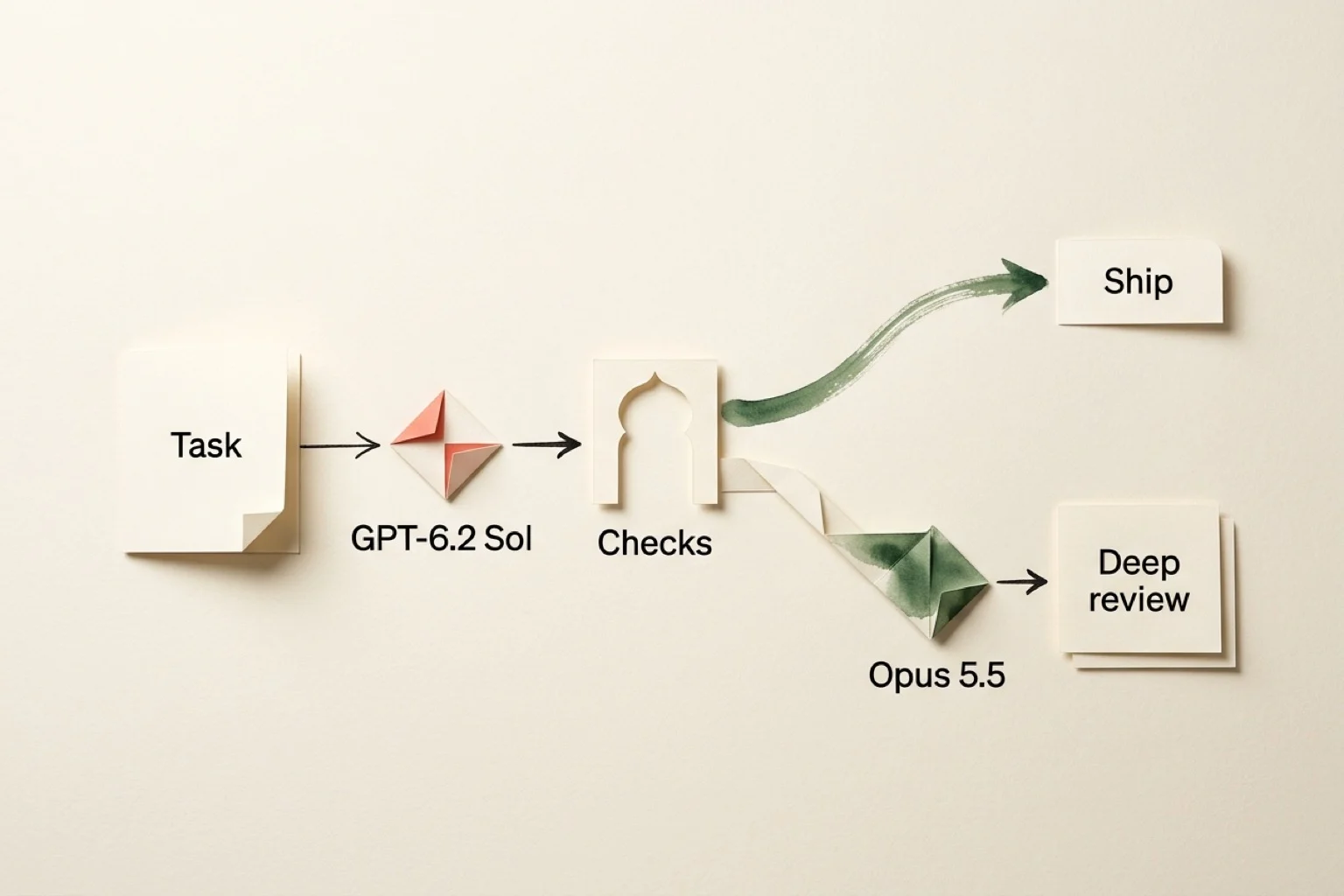
Because both gpt-6.2-sol and claude-opus-5-5 share one API key and account balance on BeatAPI, the cleanest architecture is a two-tier router: send bounded, test-backed work to gpt-6.2-sol at medium effort first, and escalate failed checks or open-ended audits to claude-opus-5-5.
Pass routine tasks through GPT-6.2 Sol with automated checks, and escalate failures or deep audits to Claude Opus 5.5.
Handle three protocol details before wiring the handoff:
Choose the right endpoint: Call gpt-6.2-sol through the Responses API whenever tool calling is active; call claude-opus-5-5 through Anthropic Messages or OpenAI-compatible endpoints.
Respect reasoning constraints:claude-opus-5-5 keeps adaptive thinking permanently on (default medium) and rejects disabled thinking or forced tool choice; gpt-6.2-sol rejects reasoning.effort: "none".
Never forward thinking blocks across vendors: Pass raw files, failing test logs, and explicit constraints when escalating from Sol to Opus 5.5.
Before promoting any routing rule, freeze 50 to 200 real production tasks, run both models under identical tool schemas, and grade outputs blindly. When human reviewers score outputs, the checklist for running comparison tests with AI helps prevent bias, and an upfront LLM API provider check ensures rate limits or timeout behavior do not masquerade as model failures. Keep logging acceptance rates, p95 latency, and retry counts for 30 days after launch—GardenBench showed measurable performance shifts within days of deployment on hosted models, so shadow runs and canary slices remain essential after cutover.
Common questions before switching
Does GPT-6.2 Sol beat Claude Opus 5.5 on coding?
At medium effort, GPT-6.2 Sol leads Claude Opus 5.5 on FrontierCode-AA 2.0 (41.4% vs. 33.1%) and the Intelligence Index (53 vs. 48). For autonomous repository coding at top settings, Claude Opus 5.5 stays ahead on Coding Agent Index v2.1 (58 in Claude Code vs. 50 for Sol in Codex) and FrontierCode-AA 2.0 at max (46.4% vs. 44.4%).
Which model is cheaper above 272,000 input tokens?
GPT-6.2 Sol stays marginally cheaper, but the margin tightens sharply. Above 272K input tokens, OpenAI bills the whole GPT-6.2 Sol request at $4.00 / $15.00—only $0.05 below Claude Opus 5.5 ($1.35 vs. $1.40 on a 300K-input, 10K-output pass). On BeatAPI, the same 300K pass costs $0.54 on GPT-6.2 Sol versus $0.70 on Claude Opus 5.5.
What is the best reasoning effort setting for GPT-6.2 Sol?
Start at medium effort. GPT-6.2 Sol jumps from 41 (low) to 53 (medium) on the Intelligence Index for $0.41 per task, whereas stepping all the way to max (57) adds just four points at $1.01 per task and nearly triple the wait time.
Wire gpt-6.2-sol at medium effort into one repeatable workflow with automated pass/fail checks, and point claude-opus-5-5 at your hardest repository investigations. Once a week of real logs shows each model's cost per accepted result and reviewer time, lock in your split and ship with confidence.