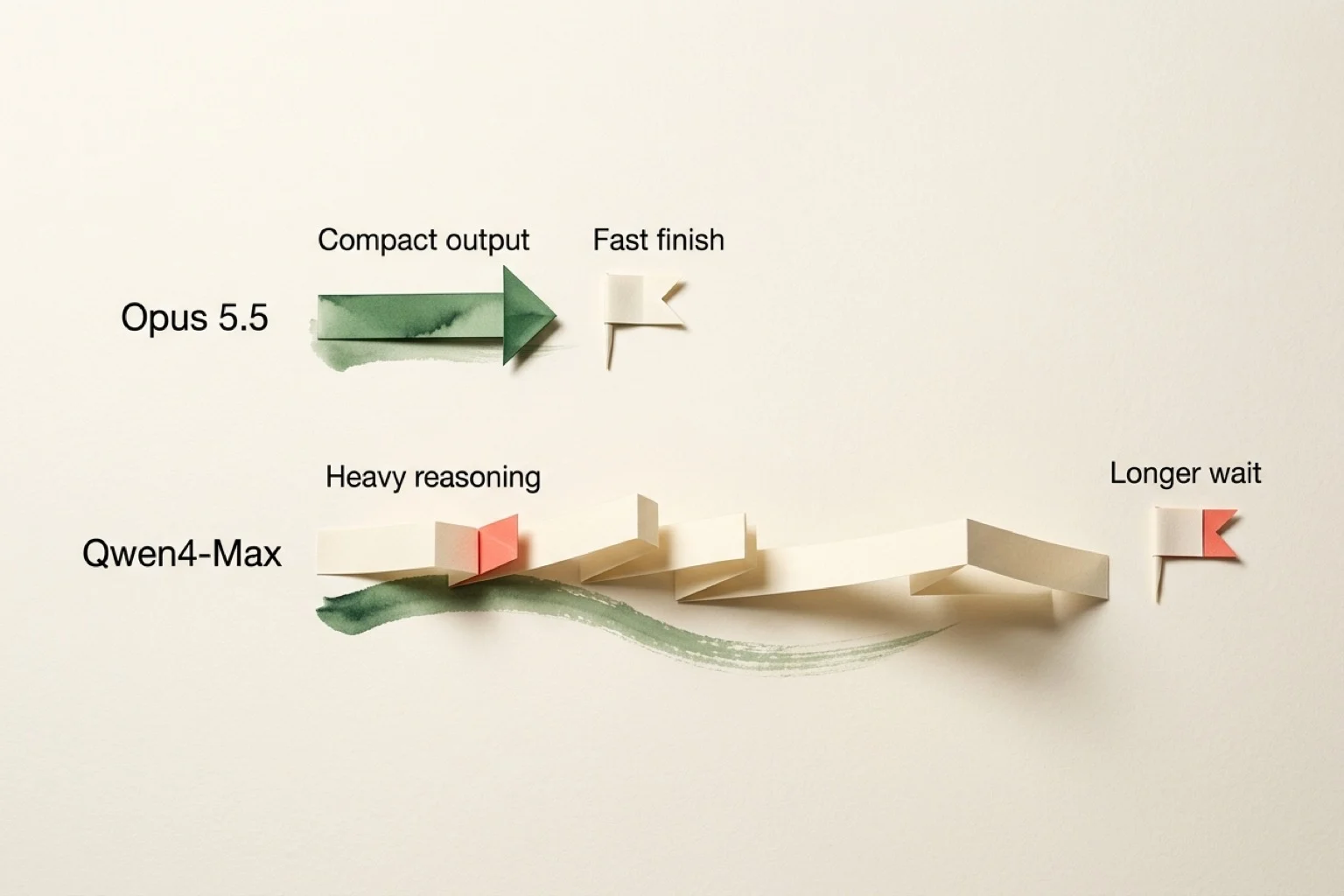
On paper, Qwen4-Max looks like an easy budget replacement for Claude Opus 5.5: Alibaba's list output rate is less than a quarter of Anthropic's ($4.50 versus $20.00 per million tokens). In practice, Qwen4-Max writes much longer reasoning chains at roughly half the decoding speed, so a cheap token rate can turn into slower—and sometimes more expensive—finished tasks.
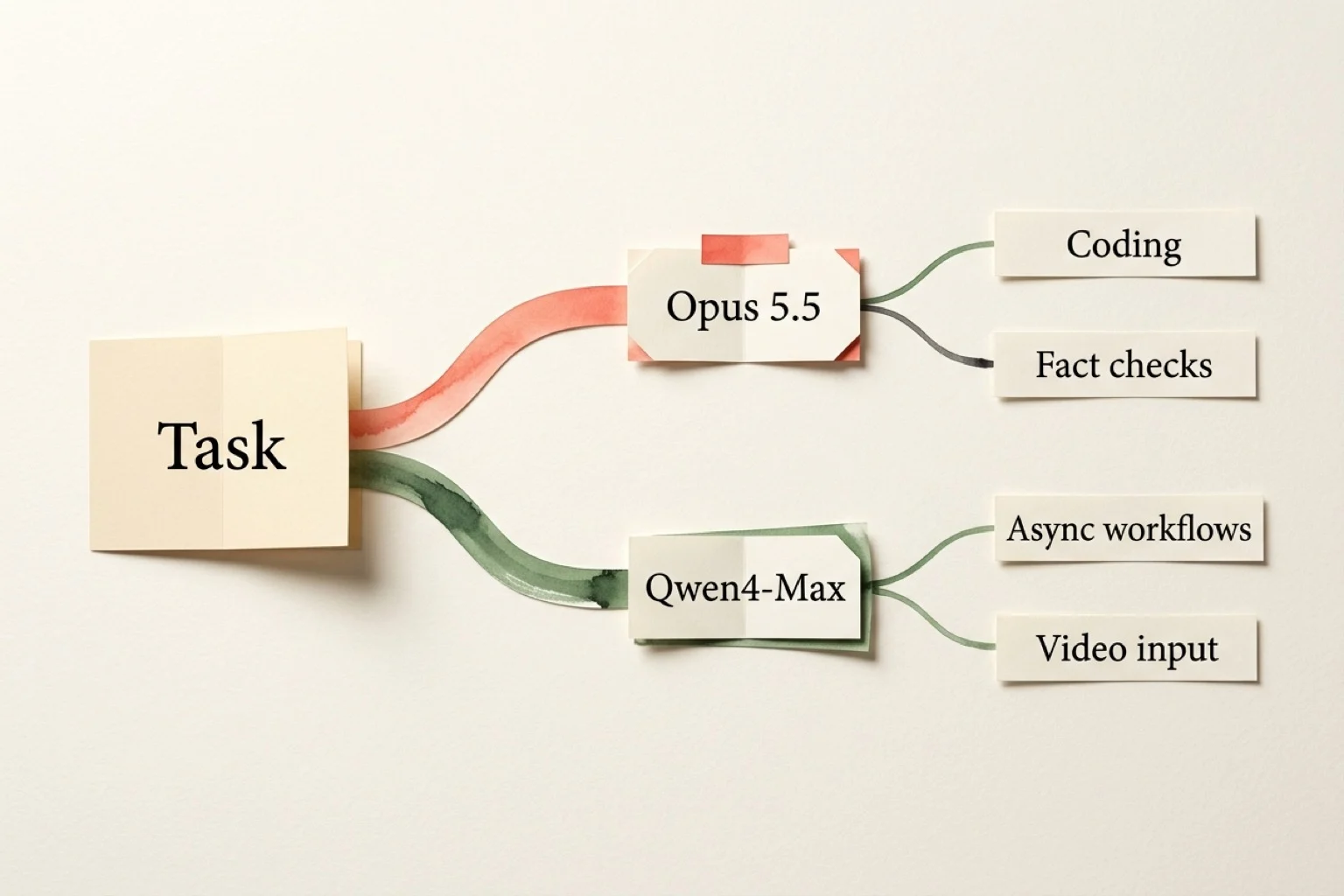
For interactive coding agents, multi-file debugging, and fact-sensitive analysis, Claude Opus 5.5 remains the stronger default. Qwen4-Max earns its slot on asynchronous business automation, log-heavy incident triage, and pipelines that need native video input without building a frame-extraction stage. Both models offer roughly one million tokens of context (released November 16, 2026 for Qwen4-Max and September 22, 2026 for Claude Opus 5.5) and share one API key on BeatAPI.
The short answer
Token price hides wall-clock wait and verbosity. On Artificial Analysis, Qwen4-Max averages 30.8 minutes and $3.27 per task (Intelligence Index 43), making it slower and more expensive than Claude Opus 5.5 at Anthropic's default medium effort (7.0 minutes, $2.45, Intelligence Index 48).
Coding and factual recall favor Claude Opus 5.5 by a wide margin. Claude Opus 5.5 (max) scores 46.4% on FrontierCode-AA 2.0 and 48 on AA-Omniscience v1.1 against Qwen4-Max's 26.5% and 28.
Workflow automation and video input favor Qwen4-Max. Qwen4-Max leads Claude Opus 5.5 (max) on AutomationBench-AA (72.6% vs. 69.5%), matches Opus 5.5 (high) on AA-Briefcase v1.1 (1686 vs. 1682), and accepts video natively alongside text and images.
Why Qwen4-Max's lower token price can still cost more per task
A low per-token price saves money only when both models emit similar output volumes. Across Artificial Analysis's full evaluation suite, Qwen4-Max emitted 127 million output tokens—about double the peer median—while decoding at 57 tokens per second, compared with 105–115 tokens per second for Claude Opus 5.5.
Longer reasoning traces at half the decoding speed turn Qwen4-Max's cheaper token rate into longer waits.
Comparing Qwen4-Max against both medium and max effort on Claude Opus 5.5 shows why the middle column matters most for production budgets:
Metric
Qwen4-Max
Claude Opus 5.5 (medium)
Claude Opus 5.5 (max)
AA Intelligence Index
43
48
59
FrontierCode-AA 2.0
26.5%
33.1%
46.4%
Terminal-Bench 4.0
48.5%
52.5%
59.6%
AA-Omniscience v1.1
28
40
48
Terminal-Bench-Science 0.1
23.3%
43.3%
59.0%
Decoding speed
57 tok/s
105 tok/s
115 tok/s
Mean task time
30.8 min
7.0 min
25.1 min
Mean task cost (official rates)
$3.27
$2.45
$10.04
At medium effort, Claude Opus 5.5 scores five points higher overall, finishes 4.4 times faster, and costs 25% less per task than Qwen4-Max. Only when you push Claude Opus 5.5 all the way to max ($10.04 per task) does Qwen4-Max pull clearly ahead on total task spend—and at max, Opus 5.5 opens a 16-point intelligence lead and a 20-point coding lead.
Three real agent runs: coding, incident triage, and policy rules
Benchmark averages hide how differently these two models behave inside an agent loop. A three-task agent benchmark run at default settings with no turn cap tested both models on three realistic engineering jobs:
Fixing 11 bugs in an accounting library (47 points). Six bugs passed the visible test suite and had to be caught against the spec, while three tests were intentionally wrong. Claude Opus 5.5 scored 45/47, fixed all 11 bugs, made its first edit on turn 4, and finished in 64 seconds ($0.38). Qwen4-Max scored 40/47, missed a penny-rounding invoice split bug, left a scratch file in the test folder, read files for 15 turns before editing anything, and took 310 seconds ($0.25). That matches Claude Opus 5.5's lead on Terminal-Bench 4.0 (59.6% independently, and 66.4% ± 2.6 with safeguards in the Claude Opus 5.5 System Card).
Untangling three overlapping production outages (60 points). Both models ruled out decoy deploys and caught two drifted server clocks. Here Qwen4-Max edged ahead 59/60 to 58/60 at less than one-third the cost ($0.44 vs. $1.41), though it took 9.5 minutes versus Opus 5.5's 3.7 minutes.
Triaging a customer bug across ticket tracker, code repo, chat, and calendar (76 points). Claude Opus 5.5 scored a clean 76/76 in 248 seconds ($2.13). Qwen4-Max scored 71/76 in 791 seconds ($0.62), losing all five points from one misread ownership-precedence rule that repeated across three questions.
Single-run agent task
Claude Opus 5.5
Qwen4-Max
Outcome
Multi-app triage (of 76)
76 ($2.13 · 248 s)
71 ($0.62 · 791 s)
Opus kept every policy rule intact; Qwen cut spend 71%
Incident investigation (of 60)
58 ($1.41 · 221 s)
59 ($0.44 · 570 s)
Qwen won by 1 point at 31% of Opus's bill
Accounting bug fix (of 47)
45 ($0.38 · 64 s)
40 ($0.25 · 310 s)
Opus fixed all 11 bugs in 12 turns; Qwen took 30 turns
Combined total
179 / 183 ($3.91 · 533 s)
170 / 183 ($1.31 · 1,671 s)
Qwen saved 66%, wrote 77% more output tokens, ran 3.1x slower
That pattern gives you a clear rule of thumb. Inside an interactive coding session, waiting three to five times longer while risking a missed edge case eats any token savings. For unattended log triage, Qwen4-Max delivers competitive root-cause accuracy for a fraction of the bill. Because Qwen4-Max trails sharply on factual recall (28 vs. 48 on AA-Omniscience v1.1), pair any dense document extraction with a verifiable research paper PDF analysis workflow so reviewers can check every extracted claim against its source page.
Where Qwen4-Max genuinely wins: automation and native video
Qwen4-Max is not just a discounted coding backup—it has two clear technical advantages over Claude Opus 5.5:
Structured business-app automation: Qwen4-Max scores 72.6% on AutomationBench-AA (ahead of Claude Opus 5.5 max at 69.5%), matches Opus 5.5 high on AA-Briefcase v1.1 (1686 vs. 1682), and edges ahead on Finance & Accounting (54 vs. 53). Built on the 2.4-trillion-parameter Qwen4 architecture (71B active parameters per token plus 328B N-gram embedding parameters), Qwen4-Max handles long, structured multi-app routines well when wall-clock latency is not interactive.
Native video input: Qwen4-Max accepts text, image, and video directly inside its one-million-token window, whereas Claude Opus 5.5 accepts text and images only. Teams inspecting product demos, bug recordings, or short-form clips avoid maintaining a separate frame-sampling pipeline. For the broader lineup and release history across Qwen 4.0, see our family tracker.
What the bill looks like on Alibaba, OpenRouter, and BeatAPI
Channel discounts change the ratio between these two models before you write a single prompt. All figures below are USD per million tokens for standard synchronous calls across Alibaba Cloud, OpenRouter, Anthropic, and BeatAPI pricing, excluding taxes or credit-purchase fees.
Platform and model
Input
Cache read
Cache write (5 min)
Output (incl. thinking)
Alibaba Cloud official: qwen4-max
$1.50
$0.075
$1.875
$4.50
OpenRouter (Alibaba Cloud Int.): qwen/qwen4-max
$1.425
$0.07125
$1.781
$4.275
BeatAPI: qwen4-max
$1.20
$0.06
$1.50
$3.60
Anthropic official standard: claude-opus-5-5
$4.00
$0.20
$5.00 (1h: $8.00)
$20.00
BeatAPI: claude-opus-5-5
$2.00
$0.10
$2.50 (1h: $4.00)
$10.00
OpenRouter adds credit-purchase fees (5.5% on Standard, 8% on Business); if you prefer fixed-model routing without top-up surcharges, compare the OpenRouter alternative path.
Applying those rates to fixed token counts (assumed-usage calculations with no caching or tool fees) shows how BeatAPI's 50% Opus discount versus 20% Qwen discount compresses the spread:
Fixed-token calculation
Official: Opus 5.5 vs. Qwen4-Max
BeatAPI: Opus 5.5 vs. Qwen4-Max
PR review (40K input + 8K output)
$0.32 vs. $0.096 (Qwen 70% less)
$0.16 vs. $0.0768 (Qwen 52% less)
Long document pass (120K input + 20K output)
$0.88 vs. $0.27 (Qwen 69% less)
$0.44 vs. $0.216 (Qwen 51% less)
PR review adjusted for Qwen's +77% output tokens (BeatAPI)
—
$0.16 vs. $0.099 (Qwen 38% less)
At official rates, Qwen4-Max looks 70% cheaper at equal tokens. On BeatAPI, once you account for both platform discounts and Qwen4-Max's heavier reasoning output (+77% in the three-task agent run), the net saving narrows to roughly 38%—worth capturing on unattended automation batches, but easy to wipe out if one missed bug adds 15 minutes of manual debugging. When your agents also call external endpoints during a run, include both model tokens and any pay-per-call data API for AI agents in the same per-deliverable denominator so tool fees stay visible.
Splitting the work without maintaining two billing accounts
Running both qwen4-max and claude-opus-5-5 behind https://api.beatapi.io/v1 lets you match each model to the job it actually wins instead of forcing one model across the whole stack.
Send interactive coding and fact checks to Claude Opus 5.5; send asynchronous automation and video workloads to Qwen4-Max.
Keep two API behaviors in mind before routing calls dynamically: Claude Opus 5.5 keeps adaptive thinking permanently enabled (128K synchronous output limit) and rejects disabled thinking or forced tool choice, whereas Qwen4-Max accepts low, high, xhigh, or disabled reasoning. Turn your trickiest failure modes—such as policy precedence, JSON schema validation, and tool retries—into scored regression cases using a dataset-driven AI agent testing playbook before moving live traffic. If you are also weighing OpenAI's lower-cost reasoning tier alongside these two, compare Claude Opus 5.5 vs. GPT-6.2 Sol.
FAQ
Is Qwen4-Max better than Claude Opus 5.5 for coding?
No. Claude Opus 5.5 leads Qwen4-Max on FrontierCode-AA 2.0 (46.4% at max and 33.1% at medium, against 26.5% for Qwen4-Max) and Terminal-Bench 4.0 (59.6% vs. 48.5%). In the hands-on accounting bug-fix test, Claude Opus 5.5 fixed all 11 bugs in 64 seconds, while Qwen4-Max fixed 10 of 11 bugs in 310 seconds.
Can I call both Qwen4-Max and Claude Opus 5.5 with one BeatAPI key?
Yes. BeatAPI serves both qwen4-max ($1.20 input / $3.60 output per million tokens) and claude-opus-5-5 ($2.00 input / $10.00 output per million tokens) under a single OpenAI-compatible API key and shared balance.
Does Qwen4-Max accept video input?
Yes. Qwen4-Max natively processes text, image, and video inputs inside its one-million-token context window, whereas Claude Opus 5.5 accepts text and image inputs only.
Pick 20 to 50 real production jobs—half interactive coding, half background automation or log triage—and run both qwen4-max and claude-opus-5-5 side by side. Track accepted outputs, wall-clock wait time, and total spend including retries, then keep interactive engineering on Claude Opus 5.5 and move unattended workflows and video analysis onto Qwen4-Max.