Google Gemini, OpenAI GPT, and Anthropic Claude no longer compete on a single leaderboard: they fit different jobs. This review compares the three providers on flagship specs, context, price, caching economics, and the production gaps that never make the headlines, then shows how to access all three through one API key without locking your stack to a single vendor.
The Short Answer: No Provider Wins Everything
If you came looking for one winner, the honest answer in 2026 is that there isn't one. Google, OpenAI, and Anthropic have each optimized for different jobs, and the useful question is not "which lab is best" but "which model is best for the workload in front of me."
| If your priority is... | Start by evaluating... | Why |
|---|
| Agentic coding and computer use | OpenAI | GPT-6 Astra is positioned around agentic execution and professional work |
| Long-horizon coding and strict instruction-following | Anthropic | Claude is a strong candidate for specification-heavy workflows and explicit prompt-cache control |
| Long context and native multimodal input | Google | Gemini 4 Argon combines a large context window with video and audio understanding |
| A broad ecosystem and tooling | OpenAI | A wide model range and integrated tool surfaces |
| Cost-sensitive text at volume | Google Flash and OpenAI Luna | Compare both: token mix, retries, and accepted-task cost can change the winner |
These are starting points for evaluation, not a provider-wide ranking.
Model availability matters as much as benchmarks. GPT-6 Astra and Claude Fable 5.1 are API models. Gemini 4 Argon became generally available on October 13, 2026, and is also available through BeatAPI.
Three Providers, Three Philosophies
The three labs emphasize different aspects of frontier models, and those differences help explain the choices below. Treat this framing as an editorial assessment, not a claim that any provider is incapable of the other jobs.
OpenAI emphasizes agents that execute work. GPT-6 Astra is positioned around computer use, professional work, and software engineering rather than conversation alone. A useful evaluation therefore measures completed tasks, tool correctness, and recovery from errors, not just answer quality.
Anthropic emphasizes sustained reasoning and instruction-following. The Claude line spans high-throughput Haiku, Sonnet, Opus, and Fable. Fable 5.1 provides a 1M-token context, 128K max output, and adaptive thinking that is always on. A large codebase or long specification is a reason to test it, not proof that every refactor will succeed.
Google emphasizes native multimodal workloads and scale. Gemini 4 Argon is a useful candidate when the input includes long documents, video, or audio. Flash models deserve a place in a high-volume shortlist, but "Flash" does not automatically mean the lowest bill across every competing model.
Put simply:
- Reach for OpenAI when the model has to do things: call tools, drive a terminal, and complete a task end to end.
- Evaluate Anthropic when the model has to reason carefully inside a long spec or large codebase and follow it precisely.
- Evaluate Google when the task is large, multimodal, or cost-sensitive: long documents, video, or high-volume traffic.
Head-to-Head: Flagships, Context, and Price
Context, output limits, and price all matter, but read the price carefully: input and output are billed separately, and a wide input-to-output ratio can flip the ranking.
| Provider | Model compared | Context | Max output | Standard list price ($/1M in / out) | Through BeatAPI |
|---|
| OpenAI | GPT-6 Astra | 1,050,000 tokens | 128K | $10 / $50 | $4 / $20 |
| Anthropic | Claude Fable 5.1 | 1M tokens | 128K | $10 / $50 | $5 / $25 |
| Google | Gemini 4 Argon | 1,048,576 tokens | 65,536 default; up to 1,048,576 with long decode | $2 / $10 through Nov 30, 2026; $4 / $20 from Dec 1 | Currently $1 / $5 |
Gemini 4 Argon's Google introductory and standard prices are separate from BeatAPI's current rate. Other rows retain the October 6 catalogue snapshot. These figures exclude caching, batch discounts and tool fees. Compare matched rates in the BeatAPI pricing table before sending traffic.
A million-token window does not mean the base rate applies across that window. The catalogue lists Astra above 272K context at $20/$75 officially and $8/$30 through BeatAPI. Gemini 3.1 Pro above 200K input is $4/$18 officially and $2/$9 through BeatAPI. Google's official pricing documents that input-length boundary.
Most production traffic never touches the frontier tier. The value tiers are where the real monthly bill lives:
| Provider | Value tiers | Catalogue list price ($/1M in / out) | Through BeatAPI |
|---|
| OpenAI | GPT-5.6 Sol / Terra / Luna | $5 / $30 · $2.50 / $15 · $0.20 / $1.20 | $2 / $12 · $1 / $6 · $0.08 / $0.48 |
| Anthropic | Claude Sonnet 5 / Haiku 4.5 | $2 / $10 · $1 / $5 | $1 / $5 · $0.50 / $2.50 |
| Google | Gemini 3.6 / 3.7 Flash | $0.75 / $3.75 | $0.375 / $1.875 |
These are the named catalogue rows, not an exhaustive list of the latest releases. In particular, GPT-5.6 Luna is cheaper per token than the Flash rows shown here. Quality requirements still determine whether it is an acceptable substitute.
The single most common pricing mistake is comparing headline input rates across providers with different output multipliers, context surcharges, and cache discounts. Compare cost per accepted task on your own workload, not dollars per token in a marketing table.
Worked example: the same token budget
For 10 million uncached input tokens and 1 million output tokens, assuming every request remains within its standard-price context band:
| Model | Official token cost | BeatAPI catalogue token cost |
|---|
| GPT-6 Astra | 10 × $10 + 1 × $50 = $150 | 10 × $4 + 1 × $20 = $60 |
| Claude Fable 5.1 | 10 × $10 + 1 × $50 = $150 | 10 × $5 + 1 × $25 = $75 |
| Gemini 4 Argon | $30 during Google's introductory period; $60 at its standard rate | $15 at the current rate |
This is arithmetic, not a measured quality-equivalent task comparison. If one model needs more reasoning tokens, retries, or human corrections, its accepted-task cost can exceed this estimate.
What the Benchmarks Actually Show
Benchmarks are where the "which is best" argument usually starts and ends, and where it goes wrong. The leaderboard has fractured by task, and scores also depend on the model version, harness, tools, and reasoning budget.
| Benchmark | What it measures | What to check before using a score |
|---|
| SWE-bench Verified | Fixing real issues in real repositories | Exact model, agent harness, and verified test outcomes |
| Terminal-Bench | Terminal-based agent tasks | Benchmark version, environment, tool budget, and retries |
| GPQA Diamond | Graduate-level science reasoning | Evaluation setup and whether tools or extra inference were used |
| FrontierMath | Advanced mathematics | Tier, dataset version, and evaluation conditions |
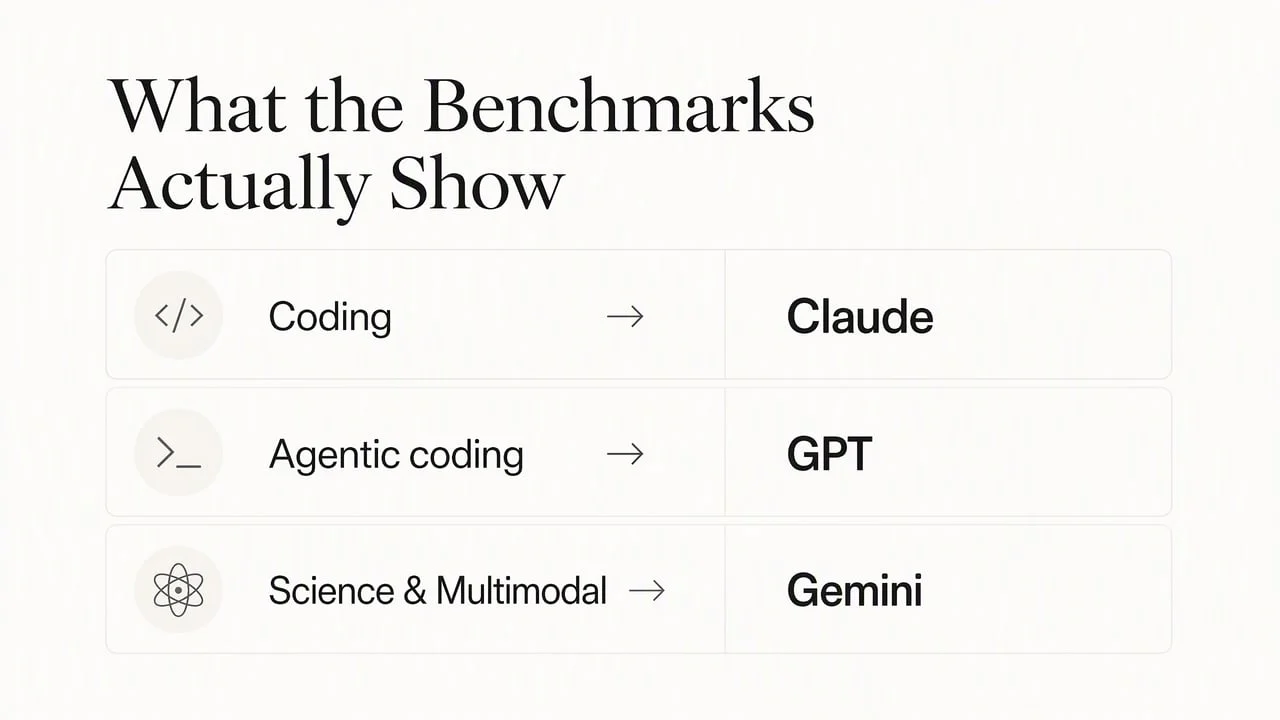
The supplied illustration is a simplified workload map, not a verified live leaderboard. Its winner labels should not be used as current rankings.
Read benchmark categories as a map of what to test, not a procurement ranking. A model that excels at one task can trail on another, which is why mature teams route by task instead of standardizing on a single provider.
Three anti-patterns to avoid:
- Buying on one benchmark. A single row is not a procurement case. Test your own traces.
- Treating an announcement as proof of API access. Check the exact model ID and your account's access before planning a migration. Gemini 4 Carbon now has a paid public API and is available through BeatAPI as
gemini-4-carbon; older restricted-access descriptions no longer apply.
- Assuming scores transfer. Your workload has messy inputs, tool calls, and retries. Published evaluation conditions may not match it.
For a closer agent-specific comparison, use the Astra vs Claude Opus reasoning guide and evaluate both against the same acceptance suite.
The Costs the Headlines Skip
Three mechanisms decide your real bill and integration effort, and none of them fit into a headline comparison.
Prompt caching. OpenAI documents automatic caching for matching prompt prefixes on eligible requests of at least 1,024 tokens. Anthropic supports explicit cache_control configuration; measure both cache writes and reads rather than treating every request as a hit. Google offers implicit and explicit caching, with storage charges relevant to explicit caches. Provider-native cache behavior is not proof that a gateway exposes every cache option identically. OpenAI caching, Anthropic caching, Google caching.
If your workload repeats a large system prompt, caching can be a major lever. For example, Fable 5.1's specifications list $10/1M for ordinary input and $0.25/1M for cache reads, with separate write rates. That is not a blanket discount on the whole bill: output, misses, writes, and retention still matter.
Embeddings. OpenAI has dedicated text embedding models. Google's Gemini Embedding 2 supports multimodal embeddings. Anthropic's embeddings documentation directs users to an external provider. That can add a dependency and separate billing if you build directly on Claude. Do not assume a model gateway exposes embeddings just because it exposes text generation. OpenAI embeddings, Google embeddings, Anthropic embeddings guidance.
Native multimodality. Google supports direct video and audio understanding in compatible Gemini models. The Astra and Fable specifications list text and image inputs with text output. Tools or separate models can extend a pipeline, but that is different from native audio/video input to the selected text model. Check the exact model and endpoint, not just the provider logo.
Before you commit, check four things on your own workload:
- Cost per accepted task, not cost per token.
- Cache behavior under your real prompt structure.
- Whether you need embeddings, and which endpoint supplies them.
- Whether the selected route accepts your actual media inputs.
Which One Should You Choose?
Match the provider to the workload, then keep a second option live. This framework is deliberately workload-first:
| Your workload | First candidate | Why evaluate it | Anti-pattern |
|---|
| Terminal agents, tool-heavy automation | OpenAI | Agentic execution and computer-use tooling | Assuming chat quality equals agent quality |
| Large-codebase refactors, spec-following | Anthropic | Sustained reasoning and precise instruction-following | Ignoring embeddings and other external dependencies |
| Long documents and video | Google | Large context and native multimodal input | Assuming the base rate applies to the full context window |
| Broad product surface, many model types | OpenAI | Wide ecosystem and tool integration | Paying frontier prices for routine traffic |
| Cost-critical bulk text | Google Flash and OpenAI Luna | Multiple low-cost candidates worth testing | Trading away accuracy you actually need |
Who each provider fits:
- OpenAI fits teams shipping agents and tools, and teams evaluating a broad ecosystem spanning budget to frontier.
- Anthropic fits teams where correctness under a long specification matters, especially in code.
- Google fits teams working with large or multimodal inputs at volume.
For anything beyond a single narrow use case, the mature answer is routing, not allegiance. Pick a primary, keep a tested fallback, and decide by task.
How to Run All Three Without Lock-In
Routing across providers is the right strategy and often the wrong amount of work. Done the obvious way, it means three API keys, three sets of docs, and separate billing relationships. That overhead can stop teams from routing at all.
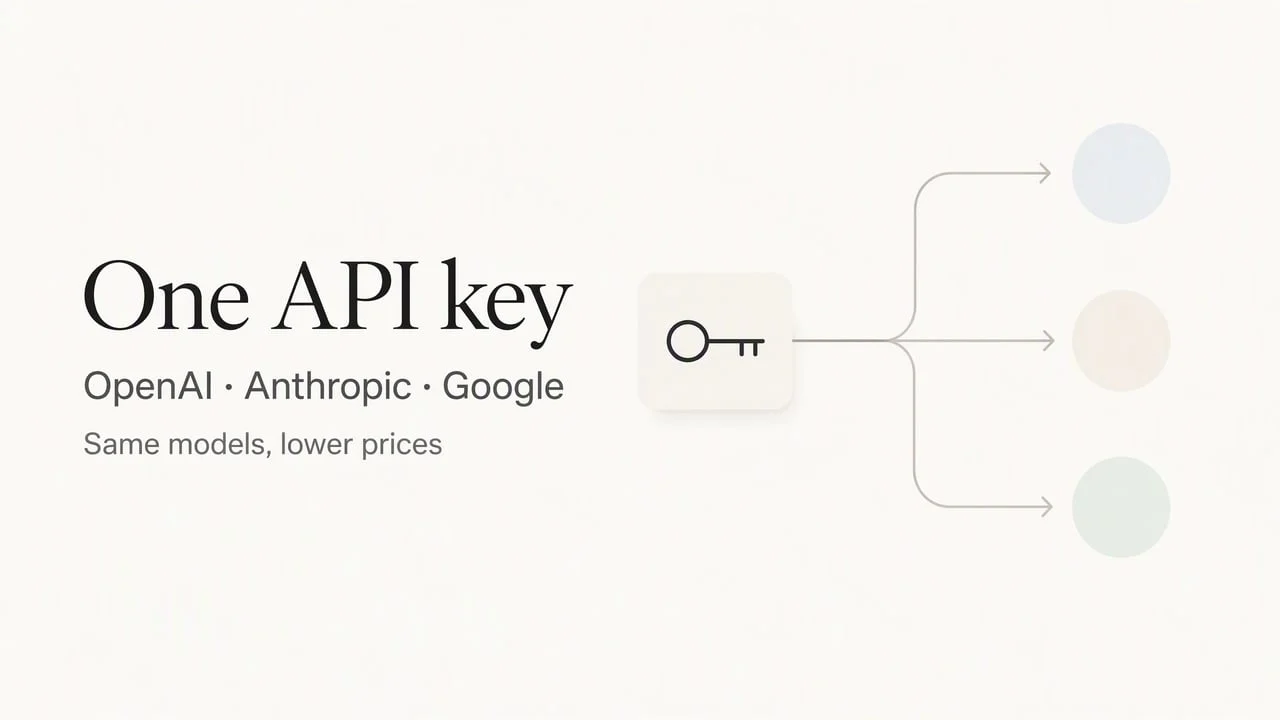
BeatAPI provides access to OpenAI, Anthropic, and Google model routes through a single key. Start with the model catalog, confirm your account's model access, and compare the matched specification on the BeatAPI pricing.
The selected GPT-6 Astra, Claude Fable 5.1 and Gemini 4 Argon routes share one account. Long-context rates and cache costs must be compared separately.
The mechanics are built for switching rather than allegiance:
- One key across supported routes. No separate provider credentials to rotate for those BeatAPI calls.
- Shared account and billing, with distinct API surfaces. Text uses documented compatibility endpoints such as
/v1/responses; asynchronous image and video generation use task submission and polling. One key does not mean every request or response shape is identical.
- Application-owned fallbacks. Keep a second public model ID configured and test it. Do not assume automatic failover, parameter parity, or unchanged tool behavior.
- Observable outcomes. Inspect usage and text responses; for asynchronous media, track task status and output files. Verify the result rather than trusting a completion summary.
Before changing a model ID, test streaming, structured outputs, tool schemas, reasoning settings, media inputs, errors, and token accounting. A unified key removes credential overhead; it does not erase model-specific semantics.
The point is not to pick a side in the Gemini-versus-GPT-versus-Claude debate. It is to make the choice reversible, so the provider that fits the workload wins without forcing a new vendor relationship each time.
FAQ
Which of the three is the strongest model?
There is no single strongest for every workload. Use coding, terminal, science, and math evaluations as separate signals, then measure your own task completion and correction cost.
If I only care about price, who wins?
Among the three selected higher-end rows, Gemini 4 Argon has the lowest listed token rate. At the value end, GPT-5.6 Luna is cheaper than the Flash rows in this comparison. Check quality, cache behavior, and cost per accepted task before choosing.
Can I use all three without three separate integrations?
You can access supported routes through one BeatAPI key and account. Endpoint compatibility and model-specific parameters still need testing; synchronous text and asynchronous media do not share one universal task shape.
How much can prompt caching actually save?
It depends on eligible matching prefixes, hit rate, write cost, retention, and output usage. A low cache-read rate is not the same as that percentage off the entire bill. OpenAI's automatic prompt caching starts at 1,024 tokens on eligible requests.
Can I use Gemini 4 right now?
Yes. Gemini 4 Argon has been generally available since October 13, 2026. Gemini 4 Carbon opened its paid public API on November 10, and both are available through BeatAPI. Choose Argon for faster everyday interaction and consider Gemini 4 Carbon for harder reasoning, while accounting for its higher thinking-token use.
Does it matter that Anthropic uses an external embeddings provider?
Only if you need embeddings. Budget for that dependency or use a separate documented embedding endpoint. BeatAPI text-model access alone does not establish embedding API availability.
Google, OpenAI, and Anthropic are not competing to be the single best model for every task. The team that wins stops asking "which is best" and starts asking "best for what," then keeps a tested alternative ready.