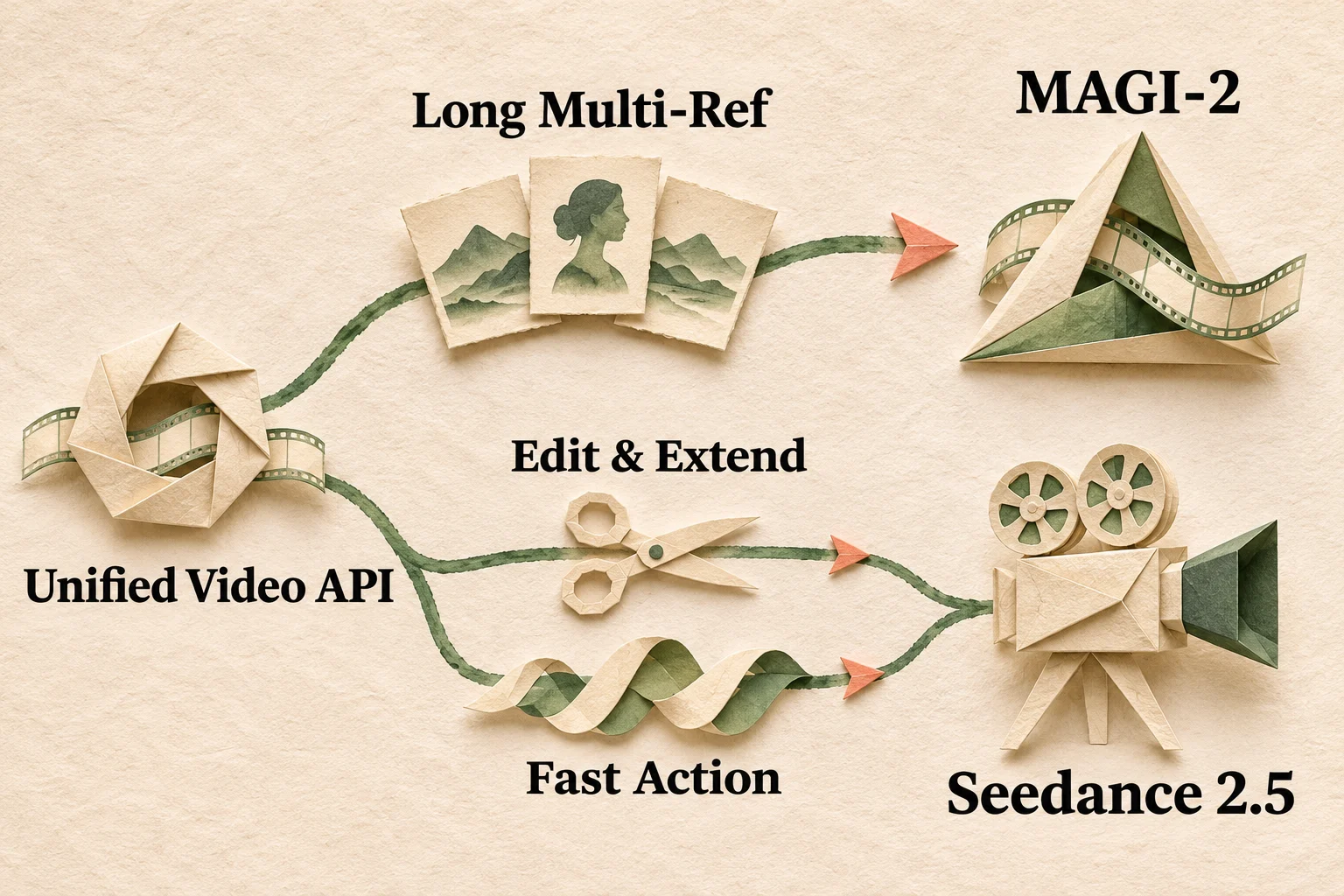
Choose MAGI-2 (magi-2) when you need 15-to-30-second 1080p takes, multi-video reference ad remakes without reference-video surcharges, or the lowest 1080p retake cost. Choose Seedance 2.5 (seedance-2.5) when you need to edit or extend an existing clip (edit / extend), feed more than 20 reference files, shoot high-speed fight choreography, or deliver finished multi-layered audio without post-production sound design.
Sand.ai released MAGI-2 on November 24, 2026 (PT) as a 480B-parameter (~28B active) single-stream Transformer with Multi-Head Latent MoE (see our MAGI-2 architecture and limits overview). MAGI-2 outputs fixed 1080p, 25 fps native audio-video clips from 4 to 30 seconds and takes up to 20 image, video, and audio references per call. ByteDance's Seed team released Seedance 2.5 on July 31, 2026 for 4-to-30-second native audio-video generation at 480p, 720p, and 1080p, supporting up to 50 multimodal references plus timestamp-level video editing and extension. Both magi-2 and seedance-2.5 run live on BeatAPI through one POST /v1/videos/tasks endpoint, one API key, and one USD balance.
Quick answer
On Artificial Analysis Video Arena v2.1, MAGI-2 ranks #1 on image-to-video with audio at 1163±14 Elo, just 5 points ahead of #2 Seedance 2.5 at 1158±14 Elo (overlapping 95% intervals). Removing audio widens MAGI-2's lead on silent image-to-video to 25 points (1153 vs 1128). On Higgsfield's 6-model blind arena judged by directors, animators, and designers, Seedance 2.5 ranks #1 at 1219 and beats #2 MAGI-2 (1146) in 61% of head-to-head matchups.
Both models generate 30-second 1080p video in a single request, so the real feature split is post-production control and reference capacity. On BeatAPI, seedance-2.5 supports in-place editing (task_type: "edit"), clip extension (task_type: "extend"), audio-only reference input, MOV output, and up to 50 references. On BeatAPI, magi-2 creates new clips only, caps references at 20 items, and locks output to 1080p.
Independent creator tests point to a clear workflow split. Given a detailed beat-by-beat shot list and clean reference sheets, MAGI-2 holds faces, on-screen product text, and cut timing across 30 seconds close to Seedance 2.5. When prompts are short, action moves fast, or multi-source soundscapes matter, Seedance 2.5 still delivers steadier physics and more natural audio.
At 1080p, Seedance 2.5 costs 5.5x to 6.5x more than MAGI-2. BeatAPI charges a flat $0.088/s for magi-2 ($0.704 for 8s; $2.64 for 30s) with $0 reference-video fees. BeatAPI charges $3.869 for an 8-second 1080p seedance-2.5 clip without video input (about $14.43 for 30s; about $17.06 on BytePlus ModelArk). Even Seedance 2.5's 480p draft tier on BeatAPI ($0.775 for 8s) costs slightly more than MAGI-2 at 1080p.
Specs, leaderboards, and pricing at a glance
The table below compares MAGI-2 and Seedance 2.5 across specs, blind rankings, and live metered rates. Upstream vendor demos and BeatAPI's actual API parameters are listed separately so you do not build against unexposed endpoints.
$0 extra (reference images, videos, audio, and audio toggle add nothing)
Billed per second (reference video seconds + output seconds billed at the with-video-input tier rate)
Why MAGI-2 leads Artificial Analysis while Seedance 2.5 leads Higgsfield
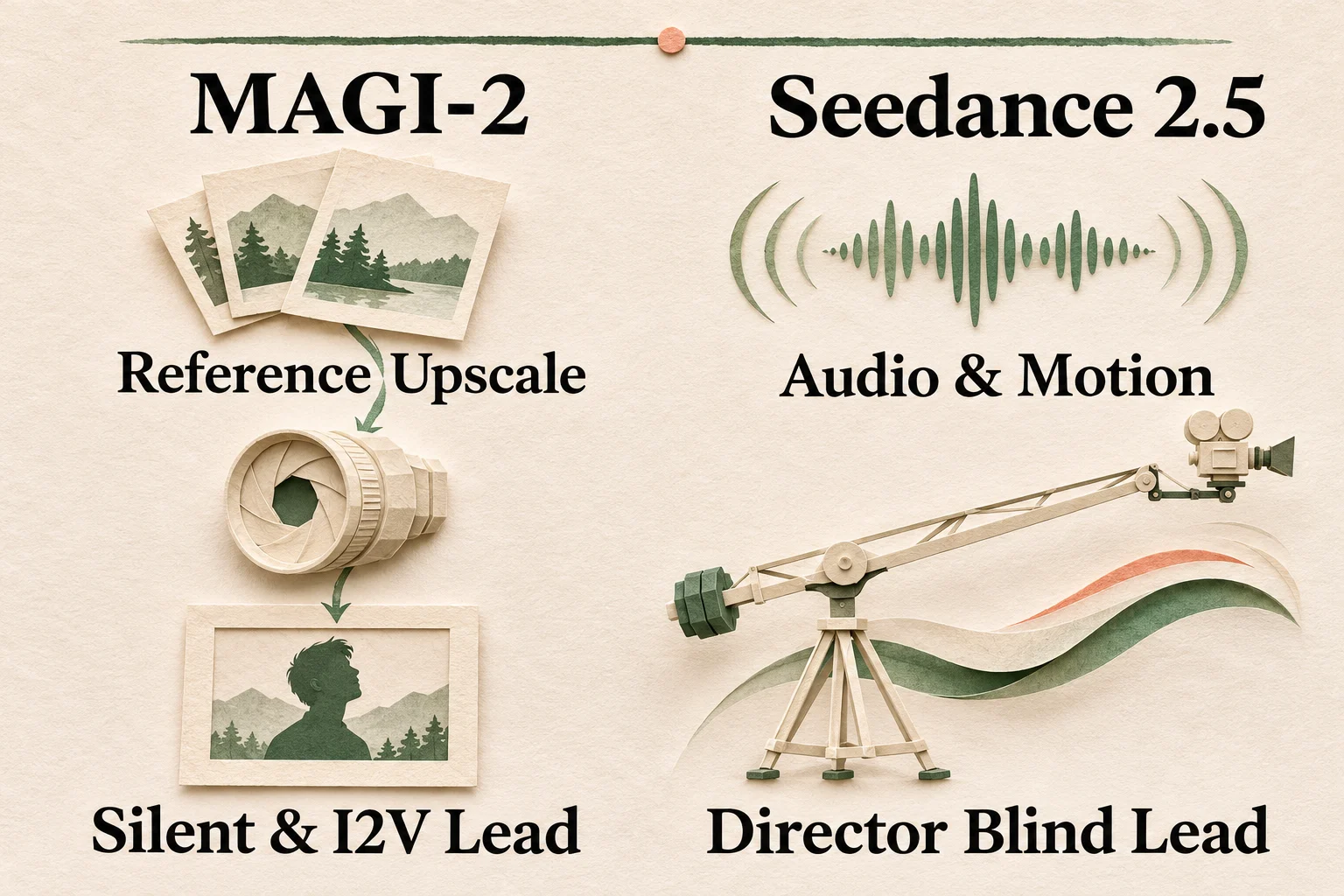
The two leaderboards pick different winners because they reward different strengths. Artificial Analysis's silent and image-to-video tracks reward MAGI-2's reference-guided 1080p upscaler, while Higgsfield's director-voted arena rewards Seedance 2.5's soundscapes, camera staging, and high-motion stability.
Leaderboard track (checked Nov 24–27, 2026)
MAGI-2 (1080p)
Seedance 2.5 (1080p)
Seedance 2.5 Flash (720p)
What the gap means
AA-Video-I2V v2.1 (with audio)
#1 · 1163±14 (95% CI 1149–1177)
#2 · 1158±14 (95% CI 1144–1172)
#8 · 1135±16
5-point gap with overlapping CIs; statistically tied at the top
AA-Video-I2V-Silent v2.1
#1 · 1153
#3 · 1128
—
Removing audio widens MAGI-2's lead to 25 points on pure reference fidelity
AA-Video-T2V v2.1 (with audio)
#7 · 1150±13 (95% CI 1137–1163)
#5 · 1154±12 (95% CI 1142–1166)
#18 · 1122±15
Seedance 2.5 leads by 4 points (overlapping CIs); both trail Wan 3.0 and MiniMax H3
AA-Video-T2V-Silent v2.1
#2 · 1144
Outside top 5
—
Same silent-vs-audio pattern: audio scoring pulls MAGI-2 down
AA-Video-Editing v1.1
Not listed
#4 · 1152±10
Not listed
Seedance 2.5 holds a tested editing track record; MAGI-2 lacks a public editing API
Higgsfield Video Arena (6 models)
#2 · 1146 (60.5% win rate)
#1 · 1219 (63.9% win rate)
Not listed
Blind votes from directors, animators, and designers; Seedance 2.5 wins 61% head-to-head
Comparing Artificial Analysis's audio and silent boards exposes the first reason right away. On AA-Video-I2V v2.1, MAGI-2 beats Seedance 2.5 by 25 points without audio, yet that lead shrinks to 5 points once audio is graded. On AA-Video-T2V v2.1, MAGI-2 sits at #2 silent and drops to #7 with audio, 4 points behind Seedance 2.5. Sand.ai's MAGI-2 technical post explains both sides of that swing. During 1080p upscaling, MAGI-2's upscaler reads the original reference images a second time to rebuild small faces and text from source pixels, which lifts silent visual fidelity. At the same time, Sand.ai acknowledges that MAGI-2's multi-source soundscapes still lack physical depth and layering, which costs points whenever audio is judged.
The second reason shows up in Higgsfield's 61%-to-39% head-to-head result. Higgsfield is MAGI-2's overseas launch partner, yet its panel of directors, animators, and designers still voted for Seedance 2.5 more often. Beyond audio, Sand.ai notes an "alignment tax" from post-training MAGI-2 on a small aesthetics-heavy dataset: visual polish jumped, while spontaneous shot planning from short prompts got weaker. ByteDance's Seedance 2.5 release post specifically targets natural skin textures, lighting continuity, and multi-beat one-take transitions. When prompts leave room for the model to direct the camera on its own, Seedance 2.5 still stages shots closer to live-action footage.
Why the two leaderboards diverge: MAGI-2's reference-re-injected upscaler drives silent and I2V wins, while Seedance 2.5's audio and camera staging drive director blind-test wins.
Four debates from creator tests, and what actually holds up
Within days of MAGI-2's launch, YouTube reviewers, Reddit threads, and commercial short-drama teams split into two loud camps. Half celebrated getting near-Seedance 2.5 clips at a fraction of the price; the other half argued that Seedance 2.5 still sits in a higher tier for music videos and action. Putting those real tests next to each other shows where each camp is right.
1. Why MAGI-2 only outputs 1080p, and why it is not a 480p wrapper
After YouTube channels posted side-by-side MAGI-2 vs Seedance 2.5 comparisons, commenters questioned why MAGI-2 omits 480p and 720p options and occasionally renders slightly smooth skin in close-ups. Several viewers guessed MAGI-2 was a 480p Seedance wrapper passed through an upscaler.
Those viewers spotted a real upscaling signature, though MAGI-2 is Sand.ai's own architecture (Sand.ai already published the 114B Apache 2.0 MAGI-2-preview on Hugging Face). Full 480B MAGI-2 runs a two-stage pipeline: the base model generates low-resolution latent audio-video to lock timing and motion, then a dedicated spatio-temporal upscaler lifts it to 1080p at 25 fps while reading the raw reference images again. That design pays off heavily on commercial shots packed with packaging text, maps, or product labels, where re-reading source pixels keeps typography sharp without paying for external upscalers. On moody close-ups without tight portrait references, however, the upscaler can smooth out fine skin grain, which is why cinema-focused directors still prefer Seedance 2.5's direct lighting and texture.
2. On 30-second scripts, MAGI-2 holds tight asset details while Seedance 2.5 handles heavy action better
Side-by-side creator tests on YouTube, Reddit (r/HiggsfieldAI, r/accelerate), and commercial short-drama workflows explain why reviews diverge by script style. When creators give MAGI-2 a structured, second-by-second shot list with clean reference sheets and explicit negative rules, MAGI-2 holds four-person dialogue scenes across 30 seconds without face swaps, preserves exact wardrobe colors and camera angles, and keeps small packaging copy legible in 12-to-15-second beverage and skincare ads.
Once prompts get shorter or shift to mech fights, close-quarters martial arts, crowded chase choreography, or whip-pans, creator feedback tilts back to Seedance 2.5. That split matches Sand.ai's own documented failure modes in its launch write-up: MAGI-2 can still lose trajectory continuity during extreme high-speed motion, smooth over subtle local movement in medium or wide 2D animation shots, and rely more heavily on explicit prompt structure than Seedance 2.5. For physical weight, motion blur, and spontaneous multi-beat staging, Seedance 2.5 remains steadier.
3. Both sync lips, yet MAGI-2 audio often needs a separate mix for client delivery
Because both MAGI-2 and Seedance 2.5 generate sound inside the same backbone as video, single sound events like cracking a can, dropping ice, or speaking a line land cleanly on frame without manual syncing. Across multi-take commercial tests, though, MAGI-2 voices can sound slightly synthetic, dense soundscapes mixing rain, crowd murmur, and dialogue feel flatter, and background music occasionally creeps in even when prompts ask for none. Seedance 2.5 delivers richer room tone and more natural vocal delivery out of the box.
High-volume short-drama and ad teams have settled on a practical split. They run MAGI-2 as their 1080p visual engine to lock faces and cut timing cheaply, then mute or replace the track with dedicated voiceover and foley in post. Seedance 2.5 gets the nod when a clip has to ship straight from the API with usable native audio or when a music track drives the entire shot on its own.
4. Moderation, launch-week queues, and the 480B open-weights reality
Three community talking points cause avoidable surprises during onboarding:
Both models block real people and copyrighted characters on public APIs. Several YouTube reviewers noticed Seedance 2.5 rejecting hospital drama prompts or flagging repeated edits of their own clips as copyrighted, leading some viewers to assume MAGI-2 is unrestricted. On hosted commercial APIs including BeatAPI, both magi-2 and seedance-2.5 enforce strict moderation on real faces, public figures, and IP with no face whitelist. Policies vary mainly by consumer web front end, and BeatAPI refunds rejected jobs in full.
30-second 1080p renders always require asynchronous queues and generous timeouts. Launch-week creator threads reported heavy queue spikes on consumer web front ends and single-job reseller caps. Even under normal load, full 30-second native audio-video renders on either magi-2 or seedance-2.5 should never run behind synchronous HTTP timeouts; poll GET /v1/tasks/{task_id} or wire a completion webhook.
Promised 480B open weights will not cut local GPU costs anytime soon. As of November 27, 2026, Sand.ai has not published the 480B weights, a release date, or a commercial license; Hugging Face still lists only 114B MAGI-2-preview and MAGI-1. Even running the smaller 114B preview requires multi-GPU data-center hardware (such as 8 Hopper or domestic accelerator cards). For most small studios and solo builders, pay-as-you-go APIs beat self-hosting for the foreseeable future.
Four real clips showing what each model handles best
The four clips below come from Sand.ai, Higgsfield, and public creator posts (browse more full prompts in the MAGI-2 Prompt Gallery and Seedance 2.5 Prompt Gallery). They show each model's ceiling with clean reference assets and explicit scripts; short, vague prompts will produce lower consistency.
MAGI-2 Example 1: One character sheet locked across three flower-field settings
Sand.ai's Into the Giant Flower World demo feeds MAGI-2 a character sheet plus an iris hillside, a pink rose garden, and a lily valley. MAGI-2 alternates between close-ups, low angles, and wide shots while keeping facial features, collar details, and each garden's palette intact, bridging cuts with foreground petals.
Reference inputs: locked character wardrobe plus iris hillside, pink rose garden, and lily valley (Sand.ai).Sand.ai 1080p demo. Watch face preservation and color anchors across scene cuts.
MAGI-2 Example 2: Three reference images driving a 1920s jazz bar walk-and-talk
Higgsfield's partner demo binds two leads to @Image 1 and @Image 2, locks the marble bar and practical lighting to @Image 3, and scripts every turn across the dance floor and corridor along with every spoken line. MAGI-2 holds room geometry, prop continuity, and lip-sync through crowd occlusion, while also illustrating how detailed complex blocking scripts need to be.
Higgsfield partner demo (1080p). Demonstrates MAGI-2 executing a long timed blocking script.
Seedance 2.5 Example 1: 30-second one-take tokusatsu transformation and impact VFX
Creator @Naiknelofar788 gives Seedance 2.5 one heroine reference image and a continuous transformation prompt: standing in wasteland ruins, shouting "Henshin!", crystal shatter, interlocking armor growth, and a high-speed strike that cracks the ground. Layered particles, rapid camera travel, and heavy physical impact remain Seedance 2.5's home turf.
Seedance 2.5 Example 2: Eight timed shots pairing voice timbre, face, and low-key lighting
Creator @ObsceneSelene binds appearance to @Image 1 and vocal accent to @Audio 1 across eight timestamped beats from 0s to 30s, mixing extreme eye close-ups, harsh shadows, industrial drone, and heavy breathing. Seedance 2.5 blends low-key lighting, tense micro-expressions, and vocal atmosphere cleanly in one pass.
Six real production jobs: which model should take each one
Most teams do not need to pick one model exclusively. Routing each shot by reference load, editing need, and motion speed keeps both visual quality and monthly spend under control.
Reference re-injection holds faces across cuts, 20 references cover 4–6 characters plus locations, and 30s 1080p costs $2.64 on BeatAPI; write explicit beat-by-beat prompts and dub client finals in post
2. E-commerce ad remakes (motion-ref video + product/model photos)
MAGI-2 (BeatAPI magi-2)
Accepts up to 5 reference videos with $0 reference-video fees ($1.056 for 12s 1080p) and keeps bottle labels legible; equivalent seedance-2.5 1080p costs $6.89 (6.5x more) because reference seconds are billed
3. Editing, wardrobe swaps, green-screen replacement, or extending finished clips
Seedance 2.5 (BeatAPI seedance-2.5)
BeatAPI exposes task_type: "edit" and "extend" plus mov export, backed by 1152 Elo on AA-Video-Editing; magi-2 creates fresh clips only on public APIs
61% head-to-head director win rate on Higgsfield, up to 50 references (including 30 images or 3D clay renders), and steadier fast-action physics
5. Audio-only music visualizers or beat-driven reels (no image/video refs)
Seedance 2.5 (BeatAPI seedance-2.5)
BeatAPI seedance-2.5 accepts reference_audios without visual assets and tracks musical pacing well; if you also pass character/scene images, magi-2 accepts up to 5 audio clips at 5.5x lower 1080p cost
6. Stylized 2D animation, woodblock, or art-film continuous takes (20–30s)
Split by motion speed
Start with MAGI-2 for slow-to-medium style transitions (woodblock, painting morphs, stop-motion); run a 5s test first on busy mid-shot 2D anime or fast fights and route to Seedance 2.5 if local motion looks too smooth
Routing video jobs from one unified BeatAPI endpoint between MAGI-2 and Seedance 2.5.
Workflow 1: Cutting 30-second short-drama scene costs by 70%+
Generating 30-second 1080p episodes on Seedance 2.5 adds up fast: two or three retakes per scene run $30 to $50 each. On BeatAPI, one 30-second 1080p MAGI-2 take costs $2.64. Start each new cast setup with one 5-second test ($0.44) to check face fidelity and moderation, then scale duration to 25–30 seconds with a timed script drafted by an LLM. Save Seedance 2.5 for the one or two hero action beats or moody close-ups per episode.
Workflow 2: Replicating winning vertical ads with new models and SKUs
When a performance team clones a proven 12-second vertical ad rhythm with a new product and model, the reference video is as long as the output. Seedance 2.5 bills both durations together (12s reference + 12s output at 1080p = 24 billable seconds, about $6.89 on BeatAPI). MAGI-2 waives reference-video fees and bills only the 12 output seconds ($1.056 on BeatAPI) while keeping bottle labels sharp, cutting per-variant spend by 84%.
Workflow 3: Targeted client revisions and shot extensions
Once a client approves an 8-second cut and asks only to swap a jacket color, replace a green screen, or extend the closing pull-back by 6 seconds, generating a brand-new clip with MAGI-2 will shift untouched details. Route those tickets to Seedance 2.5 with task_type: "edit" or "extend" (adding output_format: "mov" for NLE grading; see our Seedance 2.5 video editing guide). Even though editing bills the source duration twice ($1.87 at 720p or $4.61 at 1080p for an 8-second clip on BeatAPI), it beats rebuilding an approved scene from scratch.
API access, unified BeatAPI routing, and four parameter traps
Before wiring either model into production workers, check each vendor's onboarding gates. On BeatAPI, magi-2 and seedance-2.5 share one asynchronous contract (POST https://api.beatapi.io/v1/videos/tasks and GET /v1/tasks/{task_id}), one API key, and one non-expiring USD balance.
Direct vendor integration comes with four practical hurdles. For MAGI-2, Sand.ai's API platform lists $0.08/s but still lacks self-serve top-ups, splits multimodal references (native v2) from first/last frames (Ark-compatible endpoint), and omits idempotency keys on creation calls. Higgsfield's API offers self-serve $0.08/s access, yet caps every account at 1 concurrent job across all MAGI-2 modes unless you negotiate with sales. For Seedance 2.5, BytePlus ModelArk requires at least $30 in credits or a 90-day expiring resource pack to activate; OpenRouter, Replicate, Cloudflare Workers AI, and fal cap output at 720p with no 1080p tier, and OpenRouter (5.5%) plus Cloudflare (5%) add credit-funding fees.
BeatAPI serves both MAGI-2 (Magi 2 API docs, Generator) and Seedance 2.5 (Seedance 2.5 API docs) with self-serve pay-as-you-go billing, Idempotency-Key retry protection, and full refunds on failed or moderation-rejected jobs. Add these four validation checks to your request builder when routing between both models:
Keep aspect ratio and resolution strict: Never pass aspect_ratio when sending images (1–2 frames) to magi-2, because frame mode inherits the first frame's shape; pass resolution: "1080p" or omit it. For seedance-2.5, defaults are 720p and adaptive, valid resolutions are 480p, 720p, and 1080p, and sending 4K returns HTTP 400 (use seedance-2 for 4K).
Isolate edit and extend fields: For seedance-2.5 edits, pass task_type: "edit" and omit both duration and aspect_ratio. For extensions, pass task_type: "extend" and set duration to the total final length including the source clip (e.g., 10 to add 5s to a 5s source). Sending task_type or output_format to magi-2 fails validation.
Check reference-video hosting and frame rate: Neither model allows mixing images with reference_* arrays, and both cap reference videos at 2–30 seconds each and 30 seconds total. In addition, seedance-2.5 requires reference-video URLs to support HTTP byte-range requests (so the gateway can measure billable length) and rejects clips under 24 FPS (including common 23.976 FPS exports; re-export at 24+ FPS or upload via POST /v1/files).
Match prompt limits and persist finished MP4s: BeatAPI caps prompt at 5,000 characters on both models (Sand.ai direct allows 15,000). Use @image1, @video1, and @audio1 on magi-2; on seedance-2.5 reference mode, avoid words like "replace", "remove", or "extend" so the model does not misread a generation as an edit. Download data.output.media[].url to your own storage once a job succeeds, because BeatAPI hosted task URLs expire after 7 days.
API pricing: MAGI-2 at 1080p costs less than Seedance 2.5 at 480p
Real video API budgets come down to resolution, duration, reference-video billing, and retakes per approved clip. The rates below reflect public pay-as-you-go pricing checked on November 27, 2026 (USD; Volcengine Ark converted at 6.69 CNY/USD; taxes and custom enterprise discounts excluded):
Platform and model
480p (8s)
720p (8s)
1080p (8s)
1080p (30s)
Reference-video billing and limits
BeatAPI · magi-2
Not offered
Not offered
$0.704 ($0.088/s)
$2.64
$0 reference-video fee; self-serve pay-as-you-go, no 1-job cap, failed tasks refund in full
Sand.ai / Higgsfield · MAGI-2
Not offered
Not offered
$0.64 ($0.08/s)
$2.40
$0 reference-video fee; Sand.ai lacks self-serve top-up; Higgsfield API caps at 1 concurrent job
BeatAPI · seedance-2.5
$0.775 (16:9 ≈$0.096/s)
$1.563 (16:9 ≈$0.194/s)
$3.869 (16:9 ≈$0.481/s)
≈$14.43
Reference + output seconds billed at ≈$0.058 / $0.117 / $0.287 per second (16:9); 8s ref + 8s 1080p = $4.611
BytePlus ModelArk · Seedance 2.5
≈$0.824 ($0.103/s)
≈$1.848 ($0.231/s)
≈$4.552 ($0.569/s)
≈$17.06
Reference + output seconds billed at $0.061 / $0.138 / $0.340 per second; $30 minimum to activate
Volcengine Ark · Seedance 2.5
≈$0.808 (¥0.67/s)
≈$1.808 (¥1.51/s)
≈$4.480 (¥3.74/s)
≈$16.80
Reference + output seconds billed; mainland China verification and CNY settlement
fal · Seedance 2.5
≈$1.720 ($0.215/s)
≈$3.696 ($0.462/s)
No 1080p
No 1080p
480p and 720p only; 720p costs about 2.4x BeatAPI's rate
BeatAPI · seedance-2.5-flash
$0.504
$1.084
Not offered
Not offered
Faster budget Seedance 2.5 tier for low-res drafts and short clips
Many teams worry that MAGI-2 lacks a 480p or 720p draft tier for cheap iteration. Put the actual prices side by side: BeatAPI's 1080p magi-2 ($0.704 for 8s) costs 9% less than BeatAPI's 480p seedance-2.5 ($0.775 for 8s). Dropping standard Seedance 2.5 to 480p still does not undercut MAGI-2 at 1080p. Drafts only become cheaper than MAGI-2 when you switch to Seedance 2.5 Flash ($0.504 for 8s 480p) or MiniMax H3 ($0.16 for 8s 480p; see MAGI-2 vs MiniMax H3).
The four budget calculations below apply those published rates directly to common workloads (arithmetic planning estimates, not measured billing logs):
Assumed workload
MAGI-2 (BeatAPI magi-2)
Seedance 2.5 (BeatAPI seedance-2.5)
Seedance 2.5 (BytePlus direct)
Budget takeaway
Workload A: 50 thirty-second 1080p drama scenes 2 attempts per approved clip (100 renders, no video ref)
Even under heavy trial-and-error, magi-2 1080p slightly undercuts a Seedance 2.5 Flash 480p draft workflow
Two habits cut monthly spend further. Before ordering a 25- or 30-second magi-2 take, run one 4-to-5-second check ($0.352–$0.44) to confirm face likeness and moderation, log the seed, and scale duration afterward. Before sending reference_videos to seedance-2.5, trim unused head and tail seconds, because every extra reference second bills directly (see Seedance 2.5 API pricing across 9 providers for full provider math).
FAQ
Which model produces better video quality: MAGI-2 or Seedance 2.5?
Quality depends on input mode and shot type. With clean reference images where faces and on-screen text must stay sharp, MAGI-2 beats Seedance 2.5 by 25 points on Artificial Analysis silent I2V (1153 vs 1128) and ties within margin on I2V with audio (1163 vs 1158). For natural film-like skin lighting, fast fight choreography, and complex multi-beat directing, Seedance 2.5 still holds the edge in Higgsfield's director blind tests (61% vs 39%) and community tests.
Is MAGI-2 really 10x cheaper than Seedance 2.5 via API?
At matched 1080p specs, the real API spread is typically 5.5x to 7.1x, approaching 10x only on specific resellers or long reference-video jobs. On BeatAPI without video input, an 8-second 1080p clip costs $0.704 on magi-2 versus $3.869 on seedance-2.5 (5.5x). Against BytePlus ModelArk's official 1080p rate ($4.552), the gap is 6.5x; against Artificial Analysis's listed per-minute rates ($4.80 vs $34.12), it is 7.1x. Adding a 12-second reference video widens the gap to 6.5x versus BeatAPI and 7.7x versus BytePlus because MAGI-2 waives reference-video fees.
How should commercial teams handle MAGI-2's weaker native audio?
Single sound effects (can tabs, ice drops, table slaps) and standard lip-sync work fine natively on MAGI-2. For commercial ads or dramas needing layered ambience, nuanced voice acting, or strict silence with zero stray music, use MAGI-2 as your 1080p visual engine, set generate_audio: false on BeatAPI (same rate), and mix dedicated voiceover and foley in post. If a workflow must ship finished audio straight from the API, use Seedance 2.5.
Can MAGI-2 edit or extend existing videos like Seedance 2.5?
Not through current public APIs, including BeatAPI magi-2. Although Sand.ai showed partial video editing in its launch blog, BeatAPI's magi-2 uses reference_videos strictly to guide new generations. Whenever you need to keep an existing clip's length, framing, and untouched pixels while editing a jacket or extending the ending, call BeatAPI seedance-2.5 with task_type: "edit" or "extend".
Should teams wait for MAGI-2's open weights to self-host?
Not if you have deliverables due now. As of November 27, 2026, Sand.ai has not announced a release date or commercial license for the 480B weights; Hugging Face hosts only the 114B MAGI-2-preview. Even sparse 480B inference requires multi-GPU data-center hardware, making idle GPU costs far higher than $0.088/s metered API billing for most teams. Re-evaluate self-hosting after weights and license terms ship only if you already operate multi-GPU clusters or need custom LoRA fine-tuning.
Do I need two separate API integrations to run both MAGI-2 and Seedance 2.5?
No. On BeatAPI, MAGI-2 (magi-2) and Seedance 2.5 (seedance-2.5) share POST /v1/videos/tasks, GET /v1/tasks/{task_id}, one API key, and one USD balance. Keep per-model validation rules in your request builder (fixed 1080p and no aspect_ratio with frames on magi-2; task_type, resolution, byte-range hosting, and ≥24 FPS checks on seedance-2.5) so one worker routes shots dynamically.
Next step: Pull five real scripts from your active queue (one 20–30s multi-character dialogue scene, two reference-video ad remakes, one fast action beat, and one clip edit) and run them under one BeatAPI key on MAGI-2 (testing 5 seconds first) and Seedance 2.5 (using edit / extend where needed; see the Seedance 2.5 prompting guide). Measure settled cost per approved clip before locking your production routing split.