Gemini 4.0 Neon vs Claude Opus 5.5: Which Model Fits Which Task?
Compare Gemini 4.0 Neon and Claude Opus 5.5 across six engineering and knowledge tasks, nine thinking-effort tiers, output and caching limits, and BeatAPI pricing.
Use Gemini 4.0 Neon at its default high thinking level when the work centers on reading a large legacy repository to draft a refactor spec, running multi-app automation scripts, or reconciling screen recordings, audio, and PDFs in one context. Use Claude Opus 5.5 when you need merge-ready patches in an unfamiliar open-source repo, fault-tolerant backend changes like rate limiting and reconnect handling, multi-hour agent runs past 15 turns, or polished client-facing deliverables.
Google released Gemini 4.0 Neon on November 18, 2026, under model ID gemini-4-neon, with a 1,048,576-token shared window accepting text, images, audio, video, and PDF. Anthropic released Claude Opus 5.5 on September 22, 2026, under model ID claude-opus-5-5, with a 1,000,000-token context window accepting text and images. Both models return text only and bill internal reasoning tokens at the output token rate.
Quick answer
On the Artificial Analysis Intelligence Index v5.0.1, Gemini 4.0 Neon at high scores 60 at $3.74 and 15.3 minutes per task (at official list rates), beating Claude Opus 5.5 at max (59, $10.04, 24.8 minutes) on score, task cost, and wait time while accepting native audio and video.
Claude Opus 5.5 at max stays ahead on agentic knowledge deliverables in AA-Briefcase v1.1 (1797 Elo vs 1699 for Gemini 4.0 Neon at xhigh), open-source repository coding in FrontierCode-AA 2.0 (46.4% vs 44.4%), and hard physics in CritPt v2 (68.0% vs 60.5%), while offering a 128,000-token synchronous output cap and explicit 1-hour caching.
Keep Gemini 4.0 Neon on default high instead of turning on xhigh globally. Stepping Neon from high to xhigh adds 1 index point (60 to 61) while raising official task cost by 72% ($3.74 to $6.44) and stretching wait time to 26.9 minutes, slower than Claude Opus 5.5 at max.
Official synchronous list prices put gemini-4-neon ($3.00 input / $15.00 output per million tokens) 25% below Anthropic's official rates for claude-opus-5-5 ($4.00 / $20.00). On BeatAPI, synchronous standard rates drop gemini-4-neon to $0.90 / $4.50 (70% off, funded account required; signup credit does not apply) and claude-opus-5-5 to $2.00 / $10.00 (50% off). That makes gemini-4-neon 55% cheaper than claude-opus-5-5 on BeatAPI, and BeatAPI's claude-opus-5-5 33.3% cheaper than Google's direct gemini-4-neon.
Specs, benchmarks, and pricing at a glance
All prices below are USD per million tokens for standard synchronous API calls, excluding taxes, top-up fees, and custom enterprise contracts.
Dimension
Gemini 4.0 Neon (gemini-4-neon)
Claude Opus 5.5 (claude-opus-5-5)
Role and release date
Google mid-tier Gemini 4 reasoning model between Hydrogen and Carbon (November 18, 2026)
Anthropic flagship Opus model for long-running coding and knowledge work (September 22, 2026)
Native modalities
Input: text, image, audio, video, PDF; output: text
Input: text, image; output: text
Context and sync output cap
1,048,576 shared tokens; 65,536-token default sync output cap (longer output requires background mode or continuation)
1,000,000 context tokens; 128,000-token sync output cap (including thinking)
Thinking tiers and default
4 levels: low, medium, high (default), xhigh; minimal returns an error
5 levels: low, medium (API default), high, xhigh, max; adaptive thinking cannot be disabled
Prompt caching
Google Developer API supports implicit caching only (4,096-token shared prefix minimum, 95% hit discount, no write fee, no explicit 1h lock)
Explicit caching supported: 1.25× write for 5m TTL, 2× write for 1h TTL, 0.05× (95% off) on hits
1. Reading a legacy codebase to map service calls and write a refactor spec
Before touching a multi-hundred-file system with fuzzy requirements, split planning from implementation and hand the first pass to Gemini 4.0 Neon at default high. Put source files across services, interface contracts, and historical error logs into the 1M shared window, then ask Gemini 4.0 Neon to trace call paths, flag missing edge cases, and output a Markdown spec with target files and acceptance checks.
In Google DeepMind's published benchmarks, Gemini 4.0 Neon scores 95.2% on long-context graph traversal (GraphWalks BFS F1 across 256K to 1M tokens), compared with 66.8% for Claude Opus 5.5. Gemini 4.0 Neon also scores 54 to 55 on AA-Omniscience v1.1 factual calibration against 48 for Claude Opus 5.5, and ranks second on Agent Arena steerability, which helps when you tighten requirements mid-thread.
One limit matters during code review: do not feed an entire legacy repository to Gemini 4.0 Neon without test output and ask it to hunt freely for bugs. Without runtime context, open-ended whole-repo sweeps inflate style preferences and documented trade-offs into false high-severity alarms. Scope Gemini 4.0 Neon PR reviews to the exact diff, prior interface contract, and failing test logs.
2. Patching unfamiliar open-source repos and writing fault-tolerant backend code
When you move into high-risk backend changes such as Redis rate limiting, reconnect loops, concurrency locks, container isolation, or patches in an unfamiliar open-source codebase, route the task to Claude Opus 5.5. In those edits, guessing a third-party client's failure behavior or missing one cleanup branch costs far more than extra token spend.
On FrontierCode-AA 2.0, Claude Opus 5.5 at max scores 46.4% against 44.4% for Gemini 4.0 Neon at xhigh. On DeepMind's own reported coding suites, Claude Opus 5.5 also holds narrow leads on Terminal-Bench 4.1 (65.8% vs 65.2%) and FrontierCode 2.0 (47.3% vs 46.2%).
Agent runtime design widens this gap. On SWE-sweep, Gemini 4.0 Neon solves 12.8% inside the minimal mini-SWE-agent runner and jumps to 39.0% inside Google's orchestrated Antigravity environment. If your team runs a lightweight custom tool loop without dedicated context compaction and retry orchestration, or already standardizes on Claude Code, Claude Opus 5.5 drifts less and respects edit boundaries more consistently.
3. Multi-hour coding sessions past 15 turns with approvals or CI waits
For short 3-to-5-turn loops backed by automated unit tests, Gemini 4.0 Neon at high (or medium on smaller edits) finishes faster and cheaper, and its implicit cache avoids write surcharges once the shared prefix passes 4,096 tokens.
Once a session stretches past 15 turns, pauses for human approval or 15-minute CI builds, or needs a full migration plan plus multi-file diff in one final turn, Claude Opus 5.5 holds up better. Explicit 1-hour caching lets you lock the repository prefix across pauses without guessing whether an implicit cache survived, and the 128,000-token synchronous output cap gives twice Gemini 4.0 Neon's 65,536-token default room before truncation. If budget keeps you on Gemini 4.0 Neon for large projects, break the work into 3-to-5-turn chunks gated by passing tests.
4. Building frontend UI from scratch vs debugging with screen recordings and audio
Frontend work divides cleanly by starting point. When building a landing page, complex Tailwind layout, or interactive component system from a blank file, Claude Opus 5.5 produces more complete implementations on the first pass and leaves fewer stubbed-out skeletons on big multi-file prompts. When modifying an established design system under strict layout rules, or when you want to avoid correcting Claude's recurring default styling habits, Gemini 4.0 Neon follows structural constraints directly.
Once an incident report includes video or audio, choose Gemini 4.0 Neon. You can drop a screen recording of a UI stall, a stakeholder review recording, PDF mockups, and server logs into one 1M-token context and line up on-screen symptoms with log timestamps. Claude Opus 5.5 accepts text and images only, forcing you to build and maintain separate transcription and frame-sampling pipelines that strip out visual details.
5. Multi-app SaaS automation, scientific scripts, and batch PDF reconciliation
Tasks with explicit tool schemas and verifiable figures give Gemini 4.0 Neon its widest leads. Routing multi-step SaaS ticket workflows, writing scientific data-analysis scripts, and reconciling dense PDF invoices or charts against spreadsheets all fit Gemini 4.0 Neon.
On AutomationBench-AA, Gemini 4.0 Neon scores 79.2% at high (and 76.0% even at low), nearly ten points ahead of Claude Opus 5.5 at max (69.5%). On Terminal-Bench-Science 0.1, Gemini 4.0 Neon reaches 65.7% at high and 70.0% at xhigh versus 59.0% for Claude Opus 5.5 at max. Gemini 4.0 Neon also leads Chartography (73.5% vs 66.3%) and GDP.pdf all-pass accuracy at high (33.4% vs 26.2%).
Leave Gemini 4.0 Neon at high for PDF audits. Pushing it to xhigh drops its GDP.pdf score from 33.4% down to 28.0%.
6. Technical docs and factual checks vs client-facing business deliverables
For READMEs, API migration notes, incident logs, and factual summaries where fabricated details break trust, pick Gemini 4.0 Neon. Its prose stays direct, and even at low effort it scores 49 on AA-Omniscience v1.1, ahead of Claude Opus 5.5 at max (48).
For open-ended consulting memos, executive strategy decks, nuanced customer writing, or hard physics derivations, pick Claude Opus 5.5. Gemini 4.0 Neon can read flat on long persuasive prose, whereas Claude Opus 5.5 at max leads AA-Briefcase v1.1 at 1797 Elo against 1631 (high) and 1699 (xhigh) for Gemini 4.0 Neon, and leads CritPt v2 Hard Subset at 68.0% versus 60.5%.
Concrete task
Start with
Evidence and guardrail
Read a legacy repo, trace calls, draft a Markdown refactor spec
Gemini 4.0 Neon (high)
GraphWalks 95.2% vs 66.8%; AA-Omniscience 54–55 vs 48; scope PR reviews to exact diffs and test logs
Patch unfamiliar open-source repos or write rate-limit/retry backend code
Claude Opus 5.5
FrontierCode-AA 2.0 (46.4% vs 44.4%) and Terminal-Bench 4.1 (65.8% vs 65.2%); steadier in light tool loops
Run 15+ turn agent sessions across approvals or slow CI
Claude Opus 5.5 (or split into 3–5 turn chunks on Neon)
Explicit 1h cache locks prefixes across pauses; 128,000-token sync output cap prevents mid-diff truncation
Build complex UI from scratch vs debug with video/audio replays
Claude Opus 5.5 for greenfield UI; Gemini 4.0 Neon for video/audio/PDF
Opus 5.5 ships more complete components; Neon ingests video, audio, and PDF without extra pipelines
Multi-app SaaS automation, science scripts, PDF and chart audits
Gemini 4.0 Neon (stop at high for PDFs)
AutomationBench 79.2% vs 69.5%; Terminal-Bench-Science 70.0% vs 59.0%; Chartography 73.5% vs 66.3%; GDP.pdf 33.4% vs 26.2%
Technical docs vs client-facing business memos and hard physics
Gemini 4.0 Neon for tech docs; Claude Opus 5.5 for client memos and physics
Neon calibrates facts better; Opus 5.5 leads AA-Briefcase (1797 vs 1699 Elo) and CritPt v2 (68.0% vs 60.5%)
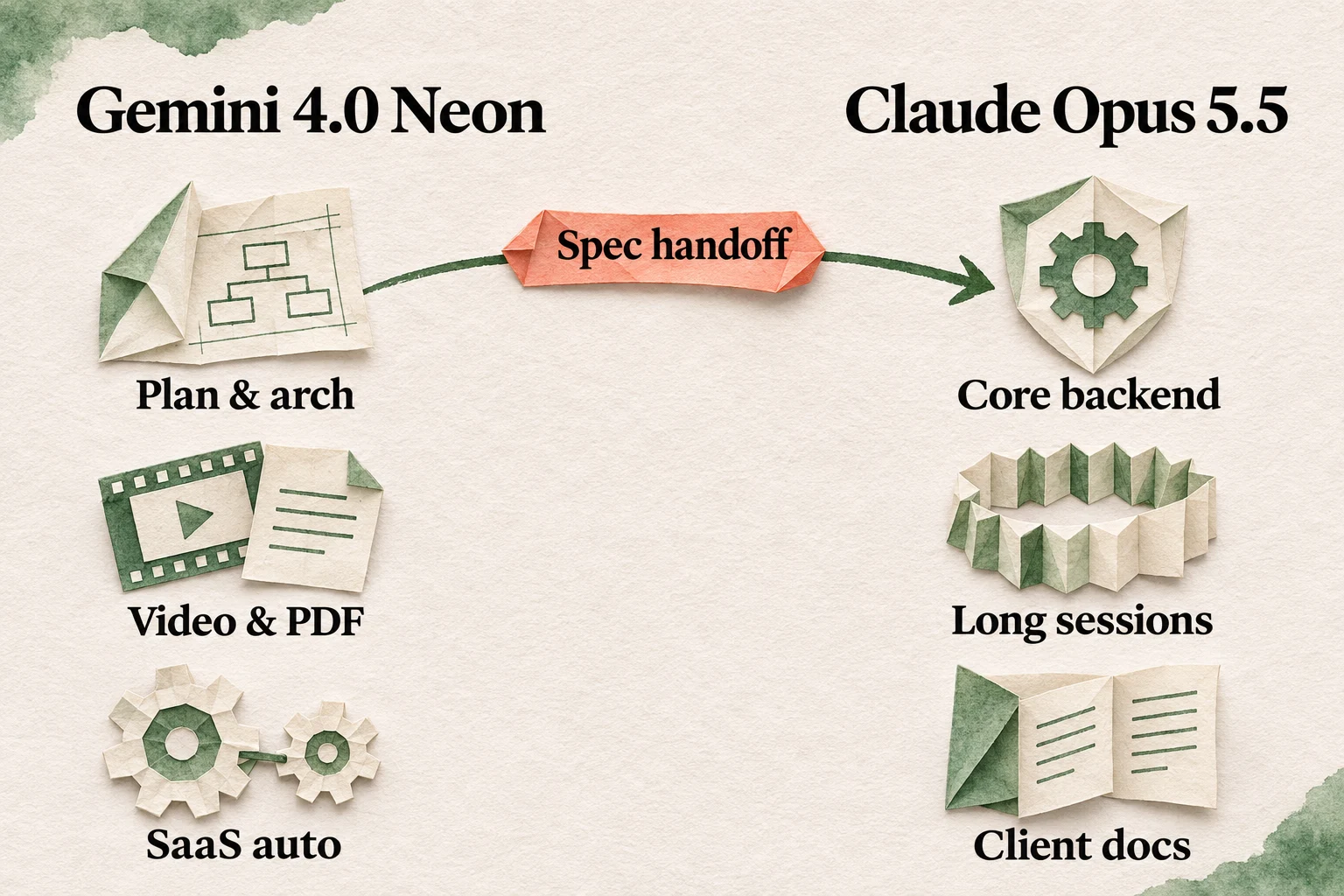
Task ownership across Gemini 4.0 Neon and Claude Opus 5.5, with a clean Markdown spec handoff from planning to core implementation.
How to pick a thinking tier, and why xhigh backfires on Neon
Both models share effort names (low, medium, high, xhigh), yet matching labels do not deliver matching capability or cost. For routine coding and fast lookups, stepping Gemini 4.0 Neon down to low or medium often runs faster and cheaper than pushing a smaller model to its ceiling. Pick your quality floor first, then compare the tier each model needs to clear it.
The table below compiles all nine tested tiers on Artificial Analysis Intelligence Index v5.0.1, with task costs calculated at official standard list prices.
Effort tier
Gemini 4.0 Neon (Index · Official cost · Time · Speed · First answer)
Claude Opus 5.5 (Index · Official cost · Time · Speed · First answer)
low
44 · $0.75 · 3.9 min · 93 tok/s · 19.49s
35 · $0.98 · 3.1 min · 103 tok/s · 5.04s
medium
55 · $1.90 · 8.9 min · 94 tok/s · 25.20s
48 · $2.45 · 6.9 min · 105 tok/s · 13.33s
high
60 · $3.74 · 15.3 min · 98 tok/s · 35.87s
52 · $3.46 · 9.3 min · 108 tok/s · 19.29s
xhigh
61 · $6.44 · 26.9 min · 88 tok/s · 58.85s
57 · $6.05 · 15.8 min · 109 tok/s · 66.58s
max
Not available
59 · $10.04 · 24.8 min · 116 tok/s · 325.12s
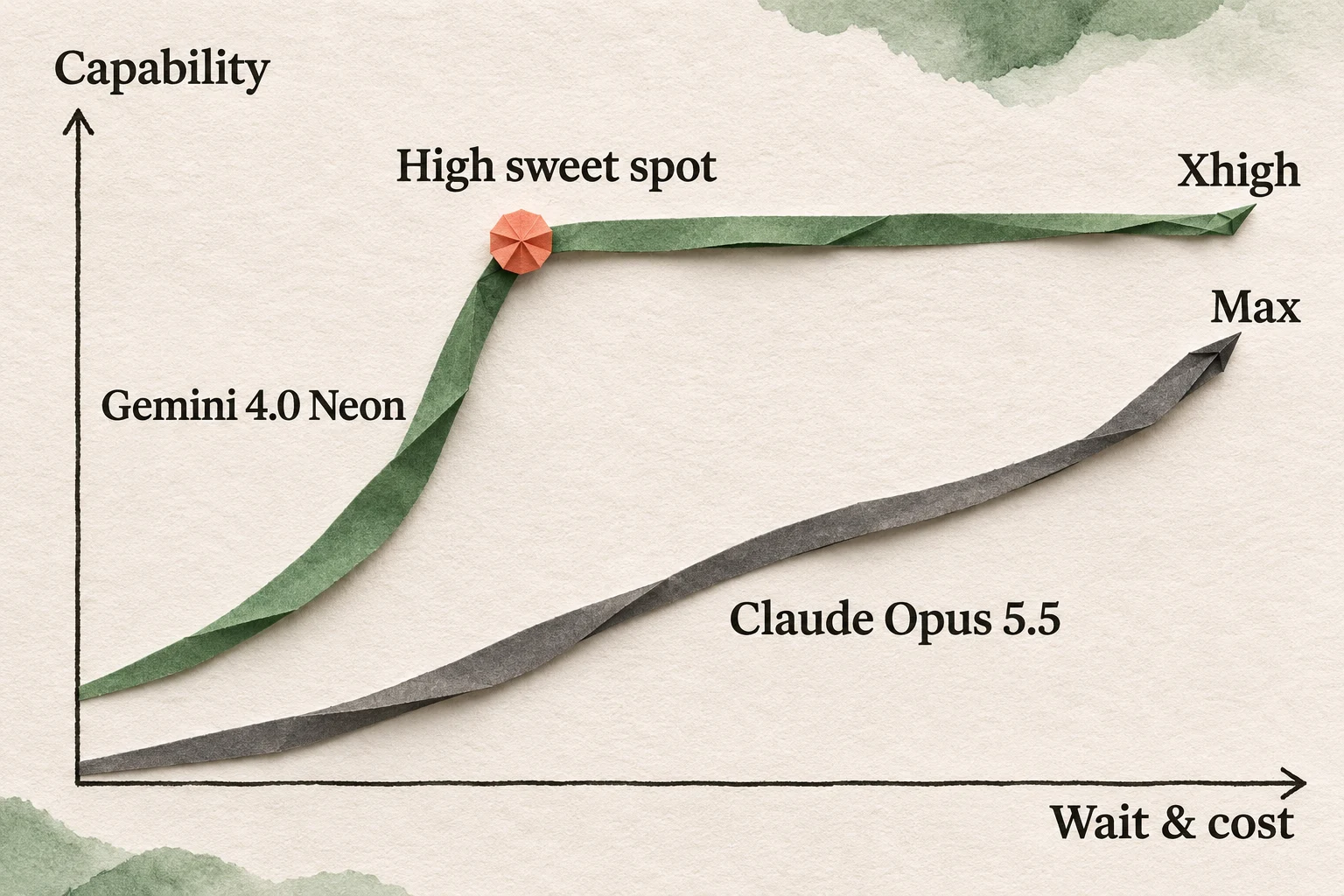
Default high is Neon's sweet spot; xhigh runs slower than Opus 5.5 max
Moving Gemini 4.0 Neon from medium to default high lifts its Intelligence Index from 55 to 60 at $3.74 and 15.3 minutes per task. At high, Gemini 4.0 Neon already tops Claude Opus 5.5 at max (59) while costing 62.7% less and finishing 9.5 minutes faster. Stepping Gemini 4.0 Neon up to xhigh buys 1 extra point (60 to 61) at a 72% jump in official task cost ($6.44) and stretches total time to 26.9 minutes, slower than Claude Opus 5.5 at max (24.8 minutes).
Why Neon costs slightly more than Opus 5.5 at matching high and xhigh labels
Google's list rate for gemini-4-neon sits 25% below Anthropic's list rate for claude-opus-5-5, yet Gemini 4.0 Neon costs slightly more per task at matching high ($3.74 vs $3.46) and xhigh ($6.44 vs $6.05) labels. Output volume causes the flip. Across the full Intelligence Index suite, Gemini 4.0 Neon at xhigh generates 283M output tokens (ranked 92nd most verbose out of 94 peer models, against a 65.4M median), roughly 30% more than Claude Opus 5.5 at max at 218M tokens. Those extra thinking tokens erase the 25% list-price gap unless you match by capability tier: Gemini 4.0 Neon high (60) against Claude Opus 5.5 max (59), or Gemini 4.0 Neon medium (55) against Claude Opus 5.5 high (52).
Watch time to first answer: Opus 5.5 leads on low–high, then jumps past 5 minutes at max
Across low, medium, and high, Claude Opus 5.5 returns its first answer token sooner (5.04s, 13.33s, and 19.29s vs 19.49s, 25.20s, and 35.87s for Gemini 4.0 Neon) and streams faster (103 to 116 tok/s vs 88 to 98 tok/s). Interactive Q&A feels snappier on Claude Opus 5.5 in those middle tiers. At max, however, Claude Opus 5.5 waits 325.12 seconds (over five minutes) for its first answer token and averages 662 seconds end to end. Any interactive client calling Claude Opus 5.5 at max needs long timeouts, streaming keepalives, or an async worker queue.
Gemini 4.0 Neon captures nearly all of its capability gain by default High effort; Claude Opus 5.5 keeps climbing through Max at a steep wait-time cost.
Three API limits to check before shipping
Synchronous output cap: 65,536 tokens vs 128,000 tokens
Gemini 4.0 Neon shares its 1,048,576-token window across input, thinking, and final text, with a default synchronous cap of 65,536 output tokens (including thinking) for both streaming and non-streaming requests. Longer single-pass outputs require background execution (background) or client continuation with max_output_tokens raised above 65,536. Claude Opus 5.5 supports up to 128,000 synchronous output tokens (including thinking), leaving far more headroom for multi-file refactors and long specifications in one response.
Prompt caching control: implicit auto-hits vs explicit 5-minute and 1-hour locks
Both models cut cached input reads by 95% (0.05× ordinary input), but control differs. On Google Developer API, Gemini 4.0 Neon does not support explicit caching (cachedContents); it relies on implicit caching for shared prefixes of at least 4,096 tokens. Implicit caching avoids write surcharges, yet it offers no guarantee that a prefix stays warm after a 20-to-40-minute pause. Claude Opus 5.5 supports explicit prompt caching at 1.25× input for a 5-minute TTL and 2× input for a 1-hour TTL, which makes hit rates far more predictable across human-in-the-loop approval workflows.
Request parameters and client compatibility traps
On gemini-4-neon, thinking_level (reasoning_effort on OpenAI Chat Completions) accepts only low, medium, high, and xhigh; passing minimal returns an error. Custom temperature, top_p, and top_k values are ignored when in range and rejected when out of range, and multi-turn tool calls must return thinking signatures verbatim. On BeatAPI, gemini-4-neon works on OpenAI Chat Completions (POST /v1/chat/completions), Anthropic Messages (POST /v1/messages), and Gemini native (:generateContent), but OpenAI Responses (POST /v1/responses) is unsupported and returns 404.
On claude-opus-5-5, adaptive thinking is permanently enabled. Native requests reject disabled thinking, forced tool choice, assistant prefills, and non-default sampling parameters. Parsers reading Anthropic Messages responses must branch by content block type rather than assuming index 0 is visible text, because the first block can be an empty-display thinking block. Also note that Anthropic builds Claude Code specifically for Claude models; routing Claude Code to Gemini does not preserve Anthropic-native thinking blocks or beta headers.
Official vs BeatAPI pricing and three workload budgets
Neither model applies a long-context surcharge across its 1M window, and both charge thinking tokens at the output rate. The table below compares synchronous standard rates in USD per million tokens.
Platform and model (sync standard)
Input
Output (incl. thinking)
Cache read
Cache write
Access notes
Google Developer API · Gemini 4.0 Neon (gemini-4-neon)
$3.00
$15.00
$0.15 (implicit, ≥4K prefix)
No separate write fee
Paid API tier only; no free tier
BeatAPI · Gemini 4.0 Neon (gemini-4-neon)
$0.90 (70% off)
$4.50 (70% off)
$0.09 (40% below official)
No write or storage fee
Funded account required; signup credit does not apply
Anthropic official API · Claude Opus 5.5 (claude-opus-5-5)
$4.00
$20.00
$0.20
$5.00 (5m) / $8.00 (1h)
Sync standard (async Batch is $2/$10; Fast is $8/$40)
BeatAPI · Claude Opus 5.5 (claude-opus-5-5)
$2.00 (50% off)
$10.00 (50% off)
$0.10 (50% off)
$2.50 (5m) / $4.00 (1h)
Sync standard; same BeatAPI key and balance
On official APIs, gemini-4-neon costs 25% less per input and output token than claude-opus-5-5. Because BeatAPI discounts gemini-4-neon by 70% ($0.90 / $4.50) and claude-opus-5-5 by 50% ($2.00 / $10.00), gemini-4-neon drops to 55% below claude-opus-5-5 on BeatAPI (Opus 5.5 runs 2.22× Neon's token price). At the same time, BeatAPI's claude-opus-5-5 ($2.00 / $10.00) costs 33.3% less than Google's official gemini-4-neon ($3.00 / $15.00).
Three assumed-usage budgets plus a +30% verbosity stress test
The estimates below hold token counts fixed to compare billing structure; they are mathematical calculations, not measured production logs. Because thinking token volume varies by model, the last row adds a stress test assuming Gemini 4.0 Neon emits 30% more output tokens than Claude Opus 5.5 (matching their top-tier output ratio on Artificial Analysis).
High-frequency uncached reviews drop to $0.072 each on BeatAPI with Neon
Workload B: 100 ten-turn repo agent sessions (cached) 80K prefix written turn 1 and hit turns 2–10 + 5K new input + 6K output per turn
$139.80 vs $218.40 (Opus 1h write) vs $194.40 (Opus 5m write)
$45.18 vs $109.20 (Opus 1h write) vs $97.20 (Opus 5m write)
Assumes all nine follow-up turns hit cache; Neon avoids write fees when hits hold, while misses bill as ordinary input
Workload C: 100 long-doc or replay audits (uncached) 250K input + 12K output (incl. thinking) each
$93.00 vs $124.00 (Neon 25% less)
$27.90 vs $62.00 (Neon 55% less)
Flat 1M pricing on both models; BeatAPI keeps Neon under half of Opus 5.5
Verbosity stress test (based on Workload A) Gemini 4.0 Neon emits 10.4K output (+30%) vs Opus 5.5 at 8K
$27.60 vs $32.00 (gap narrows to 13.8%)
$8.28 vs $16.00 (Neon still 48.3% less)
Verbose thinking quickly eats half of Neon's official discount, while BeatAPI preserves nearly a 50% margin
In production, evaluate total spend per accepted deliverable rather than raw token price. Include retry tokens and engineer time spent debugging rollbacks: one bad guess on library failure semantics wipes out a few cents of token savings, while test-backed pipelines and batch multimodal audits let BeatAPI's Gemini 4.0 Neon discount compound safely.
Running both models under one BeatAPI key
Teams handling both heavy planning/multimodal triage and deep backend or client work can split traffic across both models from one BeatAPI key and balance.
Send upfront repository mapping, Markdown refactor specs, multi-app automation, and video/audio/PDF inputs to gemini-4-neon at default high (or medium on smaller checks). You can verify prompts and payload parameters on the Gemini 4.0 Neon API Playground at standard API rates.
Escalate core fault-tolerant code changes, unfamiliar open-source patches, 15+ turn agent loops, outputs approaching 65,536 tokens, and client-facing memos to claude-opus-5-5 (starting at medium or high, reserving xhigh for hard cases). Teams already running Claude Code can follow the pay-as-you-go Claude Code setup guide for native /v1/messages routing.
Keep three protocol rules clean across the handoff: call gemini-4-neon on https://direct.beatapi.io/v1 via /v1/chat/completions, /v1/messages, or Gemini native (never /v1/responses); call claude-opus-5-5 natively on POST /v1/messages and parse blocks by type without disabled-thinking or forced-tool flags; and never forward thinking blocks across vendors. Pass only the Markdown spec, raw source files, failing logs, verified diffs, and acceptance criteria to the next model.
Frequently asked questions
Should I pick Gemini 4.0 Neon or Claude Opus 5.5 for coding?
Match the model to the exact engineering step. Use Gemini 4.0 Neon at high (or medium on lighter tasks) for mapping legacy repos into refactor specs, running test-backed edits, and orchestrated terminal workflows. Use Claude Opus 5.5 for unfamiliar open-source repo patches (46.4% vs 44.4% on FrontierCode-AA 2.0), fault-tolerant backend changes, 15+ turn sessions, or any workflow anchored in Claude Code.
Why is Gemini 4.0 Neon 25% cheaper per token officially yet slightly pricier per task at high and xhigh?
Both models bill thinking tokens at output rates, and Gemini 4.0 Neon generates roughly 30% more output tokens at top effort (283M tokens across the Intelligence Index at xhigh vs 218M for Claude Opus 5.5 at max). That makes official task costs $3.74 vs $3.46 at high and $6.44 vs $6.05 at xhigh, even though Neon scores 4 to 8 points higher at the same label. Comparing equal capability around 60 points, Gemini 4.0 Neon at high ($3.74) costs 62.7% less than Claude Opus 5.5 at max ($10.04).
For agent sessions longer than 10 turns, should I pick implicit caching or explicit 1-hour caching?
Choose Gemini 4.0 Neon's implicit caching when turns run back to back within minutes and share at least a 4,096-token prefix, because you skip the 1.25× or 2× cache-write surcharge. Choose Claude Opus 5.5's explicit 1-hour caching when sessions pause 15 to 45 minutes for human approvals or slow tool runs and you need predictable prefix reuse.
Can I swap Claude Opus 5.5 for Gemini 4.0 Neon inside Claude Code?
No. Anthropic builds Claude Code specifically for Claude models and does not support Gemini backends. Even over a compatible endpoint, non-Claude models do not guarantee Claude Code's adaptive thinking blocks, preserved-thinking prefix checks, or beta headers. To cut Claude Code spend, keep claude-opus-5-5 (or pair with Claude Sonnet 5.5) at half official price on BeatAPI's native POST /v1/messages, and run gemini-4-neon through OpenAI Chat Completions, Gemini native SDKs, or a provider-agnostic agent.
What account and tier conditions apply when running both models on BeatAPI?
Both gemini-4-neon and claude-opus-5-5 share one BeatAPI API key and balance, but calling gemini-4-neon on BeatAPI requires a funded account (signup credit does not apply). BeatAPI's 70% and 50% discounts apply to synchronous standard rates and do not cover Anthropic's asynchronous Batch ($2.00 / $10.00, non-real-time) or Fast ($8.00 / $40.00) tiers.
How to validate before switching
Before locking in your router, pull 20 to 50 real tasks from your logs covering repo planning, fault-tolerant edits, and long-document or video checks with original file sizes and acceptance criteria. Run them side by side under one BeatAPI key on gemini-4-neon (starting at high, plus medium on smaller jobs) and claude-opus-5-5 (starting at medium or high), track first-pass acceptance rate, billed output tokens, wait time, and reviewer minutes for one week, and set your split from actual cost per accepted result.