Gemini 4 Argon is Google's first Gemini 4 reasoning model, built for long, multi-step work rather than quick chat. Gemini 4 Argon is generally available and is worth testing for large codebase changes, legal and financial research, and analysis across documents, charts and video.
The short answer
Gemini 4 Argon is a reasoning-first model announced on September 30, 2026, with general availability from October 13, 2026.
Gemini 4 Argon combines long-context reading, software engineering, professional research and multimodal analysis; no single benchmark establishes a winner across all these tasks.
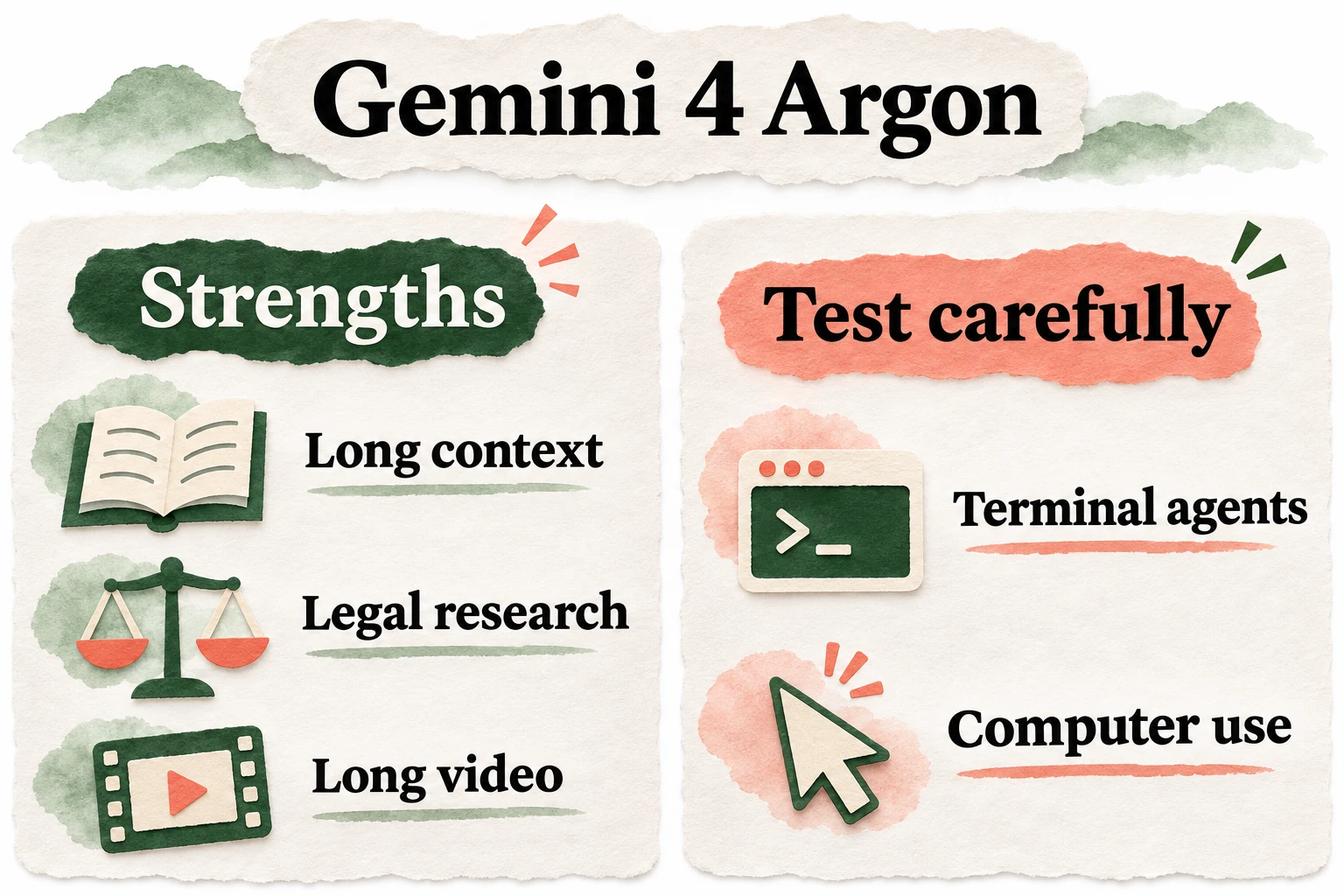
Gemini 4 Argon leads several Google-published knowledge-work and long-context tests, while GPT-6 Astra and Claude Opus 5.5 lead selected terminal and computer-use tests.
Gemini 4 Argon has a 1,048,576-token shared context window and 65,536-token default synchronous output; Google's introductory price changes on December 1, 2026.
Gemini 4 Argon requires checks for thinking settings, caching, history and continuation handling before migrating an existing Gemini integration.
Gemini 4 Carbon opened its paid public API on November 10 and is now available through BeatAPI as gemini-4-carbon. Try Carbon for complex reasoning; Argon generally uses fewer thinking tokens for everyday interaction. Compare Gemini 4 Carbon vs Gemini 4 Argon for a closer look at reasoning depth and cost, or Gemini 4 Argon vs GPT-6 Astra vs Claude Fable 5.1 vs Muse Wonder for workload-based selection.
Where Gemini 4 Argon fits
Gemini 4 Argon suits work that requires reading substantial evidence, reasoning through several steps and producing a coherent result. Legal research, financial-filings analysis and repository migration planning are sensible starting points. Video and chart analysis extend that work beyond plain text.
Gemini 4 Argon is not automatically the best choice for a CI agent that mostly runs shell commands, or an assistant that needs low-latency replies. Evaluate terminal execution, recovery from errors and accepted-task cost separately. A large output allowance is useful only when the deliverable genuinely needs the space.
Task-selection summary, not a measured ranking across every workflow.
Published benchmarks
Google's Gemini 4 Argon launch comparison reports the following results. These are published evaluation results, not tests run for this article.
Benchmark
Gemini 4 Argon
GPT-6 Astra
Claude Opus 5.5
Claude Fable 5.1
DeepSWE v1.1
77.9%
74.1%
74.2%
67.4%
Vals Index
68.9%
63.1%
67.0%
65.8%
Harvey Legal Agent
19.6%
5.4%
3.8%
6.7%
GraphWalks 256K–1M
84.2%
71.8%
66.8%
65.0%
FrontierSWE v2
55.0%
65.5%
62.3%
56.3%
Terminal-Bench 4.0
57.4%
58.2%
66.4%
57.9%
The pattern favors long-context and professional research work, not universal coding superiority. Test harnesses, tools and reasoning budgets matter; some competing scores were taken from published results rather than matched reruns.
As checked on November 10, 2026, Artificial Analysis Intelligence Index displays 50 for Gemini 4 Argon (High), using the current v5.0.1 index. Earlier index versions are not directly comparable. Token usage, latency and price basis also change the cost per task, so do not combine an older cost figure with a current score.
Pricing and specifications
Google's Gemini API pricing lists an introductory standard rate through November 30, 2026. The standard rate changes on December 1.
Per million tokens
Google through Nov 30
Google from Dec 1
Input
$2
$4
Cache-hit input
$0.10
$0.20
Output, including thinking
$10
$20
Gemini 4 Argon has been available on BeatAPI since October 13, 2026. BeatAPI currently charges $0.60 input / $3.00 output per million tokens, with cache-hit input at $0.03, 70% below Google's introductory rates; compare the matched billing items in the BeatAPI pricing table. BeatAPI's confirmed inputs are text, images and video.
The following specifications describe Google's Gemini 4 Argon, not a promise that every provider exposes every capability.
Specification
Google specification
Integration consequence
Model ID
gemini-4-argon
Check the selected endpoint's request format
Inputs / output
Text, images, video, audio and PDF / text
Native model inputs are distinct from gateway-supported inputs
Shared context
1,048,576 tokens
Input, thinking and output share the window
Default synchronous output
65,536 tokens
Budget for the selected endpoint's output limit
Long-decode output
Up to 1,048,576 tokens
Requires continuation handling and available context
Thinking
LOW, MEDIUM, HIGH
Configure reasoning rather than trying to disable it
Caching
Implicit only
Remove explicit-cache dependencies before switching
Long decode generates a logical response in segments. A CONTINUATION result carries a continuation token for the next request; the Google Gen AI SDK handles the sequence. Do not assume an OpenAI-compatible request automatically retrieves the full long response. Verify the endpoint and continuation behavior before designing around million-token output.
For a simple cost illustration at Google's introductory rate, 20K fresh input tokens, 80K cache-hit input tokens and 30K output tokens cost $0.040 + $0.008 + $0.300 = $0.348. This is arithmetic, not a measured repository-review bill. Repeated context, reasoning and retries determine actual usage.
Access and migration
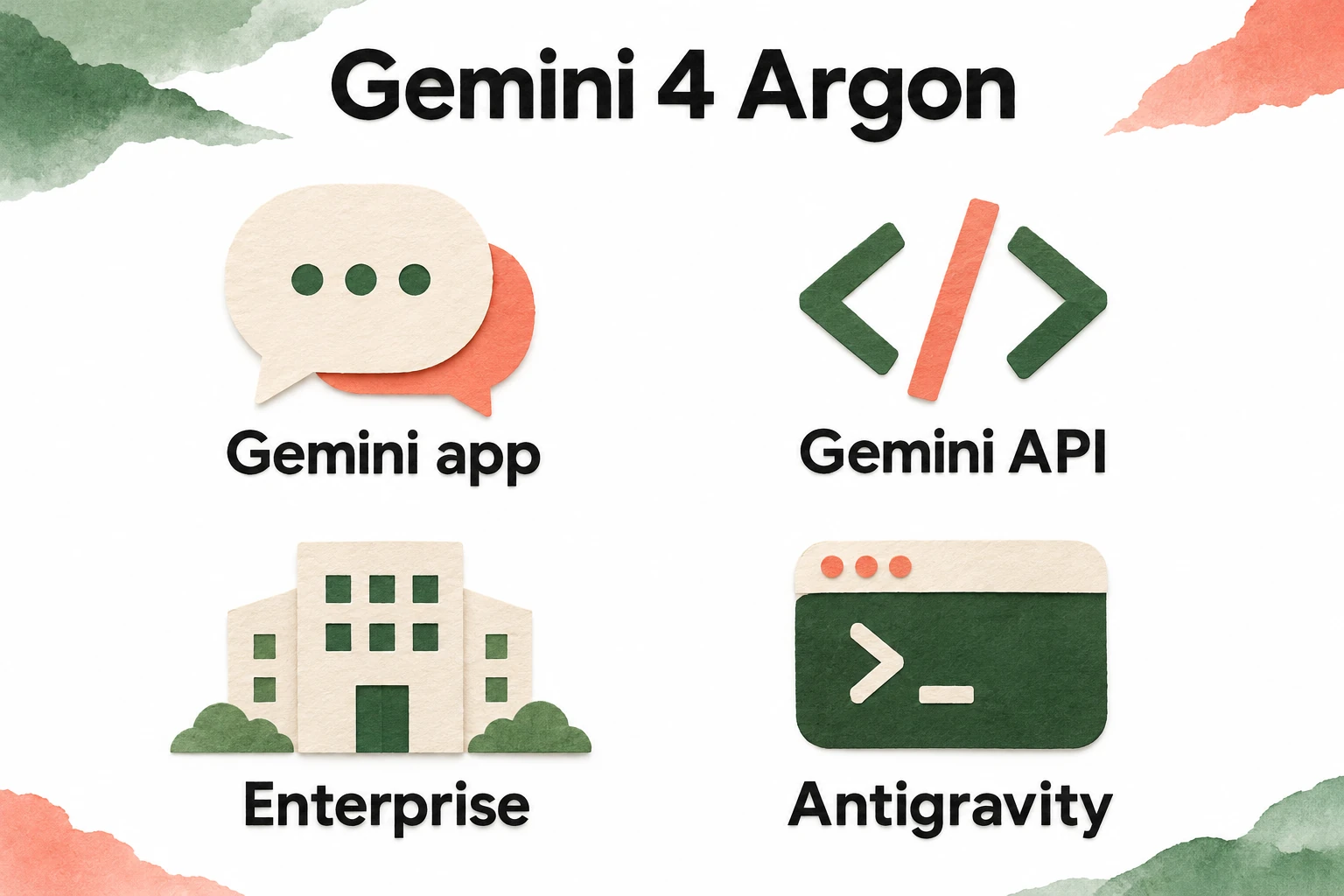
Gemini 4 Argon is accessible through the paid Gemini API, eligible Gemini app plans, Gemini Enterprise Agent Platform and Google Antigravity. App subscriptions and API billing are separate; plan and trial restrictions still apply.
Choose an app for direct use or an API for integration; account eligibility remains separate.
Upgrade the Google Gen AI SDK before relying on continuation handling.
Replace thinking_budget and MINIMAL with a supported thinking_level.
Remove rejected parameters such as frequency_penalty, presence_penalty and candidate_count; do not rely on ignored sampling settings.
Remove explicit-cache calls and put reusable context first.
Remove prefilled model replies and test complete multi-turn histories.
Recalculate the shared context budget, then test streaming, tools, structured output and usage accounting before expanding traffic.
Set a per-task output budget and start at MEDIUM thinking. Increase reasoning only when the acceptance criteria require it. Preserve continuation state instead of restarting an uncertain long request.
FAQ
Is Gemini 4 Argon free?
Google does not offer a free API tier for Gemini 4 Argon. Eligible app subscriptions and paid API usage have different billing and access conditions.
Can Gemini 4 Argon output a million tokens?
Gemini 4 Argon supports up to 1,048,576 output tokens through long decode, within the shared context limit. The default synchronous output limit is 65,536 tokens, not a million tokens in one ordinary HTTP response.
Does Google's December price change also apply to BeatAPI?
Google's published schedule applies to Google's rates. No BeatAPI adjustment date has been confirmed; use the current quoted rate rather than transferring Google's deadline to another provider.
Is Gemini 4 Argon better than GPT-6 Astra or Claude Opus 5.5?
Gemini 4 Argon leads selected long-context and professional-work tests. GPT-6 Astra and Claude Opus 5.5 lead other execution tests. Use the same tasks, tools and acceptance criteria to choose.